

Monday 10 March 2025
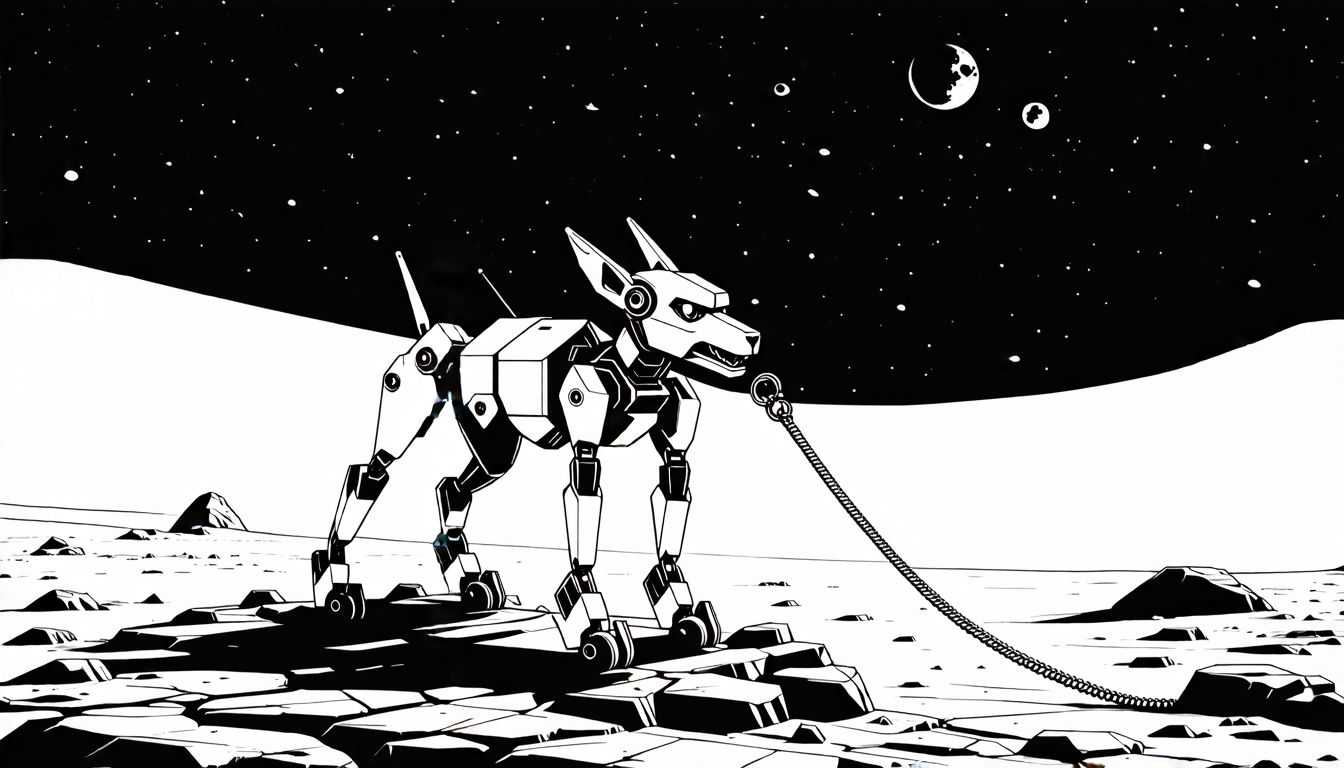
Scientists have been working on a new way to explore space, and it’s unlike anything we’ve seen before. They’re creating robots that can jump and fly through the air, using a tether to stay connected while they navigate through low-gravity environments like the Moon or asteroids.
The idea is to create a robot that can move quickly and efficiently over long distances, without having to rely on traditional methods like wheels or thrusters. The jumping and flying capabilities would allow it to traverse challenging terrain, such as rocky surfaces or deep craters, with ease.
The robots are designed to be modular, consisting of two quadrupedal robots connected by a tether. Each robot has four legs, which can move independently to create a wide range of motion. The tether is flexible and can stretch up to 10 meters in length, allowing the robots to cover large distances while remaining connected.
One of the key challenges was developing an attitude control system that would allow the robots to stabilize during flight. This required creating a sophisticated inertial morphing mechanism, which involves adjusting the limbs and tether length to modulate the system’s principal moments of inertia.
The team used model predictive control (MPC) to plan and execute the robot’s movements in real-time. MPC is a type of algorithm that uses predictions about future events to make decisions now, allowing the robot to anticipate and respond to changes in its environment.
Simulations showed that the robots were able to successfully jump and fly through low-gravity environments, while maintaining control over their movements and orientation. The results suggest that this technology could be used for a variety of applications, including planetary exploration, search and rescue missions, or even delivering packages on other planets.
The potential benefits of this technology are significant. For example, it could allow scientists to explore areas that are currently inaccessible, such as the far side of the Moon or the surface of asteroids. It could also enable faster and more efficient transportation of materials and equipment between celestial bodies.
However, there are still many challenges to overcome before this technology can be used in practice. The team is working on refining the attitude control system and developing a more robust MPC algorithm that can handle the complexities of real-world environments.
Despite these challenges, the potential payoff is significant. By creating robots that can jump and fly through low-gravity environments, scientists may be able to unlock new possibilities for space exploration and exploitation.
Cite this article: “Robots That Can Jump and Fly in Space”, The Science Archive, 2025.
Robots, Space Exploration, Jumping, Flying, Low-Gravity, Asteroids, Moon, Planetary Exploration, Search And Rescue, Modular





