

Monday 10 March 2025
Scientists have been studying the intricacies of graph theory for years, seeking to understand how different networks interact and behave. A recent paper has shed new light on a particular problem known as One-Sided Crossing Minimization (OSCM), which deals with the arrangement of edges in bipartite graphs.
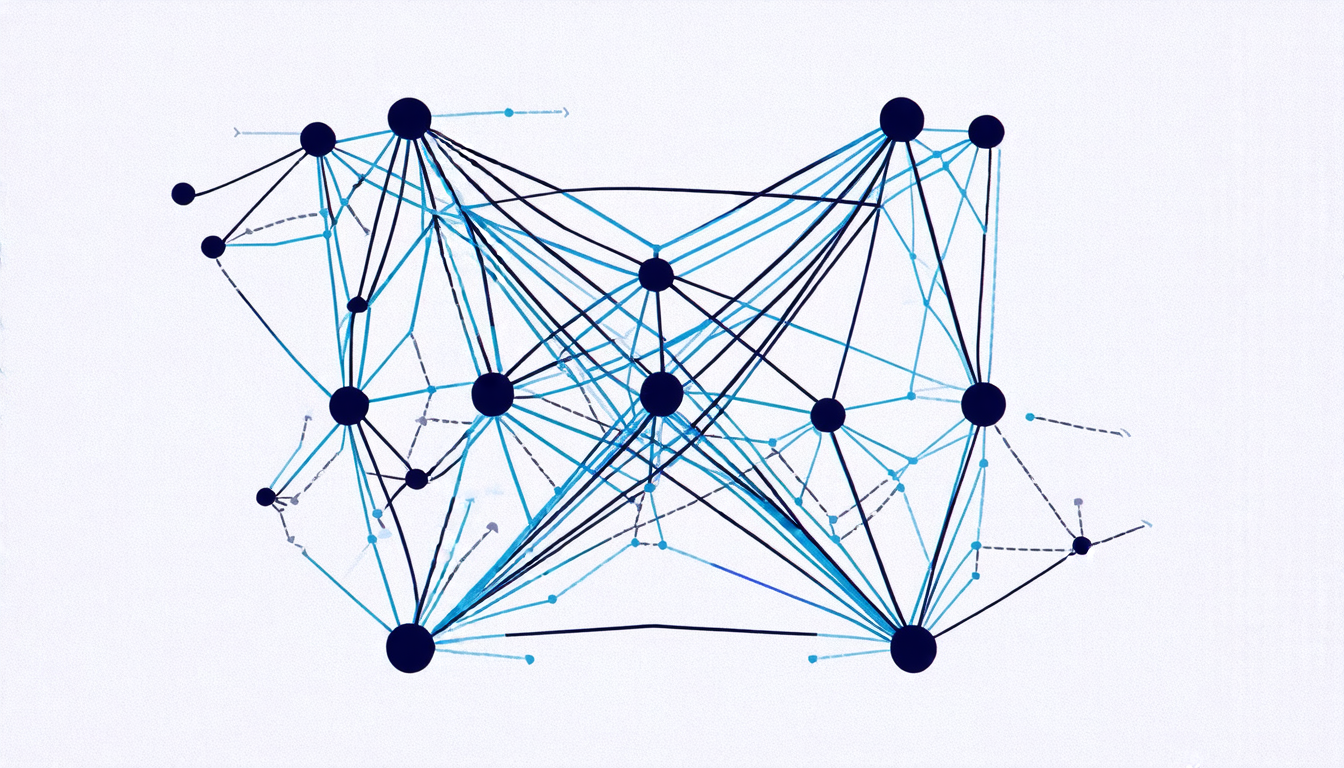
Bipartite graphs are a type of network where one set of nodes is connected only to another set of nodes, but not to each other. In an OSCM problem, we’re looking for the optimal way to arrange these edges so that they don’t intersect too much. This might seem like a simple task, but it’s deceptively complex.
The researchers behind this paper were trying to find upper bounds on the size of a graph in terms of its order and cutwidth. The order of a graph refers to the number of vertices (or nodes) it contains, while the cutwidth is a measure of how many edges are needed to separate two sets of nodes.
They discovered that there’s an asymptotically sharp upper bound on the size of a graph in terms of its order and cutwidth. This means that as the size of the graph grows, the maximum possible number of edges also grows, but at a slower rate than the number of vertices.
The researchers also looked at the number of unsuited pairs in an OSCM instance, which refers to pairs of nodes where there’s no edge between them. They found that there’s a sharp upper bound on this number, and used this to develop an algorithm for solving OSCM problems in polynomial time.
This might not seem like a particularly exciting result at first glance, but it has important implications for computer science and optimization theory. The algorithms developed by the researchers could be used in a wide range of applications, from scheduling to resource allocation.
One area where these results are particularly relevant is in the study of networks with complex topologies. In these networks, edges can intersect in all sorts of ways, making it difficult to find an optimal arrangement. By developing more efficient algorithms for OSCM problems, researchers can better understand how these networks behave and make predictions about their behavior.
The paper also highlights the connections between graph theory and other areas of mathematics, such as combinatorics and algebra. These connections are crucial for advancing our understanding of complex systems and developing new algorithms for solving them.
Overall, this paper represents a significant step forward in our understanding of OSCM problems and the networks they describe.
Cite this article: “New Insights into One-Sided Crossing Minimization: Advances in Graph Theory”, The Science Archive, 2025.
Graph Theory, Bipartite Graphs, One-Sided Crossing Minimization, Oscm, Upper Bounds, Order, Cutwidth, Network Optimization, Computer Science, Optimization Theory.
Reference: Johannes Rauch, Dieter Rautenbach, “Cutwidth and Crossings” (2025).





