

Monday 10 March 2025
A new study has shed light on the mysterious evolution of binary black holes, which are thought to be responsible for some of the most powerful explosions in the universe. By analyzing data from gravitational wave observatories, scientists have been able to reconstruct the history of these cosmic events and uncover hidden patterns that could help us better understand how they form and merge.
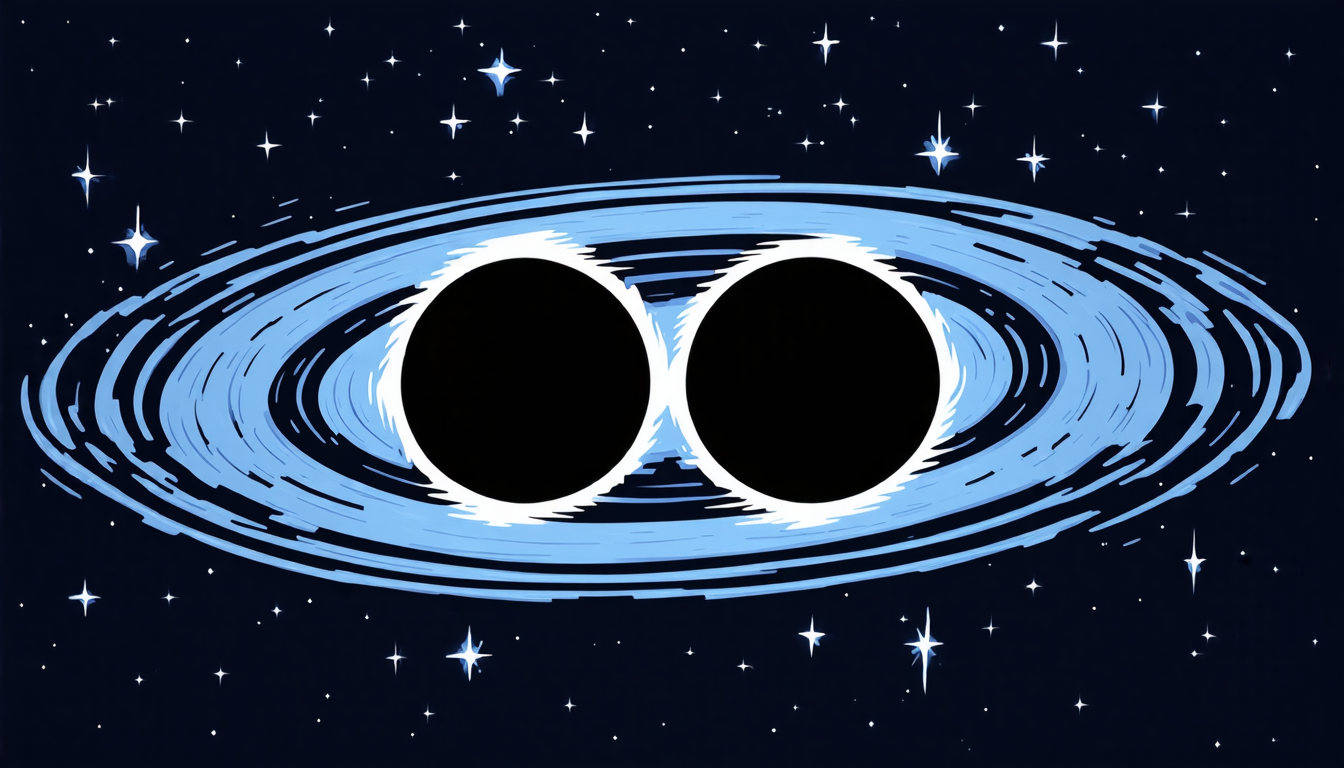
Binary black holes are formed when two massive stars collapse into black holes, which then orbit each other before eventually merging in a spectacular display of energy release. This merger releases a burst of gravitational waves, ripples in the fabric of spacetime that can be detected by sensitive instruments like LIGO and Virgo.
The new study focused on a sample of 90 binary black hole mergers detected by these observatories, analyzing the masses of the individual black holes as well as their orbital patterns. By doing so, scientists were able to identify two key features in the mass distribution of these events: an excess of black holes with masses around 35 times that of our sun, and a broad power-law continuum spanning from 10 to over 80 solar masses.
What’s remarkable about this study is that it found no evidence that either of these features changes with redshift, which is a measure of how far away the events occurred. This suggests that binary black hole mergers have been happening consistently throughout cosmic history, with no significant evolution in their properties over billions of years.
The implications of this discovery are far-reaching. For one, it provides strong evidence for the idea that many binary black holes form through the merger of stellar-mass black holes in globular clusters, rather than through other mechanisms like the collapse of massive stars. This has important consequences for our understanding of how these clusters form and evolve over time.
The study also offers a unique window into the early universe, allowing scientists to probe the properties of binary black holes at different points in cosmic history. By analyzing the masses and orbits of these events as a function of redshift, researchers can gain insights into the formation and evolution of galaxies, as well as the role that binary black hole mergers play in shaping the cosmos.
Ultimately, this research highlights the power of gravitational wave astronomy to reveal the hidden secrets of the universe. By continuing to detect and analyze these cosmic events, scientists will be able to unravel even more mysteries about the nature of space and time itself.
Cite this article: “Unlocking the Secrets of Binary Black Hole Mergers”, The Science Archive, 2025.
Black Holes, Binary Black Holes, Gravitational Waves, Ligo, Virgo, Redshift, Cosmic History, Stellar-Mass Black Holes, Globular Clusters, Galaxy Evolution





