
Monday 10 March 2025
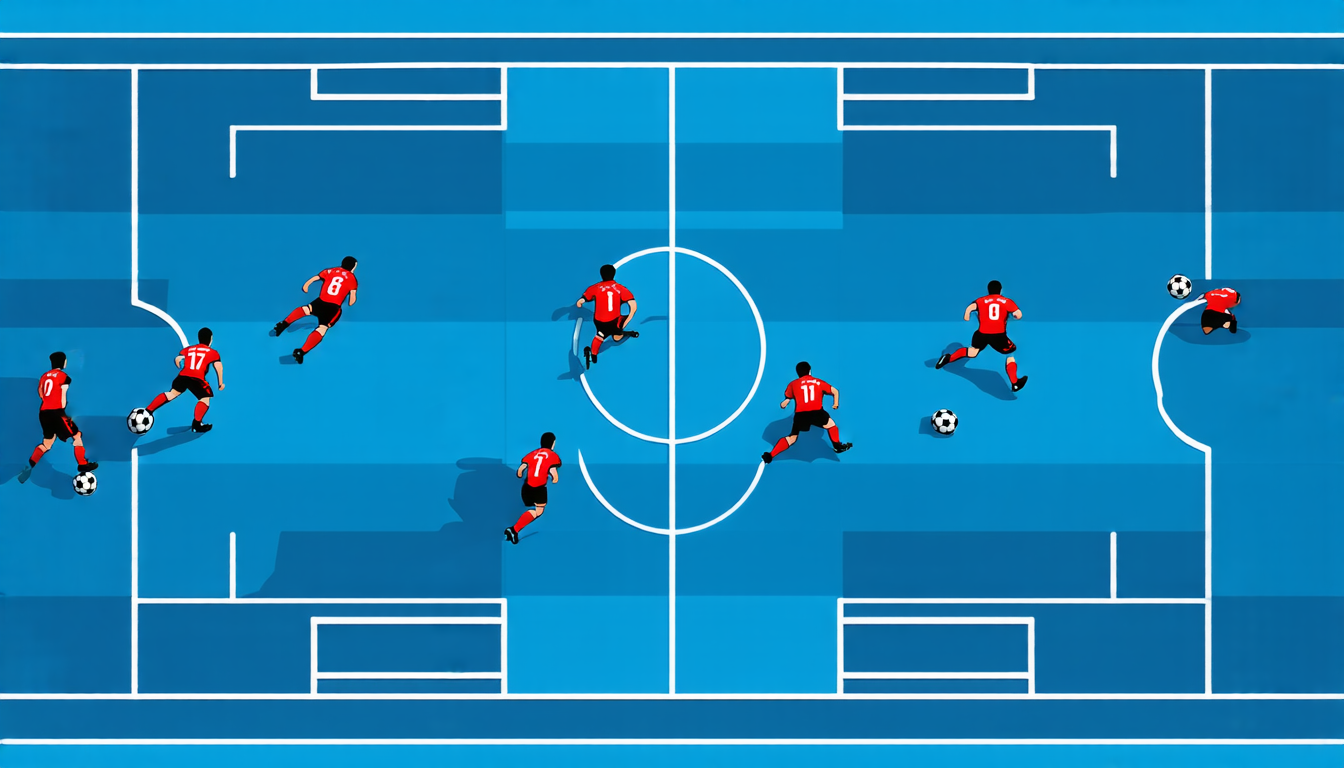
A new way of measuring the distance between two teams in a game of soccer has been developed by a team of researchers. This method, known as the sliced-Wasserstein distance, takes into account the spatial distribution of players on the field and can be used to analyze the style of play adopted by each team.
Traditionally, coaches and analysts have relied on metrics such as possession percentage and shot attempts to evaluate a team’s performance. However, these measures only provide a limited view of a team’s strategy and tactics. By analyzing the spatial distribution of players, researchers can gain insights into how teams move around the field, create scoring opportunities, and defend against their opponents.
The sliced-Wasserstein distance is a mathematical technique that calculates the distance between two distributions of points in space. In this case, the researchers used data from 100 games to calculate the distance between each pair of teams based on their spatial distribution. The results showed that the method was able to accurately distinguish between different styles of play and identify patterns in how teams moved around the field.
One of the key findings of the study was that certain teams were more likely to adopt a particular style of play, such as possession football or counter-attacking soccer. The researchers also found that teams that adopted a more flexible and adaptable approach to the game were often more successful.
The sliced-Wasserstein distance has many potential applications in sports analysis. For example, it could be used by coaches to identify areas where their team needs to improve its spatial distribution and adjust its strategy accordingly. It could also be used by analysts to provide more detailed insights into a team’s performance and help fans better understand the game.
The study is part of a larger effort to develop new methods for analyzing sports data and gaining insights into the behavior of teams and players. As data becomes increasingly important in sports, researchers are working to develop tools that can help coaches, analysts, and fans make sense of the vast amounts of information available.
In addition to its potential applications in soccer, the sliced-Wasserstein distance could also be used in other sports, such as basketball or hockey, where spatial distribution is an important factor. The method is flexible enough to be applied to a wide range of data sets, making it a valuable tool for researchers and analysts across many different fields.
Overall, the sliced-Wasserstein distance offers a new way of understanding the game of soccer and could have significant implications for how coaches and analysts approach the sport.
Cite this article: “A New Metric for Soccer: The Sliced-Wasserstein Distance”, The Science Archive, 2025.
Soccer, Spatial Distribution, Sports Analysis, Sliced-Wasserstein Distance, Team Performance, Strategy, Tactics, Possession Percentage, Shot Attempts, Data Analysis.