

Monday 10 March 2025
The researchers at Stanford University have made a significant breakthrough in the field of robotics, developing a method for collecting high-quality demonstrations of dexterous manipulation tasks that can be used to train robots to perform complex actions.
Traditionally, roboticists have relied on retargeting-based data collection methods, which involve tracking human hand motion and then mapping it to robot positions. However, this approach has several limitations, including the lack of direct haptic feedback and unintuitive human-robot motion retargeting.
The new method, dubbed DexForce, uses measured forces during kinesthetic demonstrations to compute force-informed actions for policy learning. This allows robots to learn from high-quality demonstrations that account for contact forces, a crucial aspect of dexterous manipulation tasks such as opening an AirPods case or unscrewing a nut.
To collect these demonstrations, the researchers used an Allegro Hand instrumented with wrist-mounted cameras and force-torque sensors at the bases of the thumb and index fingers. The hand was then moved through a range of motions while measuring forces and contact moments. These measurements were then used to compute force-informed actions for policy learning.
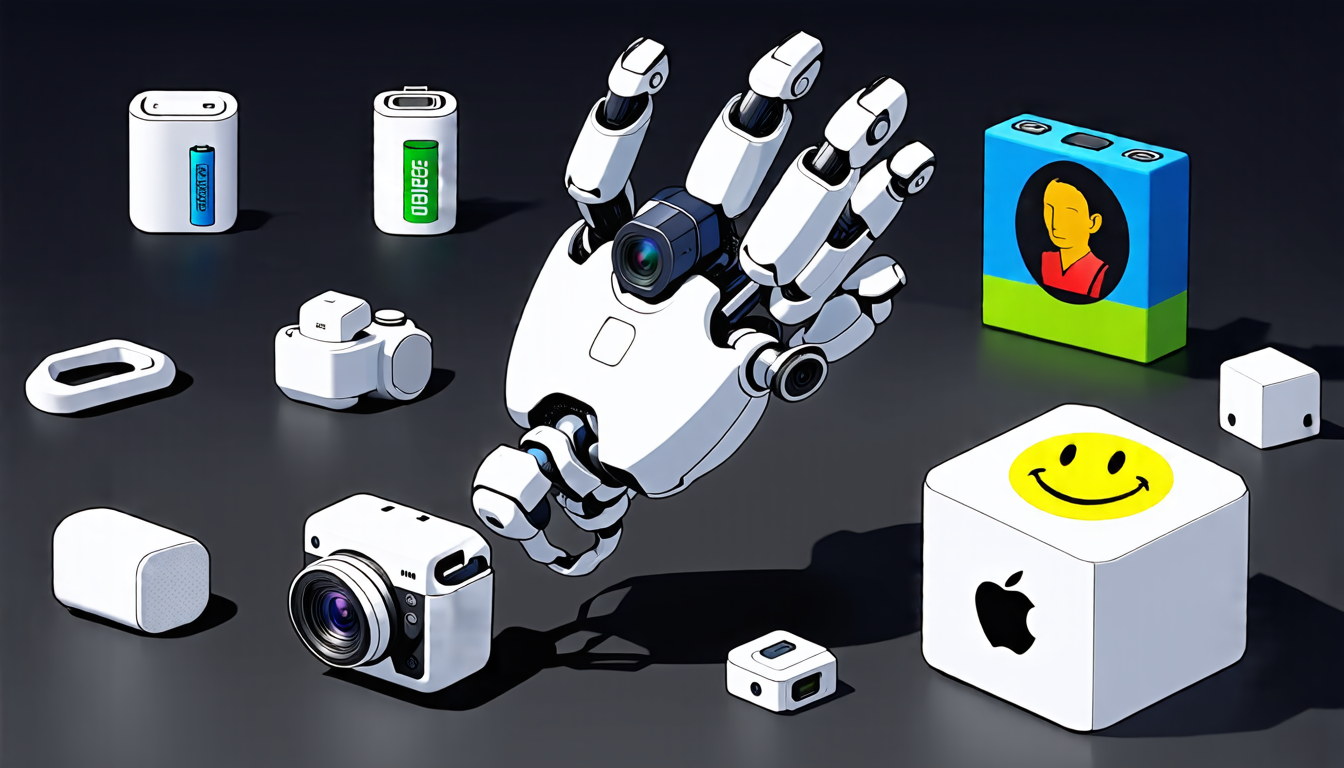
The researchers tested their method on six tasks, including opening an AirPods case, unscrewing a nut, grasping a thin camera battery, flipping a box, sliding a cube, and reorienting a smiley face. The results showed that policies trained on the force-informed actions achieved an average success rate of 76% across all tasks, while policies trained directly on observed fingertip positions had near-zero success rates.
The researchers also found that including force data in policy observations improved performance for tasks that required precision and coordination, such as opening an AirPods case and unscrewing a nut. In contrast, policies without force data performed poorly on these tasks.
Furthermore, the study showed that policies trained with force-informed actions generalized well to out-of-distribution scenarios with different force characteristics, indicating that the method can be used in real-world applications.
The development of DexForce has significant implications for the field of robotics, enabling robots to learn complex manipulation tasks more effectively and efficiently. The method also paves the way for further research into haptic feedback and direct human-robot interaction.
In the future, the researchers plan to explore alternative means of providing demonstrations that retain the benefits of kinesthetic teaching, such as using augmented reality feedback or wearable robotic hands.
Cite this article: “Stanford Researchers Develop Method for Training Robots with High-Quality Demonstrations”, The Science Archive, 2025.
Robotics, Dexterous Manipulation, Kinesthetic Teaching, Force-Informed Actions, Policy Learning, Human-Robot Interaction, Haptic Feedback, Robotics Research, Stanford University, Dexforce.





