

Monday 10 March 2025
Scientists have been studying how waves propagate through porous materials for decades, but a new study has shed light on some fascinating phenomena that occur when these waves encounter random distributions of poroelastic spheres.
Poroelastic materials are those that contain both solid and fluid components, like soil or rock with water-filled pores. When a wave travels through such a material, it encounters resistance from the fluid and the surrounding solid particles, which affects its speed and behavior.
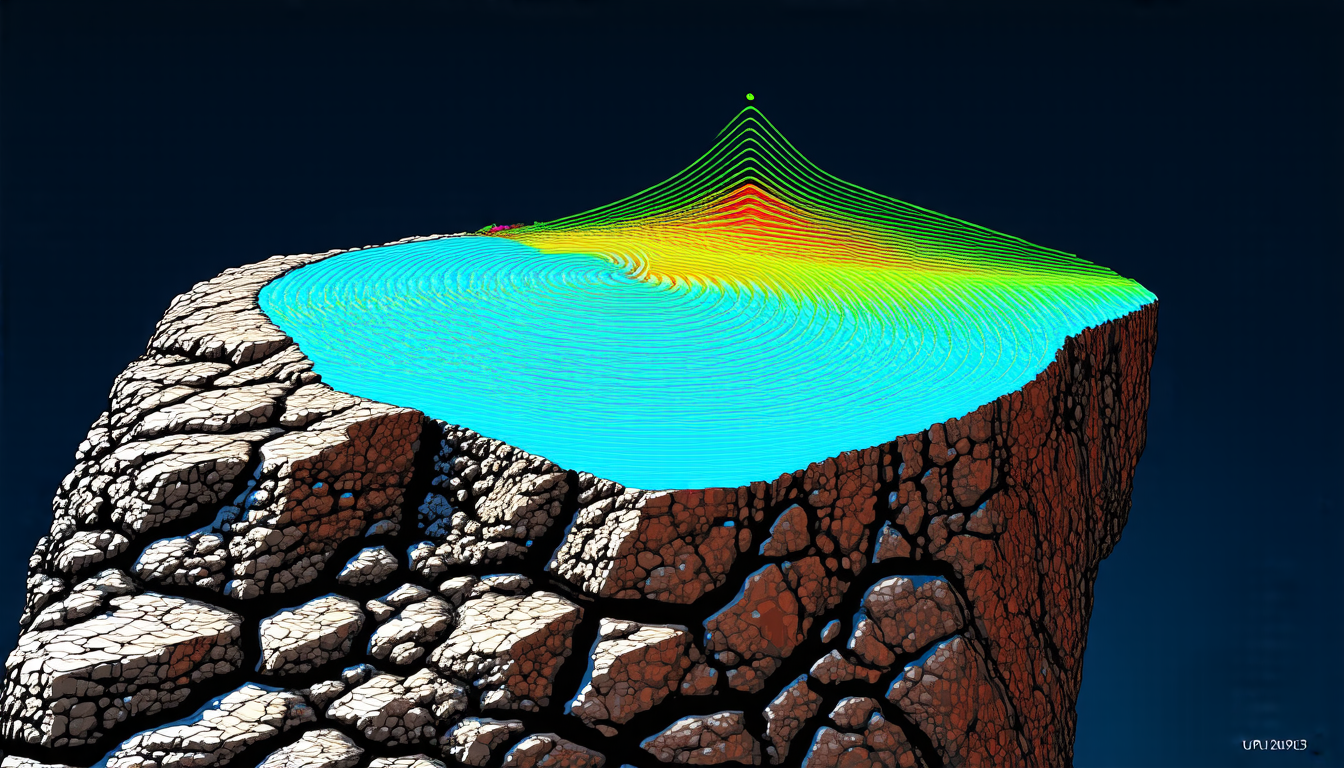
In this study, researchers examined the propagation of longitudinal waves – essentially, sound waves that travel along the length of an object – through a random distribution of poroelastic spheres in a poroelastic matrix. Longitudinal waves are commonly found in nature, such as in earthquakes or when you knock on a door.
The team used mathematical models to simulate the behavior of these waves and found some intriguing results. For instance, they discovered that the effective mass density of the material – essentially, its resistance to compression – is significantly affected by the size and distribution of the poroelastic spheres.
The researchers also found that the slow wave, which is a type of longitudinal wave that travels at a slower speed than the fast wave, plays a crucial role in determining the overall behavior of the material. The slow wave is particularly important when it comes to understanding how waves propagate through porous materials with high porosity – think of a sponge or a very porous rock.
One of the most fascinating aspects of this study is its implications for non-destructive testing and material characterization. By analyzing how waves propagate through a material, scientists can gain valuable insights into its properties, such as its stiffness, density, and even its internal structure.
The researchers used mathematical models to simulate the behavior of the waves and compare it to experimental data. They found that their simulations accurately predicted the observed behavior of the waves, which is a significant achievement in the field of wave propagation.
This study has far-reaching implications for various fields, including geophysics, civil engineering, and materials science. By better understanding how waves propagate through porous materials, scientists can develop new methods for non-destructive testing, improve the design of porous structures like filters or acoustic devices, and gain insights into complex geological processes.
In summary, this study has shed new light on the fascinating world of wave propagation in porous materials. By examining the behavior of longitudinal waves as they travel through random distributions of poroelastic spheres, scientists have gained valuable insights into the properties of these materials and their potential applications.
Cite this article: “Unraveling the Mysteries of Wave Propagation in Poroelastic Materials”, The Science Archive, 2025.
Porous Materials, Wave Propagation, Poroelastic Spheres, Longitudinal Waves, Sound Waves, Non-Destructive Testing, Material Characterization, Geophysics, Civil Engineering, Materials Science





