

Monday 10 March 2025
Scientists have made a significant breakthrough in developing a system that can effectively detect and track rogue drones, which are increasingly becoming a concern for national security and public safety. The team of researchers has designed a multi-agent reinforcement learning scheme to optimize the search and track process of multiple drone targets.
Rogue drones are unmanned aerial vehicles (UAVs) that operate without permission or authorization, posing a significant threat to critical infrastructure facilities such as airports, power plants, and government buildings. Current counter-drone systems primarily focus on jamming or spoofing signals to disrupt the drone’s navigation system, but these methods are not always effective.
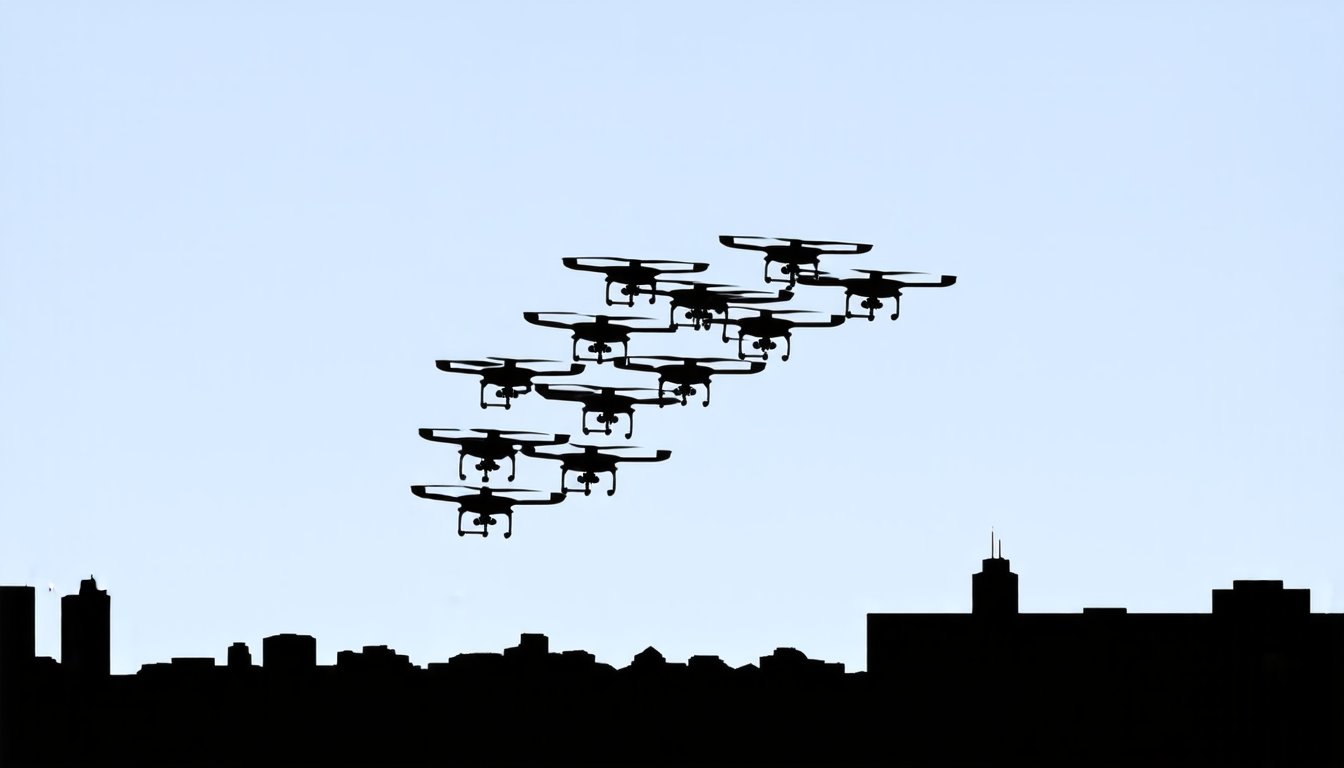
The proposed system uses multiple agents, or drones, that work together to detect and track rogue targets. Each agent has its own decision-making process and communication network, allowing them to adapt to changing situations and adjust their strategy accordingly. The system is trained using reinforcement learning, a machine learning approach that encourages the agents to learn from experience and improve their performance over time.
The team’s simulation results show that the multi-agent system outperforms traditional single-agent approaches in detecting and tracking multiple rogue targets. The agents are able to effectively coordinate their search patterns, reducing the overlap of their sensing ranges and increasing the chances of detecting the targets. The system also demonstrates scalability, meaning it can be easily adapted to larger or more complex scenarios.
One of the key advantages of this approach is its ability to learn from experience and adapt to changing situations. The agents are able to adjust their strategy based on feedback from previous attempts, allowing them to improve their performance over time. This makes the system particularly effective in real-world scenarios where the environment and targets can be unpredictable.
The proposed system has significant implications for national security and public safety. It could be used to detect and track rogue drones in real-time, allowing authorities to take swift action to prevent potential threats. The system’s scalability also makes it suitable for use in a variety of settings, from small-scale events to large-scale operations.
While the team’s research is still in its early stages, the results are promising and have significant potential for future applications. As the threat of rogue drones continues to grow, developing effective countermeasures is crucial for maintaining public safety and national security. The proposed system offers a new approach to detecting and tracking these threats, and could play a critical role in protecting against the misuse of drones.
Cite this article: “Detecting and Tracking Rogue Drones with Multi-Agent Reinforcement Learning”, The Science Archive, 2025.
Rogue Drones, National Security, Public Safety, Multi-Agent System, Reinforcement Learning, Unmanned Aerial Vehicles, Uavs, Jamming, Spoofing Signals, Counter-Drone Systems.





