

Monday 10 March 2025
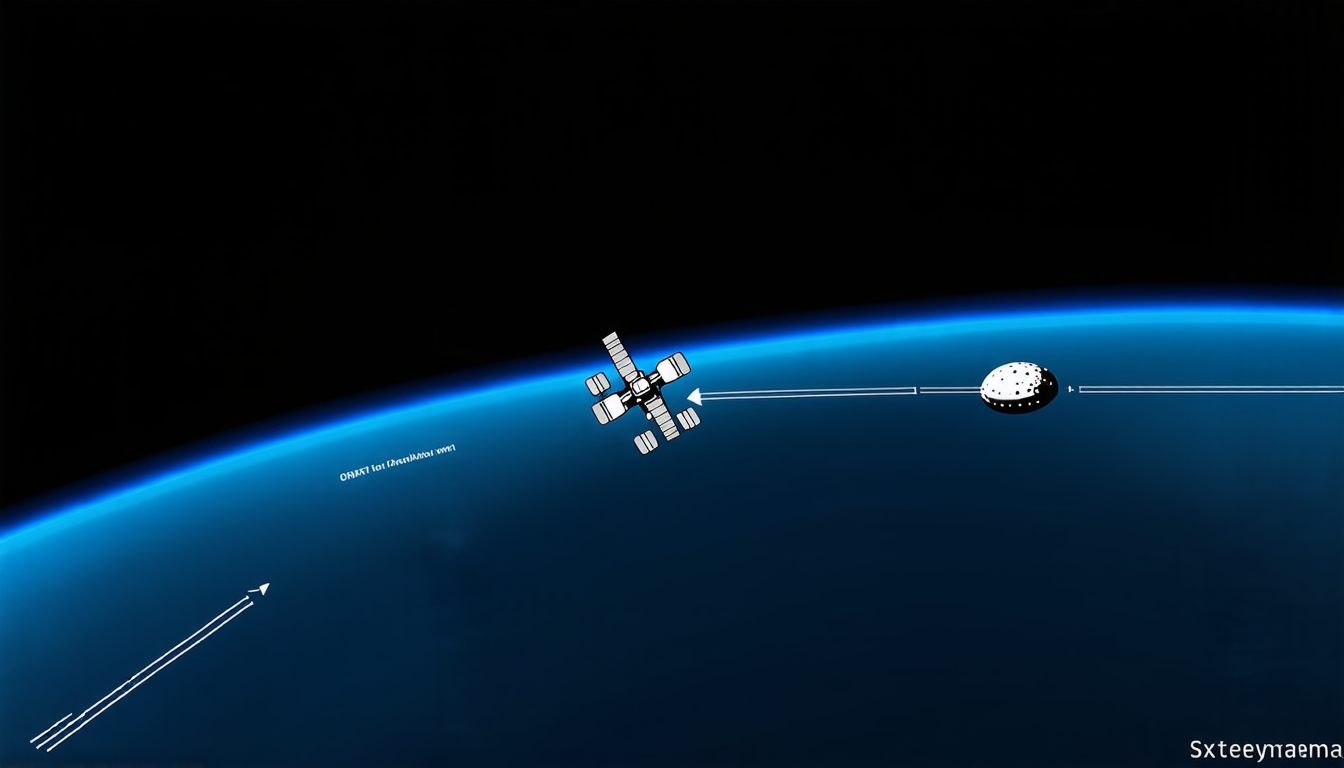
The quest for precise control in spacecraft rendezvous operations has long been a challenge for aerospace engineers. A new approach, dubbed event-based impulsive control, promises to revolutionize this process by leveraging the power of non-linear systems theory and advanced computational methods.
The traditional method of controlling spacecraft during rendezvous involves tracking the vehicle’s position and velocity over time, making adjustments as needed to ensure a smooth and precise docking. However, this approach can be computationally intensive and may not always result in the most efficient or effective solution.
Enter event-based impulsive control, which takes a more holistic view of the problem by focusing on specific events or milestones during the rendezvous process. Rather than tracking every detail of the spacecraft’s motion, this approach identifies key points where control inputs can be applied to achieve the desired outcome.
At its core, event-based impulsive control relies on a technique called impulsive systems theory, which is used to model and analyze non-linear systems that exhibit sudden changes in behavior. By applying this theory to the problem of spacecraft rendezvous, researchers have been able to develop new algorithms that can quickly identify optimal control strategies for complex systems.
One of the key benefits of event-based impulsive control is its ability to handle uncertainty and noise in the system. Traditional methods often rely on precise knowledge of the spacecraft’s initial conditions and trajectory, but real-world systems are rarely so forgiving. By focusing on specific events rather than continuous tracking, this approach can adapt more easily to changing circumstances and maintain optimal performance.
The event-based impulsive control method has been tested using a variety of simulations and case studies, with promising results. In one example, researchers used the technique to guide a spacecraft through a complex rendezvous maneuver involving multiple gravitational assists and course corrections. The result was a highly efficient and precise docking sequence that would have been difficult or impossible to achieve using traditional methods.
While event-based impulsive control shows great promise for improving the accuracy and efficiency of spacecraft rendezvous operations, there are still challenges to overcome before it can be widely adopted. One major hurdle is the need for advanced computational resources to process the large amounts of data generated by these complex systems.
Despite these challenges, researchers are optimistic about the potential of event-based impulsive control to transform the field of aerospace engineering. By leveraging non-linear systems theory and advanced computational methods, this approach offers a powerful new tool for solving some of the most complex problems in space exploration.
Cite this article: “Revolutionizing Spacecraft Rendezvous Operations with Event-Based Impulsive Control”, The Science Archive, 2025.
Spacecraft Rendezvous, Event-Based Impulsive Control, Non-Linear Systems Theory, Advanced Computational Methods, Impulsive Systems, Uncertainty, Noise, Optimal Performance, Spacecraft Navigation, Aerospace Engineering.





