

Monday 10 March 2025
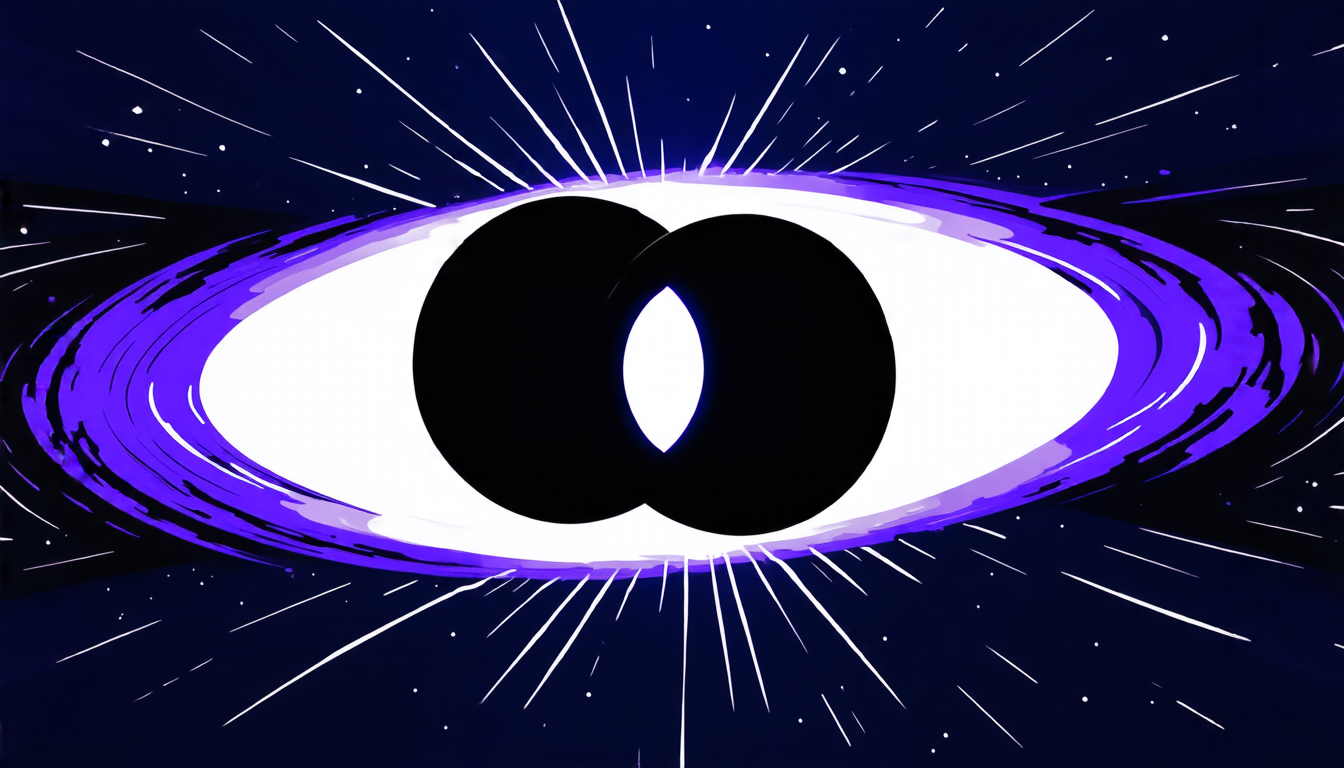
The hunt for gravitational waves has long been a fascinating pursuit, and scientists have made significant strides in detecting these ripples in space-time. The latest breakthrough comes from a team of researchers who have developed a new approach to enhance the reliability of gravitational wave parameter estimation.
For those not familiar with the subject, gravitational waves are disturbances in the fabric of space-time that occur when massive objects collide or merge. These waves were first predicted by Albert Einstein’s theory of general relativity and were only recently detected directly for the first time in 2015.
The challenge lies in accurately estimating the properties of these events from the faint signals received by gravitational wave detectors. Current methods rely on computationally expensive simulations to reconstruct the signals, which can take days or even weeks. This limitation has led researchers to explore alternative approaches that can speed up the process while maintaining accuracy.
Enter machine learning, a field that has revolutionized many areas of science and technology. By applying neural networks to gravitational wave data, scientists have found a way to significantly reduce the computational cost without compromising on precision. The new approach uses attention mechanisms, which allow the model to focus on specific parts of the signal that are most relevant for parameter estimation.
The results are impressive: the machine learning models can estimate the parameters of gravitational waves with an accuracy comparable to traditional methods, but at a fraction of the time and computational resources required. This breakthrough has far-reaching implications for our understanding of cosmic events and the universe as a whole.
For instance, scientists can now analyze larger datasets in real-time, allowing them to respond more quickly to new detections. This is crucial for studying rapidly changing astrophysical phenomena, such as black hole mergers or neutron star collisions. The increased speed also enables researchers to perform more detailed analyses of individual events, shedding light on the underlying physics and potentially revealing new insights into the behavior of matter in extreme environments.
The team’s work has significant implications not only for theoretical astrophysics but also for experimental research. As detectors like LIGO and Virgo continue to improve their sensitivity and range, machine learning will play an increasingly important role in extracting valuable information from the data they produce.
While this development is still a step forward, it marks an exciting milestone in the ongoing quest to unlock the secrets of gravitational waves. By harnessing the power of artificial intelligence, scientists are poised to uncover new discoveries that will rewrite our understanding of the universe and its many mysteries.
Cite this article: “Boosting Gravitational Wave Research with Machine Learning”, The Science Archive, 2025.
Gravitational Waves, Machine Learning, Neural Networks, Attention Mechanisms, Parameter Estimation, Ligo, Virgo, Black Hole Mergers, Neutron Star Collisions, Astrophysics.





