

Monday 10 March 2025
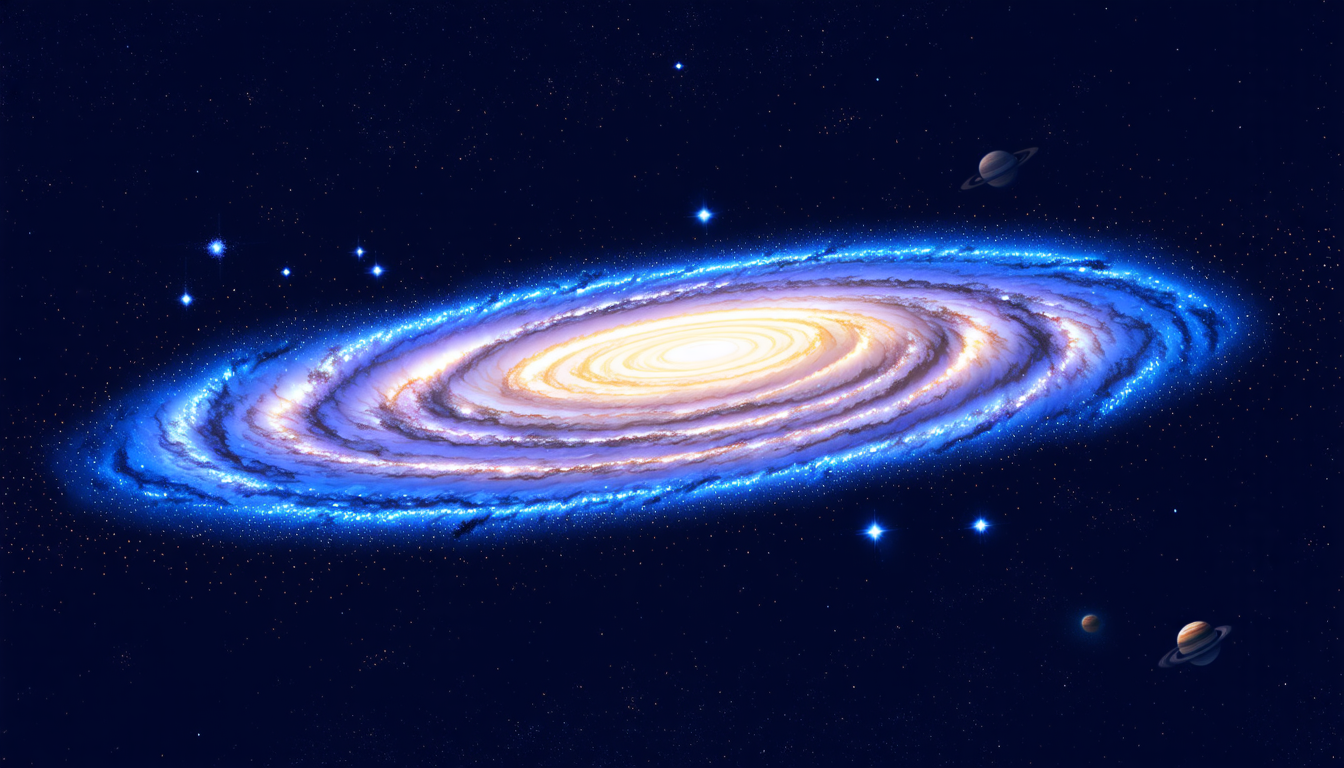
A mysterious glow has been emanating from the center of our galaxy, and scientists are still struggling to explain its origins. For decades, astronomers have been fascinated by the MeV gamma-ray emission observed in the direction of the Galactic Center, but a consensus on what’s causing it remains elusive.
One popular theory is that this radiation is produced by positrons – the antiparticles of electrons – annihilating with normal matter in the form of photons. However, recent studies have suggested that this explanation may not be sufficient to account for all the observed emission.
A new analysis published today challenges these findings and proposes an alternative explanation for the MeV gamma-ray signal. According to the researchers, the emission can be attributed to the annihilation of dark matter particles in the Galactic Center.
Dark matter is a type of invisible matter that is thought to make up approximately 27% of the universe’s mass-energy budget. While its existence has been confirmed through various astrophysical observations, its nature remains unknown.
The proposed mechanism involves MeV-scale Dirac Dark Matter (DDM) particles annihilating into axion-like particles, which then decay into electron-positron pairs and emit gamma-rays. This process is thought to occur in the Galactic Center due to the high density of dark matter there.
The researchers claim that their model can reproduce the observed emission morphology, including its intensity and spatial distribution. Moreover, it satisfies various cosmological and astrophysical constraints, such as the relic abundance of dark matter and the lack of annihilation signals from other regions of the galaxy.
While this explanation is intriguing, it’s not without its challenges. For instance, the required properties of DDM particles are still uncertain and require further study. Additionally, alternative explanations, such as pulsar wind nebulae or supernovae remnants, cannot be ruled out entirely.
Despite these uncertainties, the proposed model offers a compelling resolution to this long-standing astrophysical puzzle. If confirmed, it would provide strong evidence for the existence of dark matter in our galaxy and shed new light on the nature of this mysterious substance.
The search for answers continues, with scientists eagerly awaiting further observations and simulations to test the validity of this hypothesis. As researchers delve deeper into the mysteries of the Galactic Center, they may uncover even more surprises that challenge our current understanding of the universe.
Cite this article: “Mysterious Galactic Glow Linked to Dark Matter”, The Science Archive, 2025.
Gamma-Ray Emission, Galactic Center, Dark Matter, Annihilation, Positrons, Electrons, Antiparticles, Axion-Like Particles, Dirac Dark Matter, Astrophysics





