

Monday 10 March 2025
The intricate dance of electrostatic forces has long fascinated scientists and engineers, particularly in the fields of materials science and colloid chemistry. Recently, researchers have made significant strides in understanding these interactions, shedding light on the mysterious phenomenon of like-charge attraction.
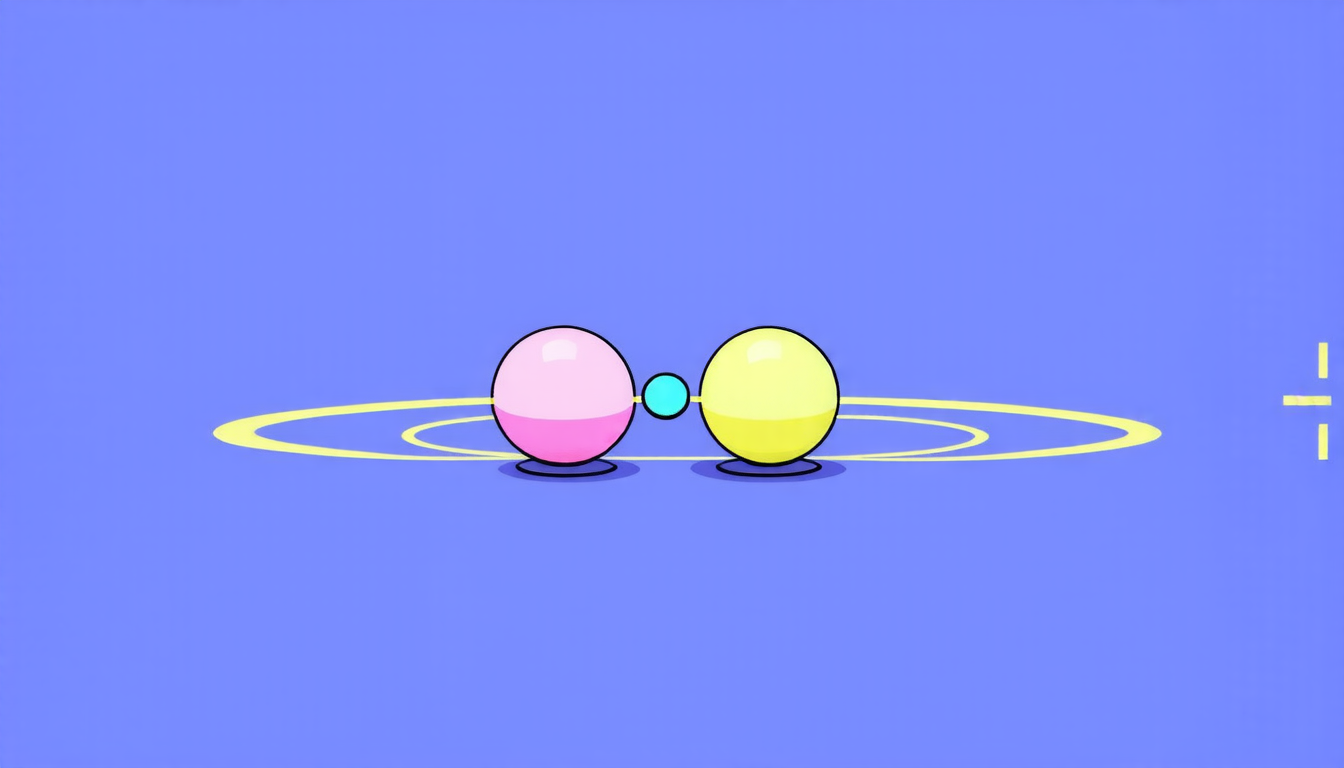
At its core, like-charge attraction refers to the unexpected occurrence where two particles with the same electric charge – typically repulsive forces would dominate – instead experience an attractive force. This counterintuitive behavior has been observed in various systems, from colloidal suspensions to biological molecules. However, a comprehensive theoretical framework to explain and predict these interactions was lacking.
Enter the three-point image formula, a novel mathematical approach developed by researchers Zecheng Gan and Yanyu Duan. By combining elements of classical electrostatics with the incomplete beta function, they have created a powerful tool for calculating the interaction between two polarizable spheres. The formula allows for the prediction of critical conditions under which like-charge attraction occurs, providing valuable insights into the underlying physics.
The three-point image formula is particularly useful in systems where dielectric interfaces are involved, such as at the surface of colloidal particles or biological membranes. In these scenarios, the induced charges on the interface can significantly affect the electrostatic interactions between nearby particles. The new formula takes this into account, accurately capturing the complex interplay between the induced charges and the Coulomb forces.
One key advantage of the three-point image formula is its ability to handle unequal-sized spheres with different dielectric constants. This capability opens up new avenues for research in fields such as materials science, where tailoring the properties of colloidal particles can lead to innovative applications in areas like catalysis or energy storage.
The implications of this work extend beyond basic scientific curiosity. A deeper understanding of like-charge attraction has significant potential for technological advancements, particularly in the development of advanced materials and devices. For instance, researchers may be able to design novel colloidal systems that exhibit unique properties, such as enhanced stability or controlled assembly.
As scientists continue to unravel the mysteries of electrostatic forces, the three-point image formula serves as a valuable tool in their arsenal. By providing a more accurate and comprehensive understanding of like-charge attraction, this mathematical approach has the potential to drive innovation in a wide range of fields, from materials science to biomedicine.
Cite this article: “Unlocking the Secrets of Like-Charge Attraction: A New Mathematical Approach”, The Science Archive, 2025.
Electrostatic Forces, Like-Charge Attraction, Colloid Chemistry, Materials Science, Electrostatic Interactions, Dielectric Interfaces, Coulomb Forces, Induced Charges, Polarizable Spheres, Incomplete Beta Function





