

Monday 10 March 2025
For years, researchers have been working on developing artificial intelligence that can collaborate with humans in complex tasks. But one of the biggest hurdles has been figuring out how to get these AI systems to understand and respond to changing human goals. It’s a bit like trying to teach a robot to adapt to your ever-changing mood – it requires a deep understanding of human behavior and decision-making.
A team of scientists has made significant progress in this area by creating a new type of artificial intelligence that can learn to infer human goals in real-time. The system, called COLORGRID, is designed to work in complex environments where multiple agents (like humans or other robots) need to collaborate to achieve a common goal.
The key innovation behind COLORGRID is its ability to learn from sparse rewards – in other words, it can figure out how to do the right thing even when it doesn’t receive immediate feedback. This is a major challenge for AI systems, as they typically rely on dense rewards (like getting a gold star every time they make a correct decision) to learn and improve.
In COLORGRID, the researchers use a combination of reinforcement learning and multi-agent deep Q-networks to train their system. The system learns by interacting with other agents in the environment, trying different actions and observing the outcomes. Over time, it develops an understanding of which actions lead to successful goal achievement and adjusts its behavior accordingly.
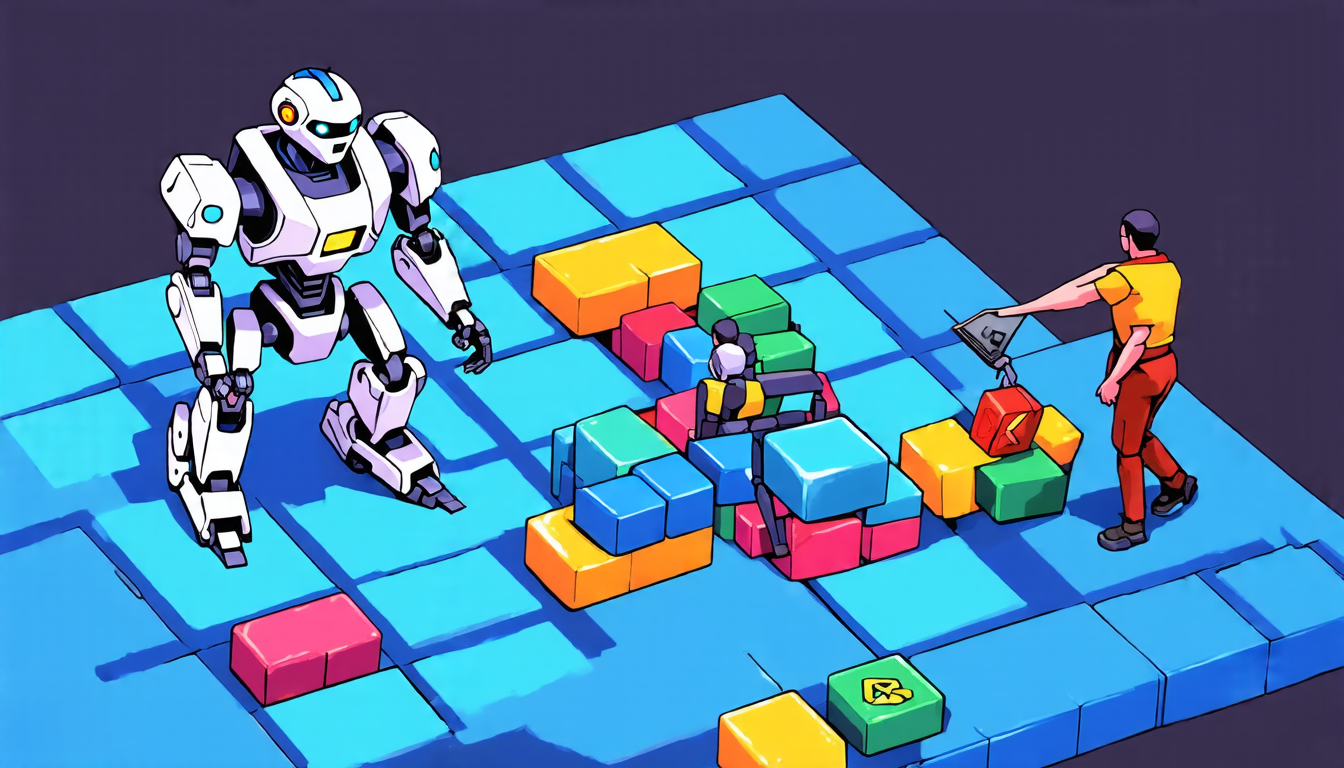
One of the most impressive aspects of COLORGRID is its ability to adapt to changing human goals. In a series of experiments, the researchers demonstrated that their system could learn to infer new goals from sparse rewards and adjust its behavior accordingly. For example, in one experiment, the system was tasked with collecting blocks of different colors – but the goal color changed randomly over time. COLORGRID was able to adapt to these changes and continue to collect the correct blocks even when the goal color shifted.
The potential applications of COLORGRID are vast. Imagine a future where robots can work alongside humans in complex tasks like search and rescue, or construction, without needing explicit instructions on what to do. Or picture a world where autonomous vehicles can learn to navigate changing traffic patterns and respond accordingly – all without requiring human intervention.
Of course, there’s still much work to be done before COLORGRID becomes a reality. But the progress made so far is a major step forward in the development of artificial intelligence that can truly collaborate with humans.
Cite this article: “AI System Learns to Adapt to Changing Human Goals in Real-Time”, The Science Archive, 2025.
Artificial Intelligence, Human Collaboration, Colorgrid, Reinforcement Learning, Multi-Agent Deep Q-Networks, Goal Achievement, Sparse Rewards, Adaptive Behavior, Robot-Human Interaction, Autonomous Vehicles





