

Monday 10 March 2025
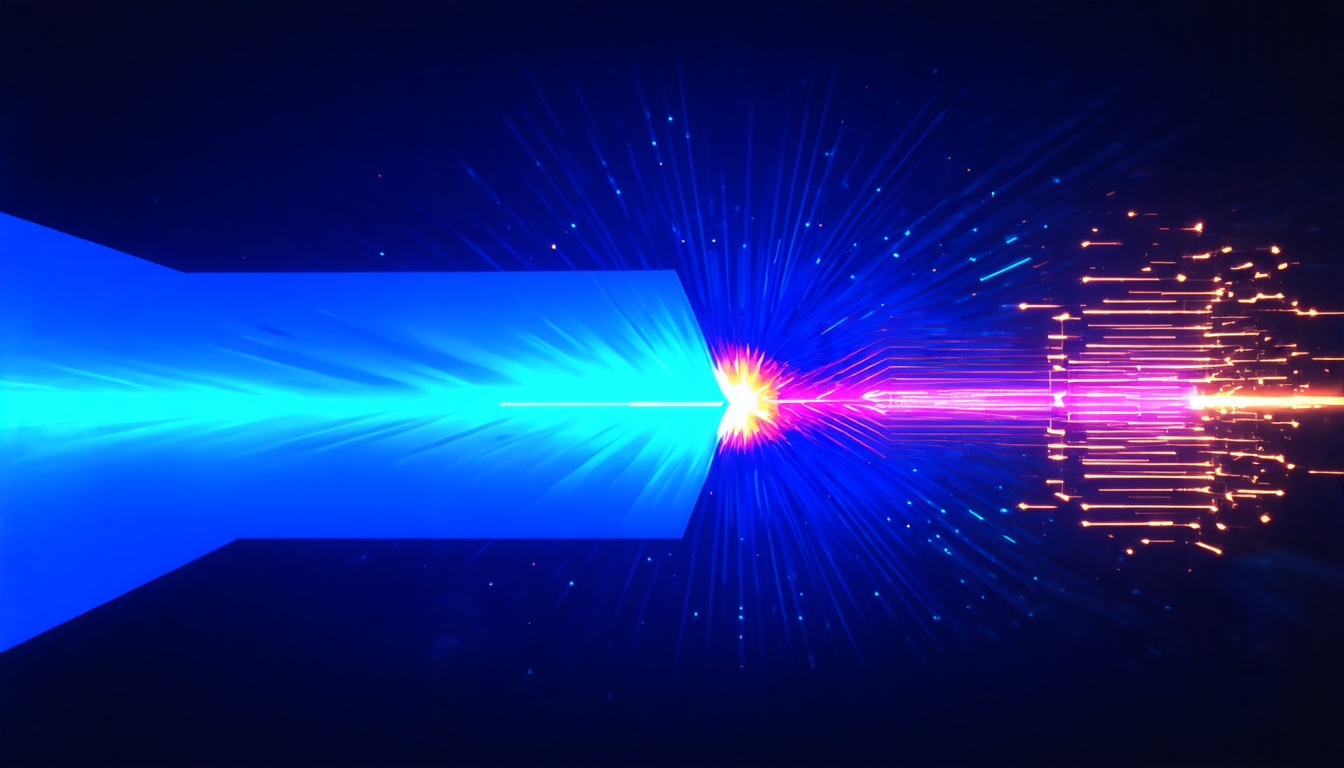
Plasma wakefield accelerators are a type of device that can accelerate charged particles, such as electrons or positrons, to incredibly high speeds. These devices work by using a plasma, a gas-like state of matter made up of ions and free electrons, to create a series of electromagnetic waves. When an electron beam is passed through the plasma, it interacts with these waves in a way that amplifies its energy, allowing it to accelerate to incredible speeds.
One of the key challenges facing plasma wakefield accelerators is the instability that can arise when the accelerating field becomes too strong. This instability, known as the beam-breakup instability, can cause the electron beam to spread out and lose its coherence, leading to a reduction in its acceleration efficiency.
Researchers have been working to mitigate this instability by optimizing the plasma density and the shape of the accelerating field. However, recent studies have shown that even with these optimizations, the beam-breakup instability can still be severe.
A new study has shed light on this problem by performing detailed simulations of the beam-breakup instability in a plasma wakefield accelerator. The researchers used a combination of theoretical modeling and computer simulations to study the behavior of the electron beam as it is accelerated through the plasma.
Their results show that the beam-breakup instability can be severe, leading to a rapid growth in the oscillation amplitude of the electron beam. This growth is not only a problem for the efficiency of the accelerator, but also for its stability and reliability.
However, the researchers found that there are ways to mitigate this instability. They discovered that by including initial energy spread in the electron beam, or by using a gas species with sufficient ion motion, it is possible to reduce the growth rate of the oscillation amplitude.
These findings have important implications for the development of plasma wakefield accelerators. By understanding the mechanisms behind the beam-breakup instability, researchers can work to develop new techniques and technologies that will allow them to build more efficient and reliable accelerators.
One potential application of these accelerators is in the development of future particle colliders. These machines are used to study the fundamental nature of matter and the universe, and they require powerful accelerators to produce high-energy collisions.
In recent years, there has been a growing interest in using plasma wakefield accelerators to drive future colliders. However, the beam-breakup instability is a major challenge that must be overcome before these machines can become a reality.
The study provides new insights into this problem and offers potential solutions.
Cite this article: “Mitigating Instability in Plasma Wakefield Accelerators”, The Science Archive, 2025.
Plasma Wakefield Accelerators, Beam-Breakup Instability, Electron Beam, Plasma Density, Accelerating Field, Particle Colliders, Ion Motion, Energy Spread, Computer Simulations, Theoretical Modeling





