

Monday 10 March 2025
In the world of cryptocurrency and blockchain technology, speed and efficiency are key. A new development in this field has been making waves, promising to revolutionize the way transactions are processed on these decentralized networks.
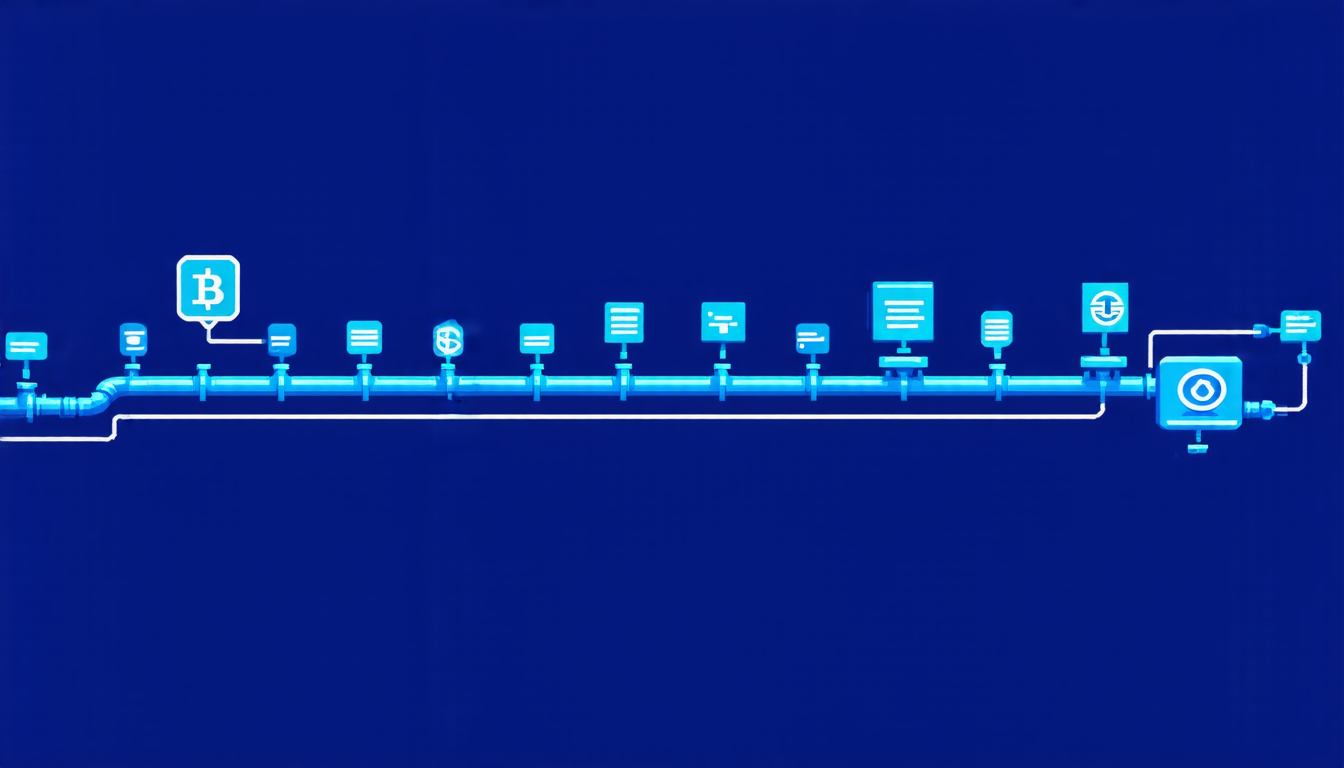
The innovation at the heart of this breakthrough is a novel pipeline architecture, designed to optimize the processing of transactions by parallelizing certain stages of the process. This allows for faster and more efficient transaction verification, which in turn enables greater scalability and reliability.
To understand how this works, let’s take a step back and look at the traditional process of verifying transactions on a blockchain network. When a new transaction is made, it needs to be verified by nodes on the network before it can be added to the permanent record of transactions known as the blockchain. This verification process involves several stages, including data dissemination, ordering, execution, and certification.
In traditional architectures, these stages are performed sequentially, with each stage waiting for the previous one to complete before moving forward. However, this can lead to bottlenecks and slow down the overall processing time of transactions.
The new pipeline architecture addresses this issue by parallelizing certain stages of the process. Specifically, it separates the data dissemination stage from the ordering and execution stages, allowing these two stages to be performed concurrently. This reduces the overall processing time of transactions and enables greater scalability.
But how does this work in practice? To put it simply, the new architecture uses a combination of advanced algorithms and cleverly designed data structures to enable parallel processing of transactions. This allows multiple nodes on the network to process transactions simultaneously, rather than sequentially.
The benefits of this approach are numerous. For one, it enables faster transaction verification times, which is critical for applications that require fast and reliable transaction processing, such as cryptocurrencies and digital wallets. It also enables greater scalability, allowing more transactions to be processed on the network at any given time.
Another significant advantage of this architecture is its ability to improve the overall security of the network. By parallelizing certain stages of the process, it becomes much harder for malicious actors to disrupt the verification process or manipulate transactions.
In addition to these benefits, the new pipeline architecture also enables greater flexibility and adaptability in the way transactions are processed on the network. For example, it allows nodes to dynamically adjust their processing power and capacity in response to changing network conditions, which can help ensure that the network remains stable and secure.
Overall, this innovative new architecture has the potential to revolutionize the way transactions are processed on blockchain networks.
Cite this article: “Revolutionizing Blockchain Transaction Processing with Parallel Pipeline Architecture”, The Science Archive, 2025.
Blockchain, Cryptocurrency, Pipeline Architecture, Transaction Verification, Parallel Processing, Scalability, Security, Algorithms, Data Structures, Network Stability.





