

Monday 10 March 2025
As autonomous agricultural vehicles (AAVs) continue to revolutionize modern farming, a team of researchers has made significant strides in improving their safety and efficiency. By developing an innovative trajectory planning algorithm, they’ve enabled AAVs to navigate complex orchard environments with unprecedented precision.
The challenge lies in the intricate dance between the vehicle’s movements and the constraints imposed by the surrounding landscape. Traditional methods often rely on overly conservative approaches, resulting in lengthy trajectories that waste time and resources. The new algorithm, however, takes a more nuanced approach, incorporating advanced geometric modeling and optimization techniques to create smoother, faster paths.
One key innovation is the use of covering circles to detect potential collisions between the vehicle and its implement (such as a sprayer or pruner). By accounting for the geometry of both objects, the algorithm can identify optimal turning routes that avoid obstacles while minimizing time and fuel consumption. This not only boosts efficiency but also reduces the risk of accidents.
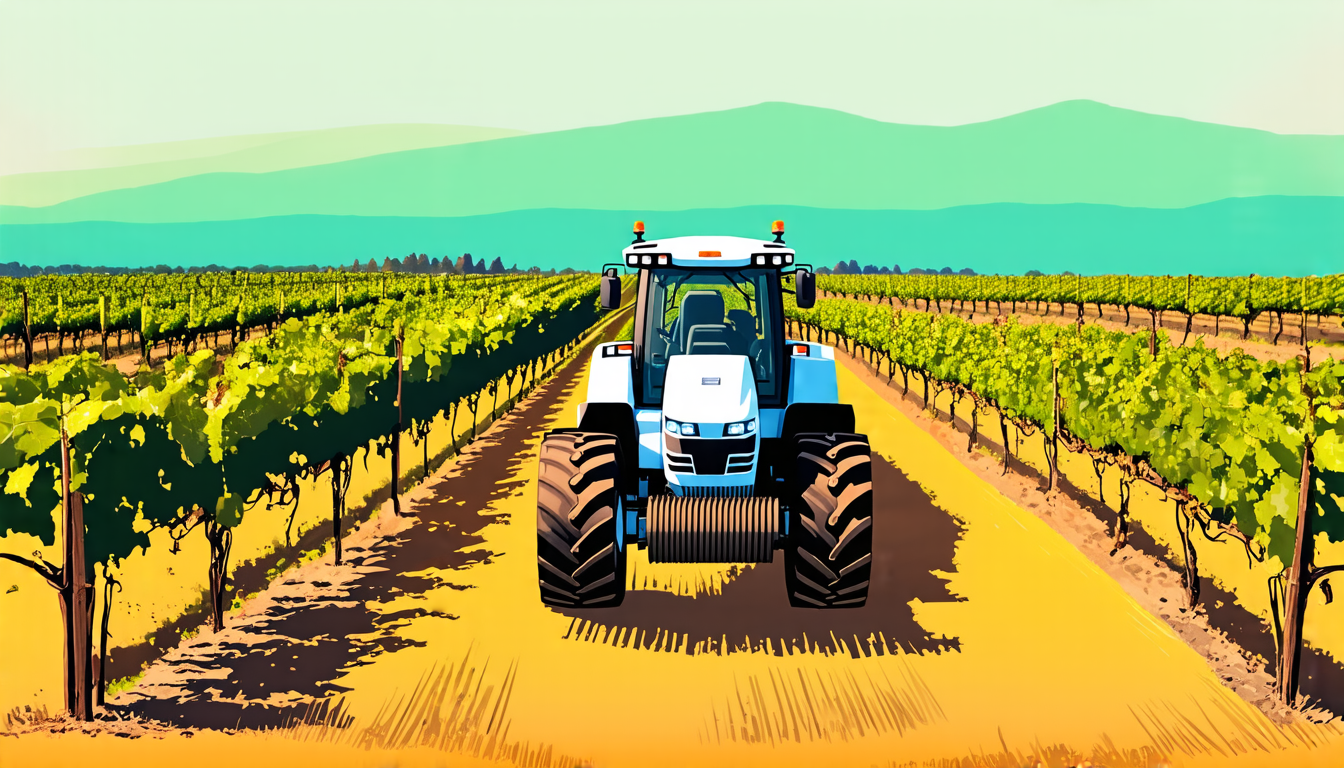
The researchers have tested their algorithm in simulations and on physical robots, with impressive results. In one trial, a tricycle robot carrying a spray boom successfully navigated a vineyard headland, expertly avoiding virtual obstacles to complete the task in just 2.35 seconds. This represents a significant improvement over traditional methods, which can take several minutes longer.
The algorithm’s success is attributed to its ability to balance competing demands. By prioritizing safety while minimizing energy consumption and maximizing coverage, it creates trajectories that are both efficient and practical. This flexibility will be crucial as AAVs continue to evolve and adapt to diverse agricultural environments.
As the world grapples with the challenges of climate change, sustainable agriculture, and food security, autonomous vehicles like these could play a vital role in improving crop yields and reducing waste. By streamlining operations and reducing labor costs, they can help farmers stay competitive while minimizing their environmental footprint.
The implications extend beyond the agricultural sector as well. As autonomous systems become increasingly prevalent in various industries, this research provides valuable insights into how to optimize performance while prioritizing safety and efficiency. The potential applications are vast, from warehouse logistics to search and rescue operations.
This innovative trajectory planning algorithm represents a significant step forward in the development of AAVs. By combining advanced modeling techniques with practical considerations, it has paved the way for more efficient, safe, and effective agricultural operations – and beyond.
Cite this article: “Revolutionizing Agricultural Efficiency: Advanced Algorithm for Autonomous Vehicles”, The Science Archive, 2025.
Autonomous Agriculture, Trajectory Planning, Algorithm, Orchard Navigation, Precision Farming, Geometric Modeling, Optimization Techniques, Covering Circles, Collision Detection, Agricultural Vehicles.





