

Tuesday 11 March 2025
A team of researchers has made a significant breakthrough in understanding the behavior of ant colony optimization algorithms, which are used to solve complex problems such as finding the shortest path between two points.
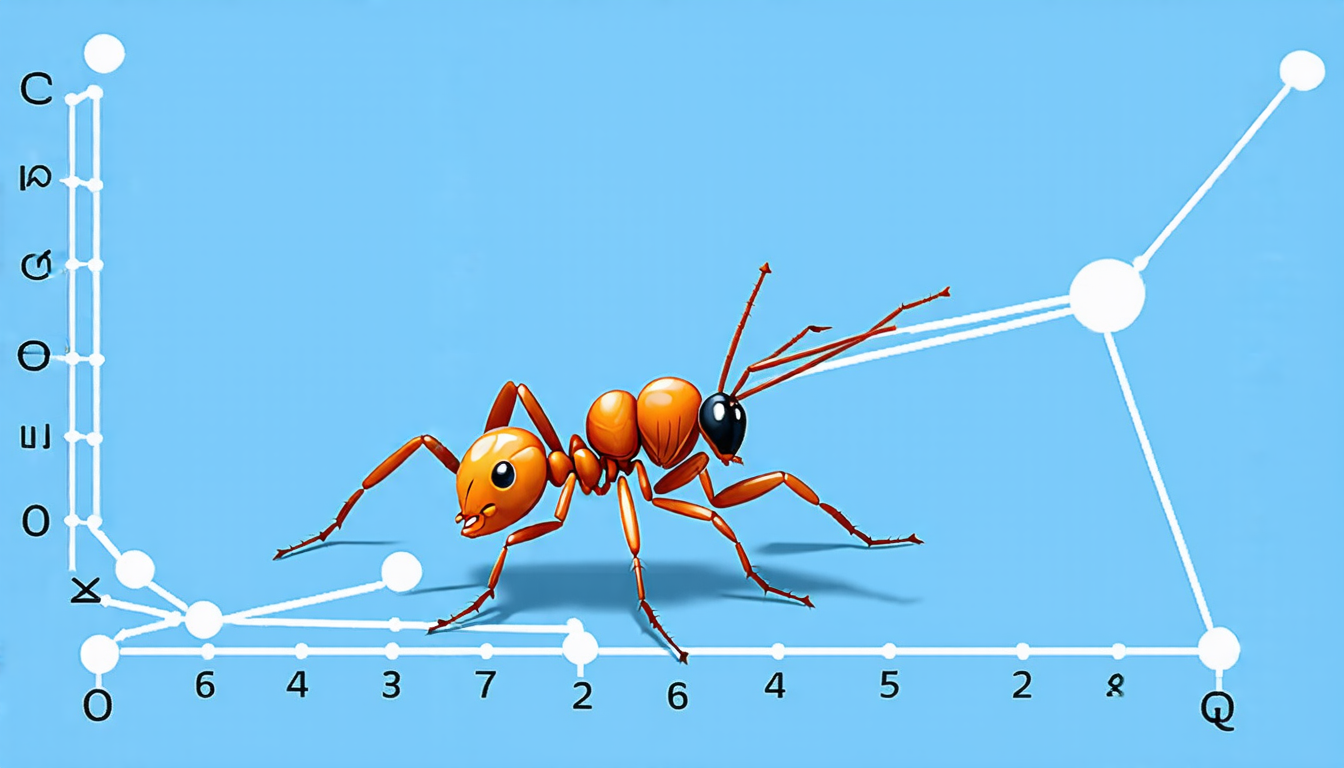
These algorithms are inspired by the way ants communicate with each other by depositing pheromones on their paths. The more often an ant follows a particular route, the stronger the pheromone trail becomes, making it more likely for other ants to follow that same path.
In this study, researchers analyzed a specific type of ant colony optimization algorithm called Graph-based Ant System with Time-dependent Evaporation Rate (GBAS/tdev). This algorithm is designed to find the shortest path between two points in a graph, and it has been shown to be highly effective in solving this problem.
The researchers used mathematical techniques to analyze the behavior of GBAS/tdev and found that it converges to the optimal solution with probability 1 for a specific range of parameters. This means that if you use GBAS/tdev to find the shortest path between two points, it will almost always give you the correct answer, as long as you adjust the parameters correctly.
The study also showed that another variant of ant colony optimization algorithm, called n-ANT with Time-dependent Lower Pheromone Bound (n-ANT/tdlb), has a polynomial time upper bound on the shortest path problem. This means that this algorithm can find the shortest path in a reasonable amount of time, making it a promising approach for solving complex problems.
The researchers used mathematical techniques to analyze the behavior of GBAS/tdev and n-ANT/tdlb, including using the Lambert W function to solve certain equations. They also developed new technical lemmas that will be useful for future research in this area.
Overall, this study provides important insights into the behavior of ant colony optimization algorithms and has potential applications in a wide range of fields, from computer science to biology. The researchers’ work shows that these algorithms can be highly effective in solving complex problems, and it may lead to new approaches for tackling difficult challenges in many areas.
Cite this article: “Unlocking the Power of Ant Colony Optimization Algorithms”, The Science Archive, 2025.
Ant Colony Optimization, Graph Theory, Shortest Path Problem, Pheromone Trails, Algorithms, Time-Dependent Evaporation Rate, N-Ant, Lambert W Function, Technical Lemmas, Complex Problems.





