

Tuesday 11 March 2025
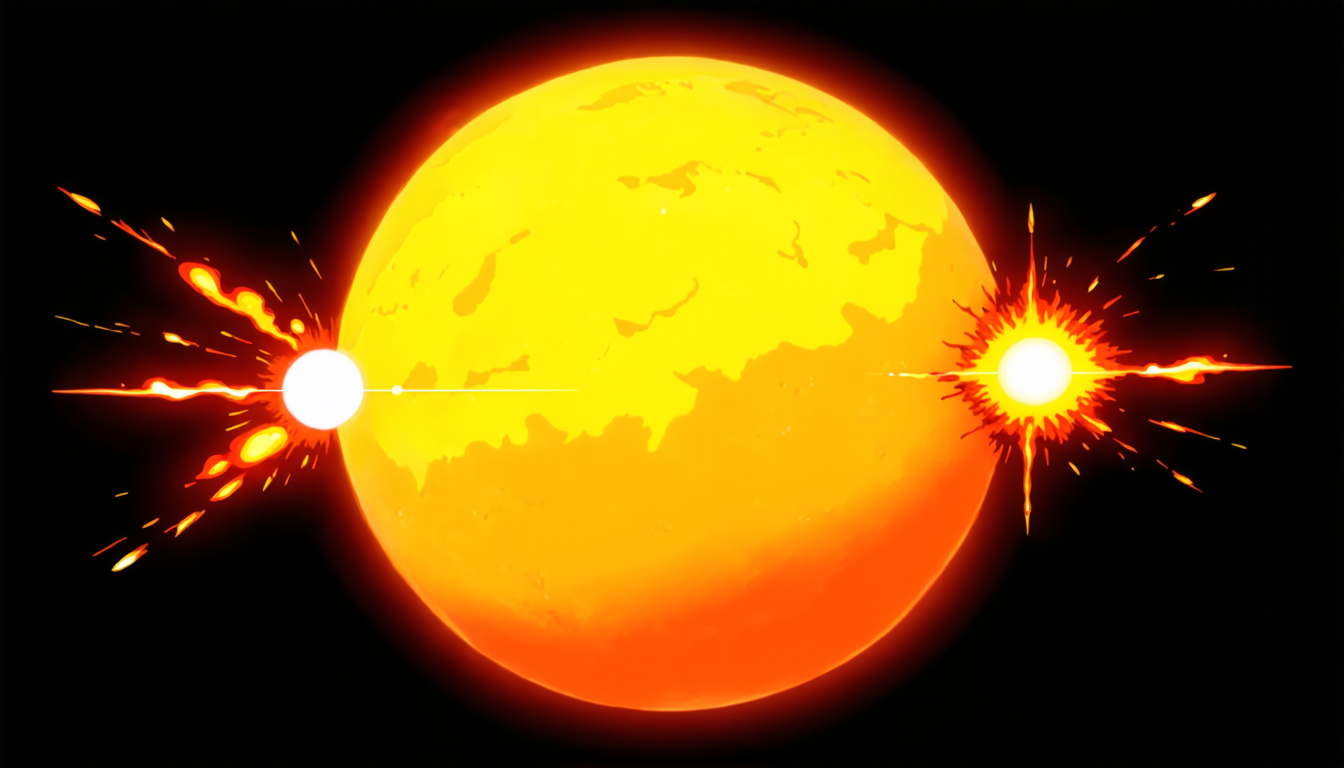
The Sun, our star and life-giving force, is a complex and dynamic ball of hot, glowing gas. Its surface is constantly in motion, churning out powerful magnetic fields that shape its behavior and affect the planets that orbit it. One fascinating aspect of the Sun’s behavior is its oblateness, or flattening at the poles and bulging at the equator.
For decades, scientists have been studying the Sun’s oblateness to better understand its internal dynamics and how they impact the star’s surface activity. Recently, a team of researchers made new measurements using data from NASA’s Solar Dynamics Observatory (SDO) and the Solar and Heliospheric Observatory (SoHO). Their findings provide fresh insights into the Sun’s behavior during different stages of its 11-year solar cycle.
The researchers analyzed the frequencies of solar oscillations, or waves that travel through the Sun’s interior. These waves are sensitive to changes in the star’s internal structure and magnetic field, allowing scientists to infer the shape and size of the Sun’s core and radiative zone. By studying these oscillations over time, the team was able to reconstruct the Sun’s oblateness during different stages of its solar cycle.
The results show that the Sun’s oblateness varies significantly over the course of a solar cycle. During periods of high magnetic activity, the Sun becomes more spherical in shape, with a slightly reduced equatorial radius and a correspondingly increased polar radius. Conversely, during periods of low magnetic activity, the Sun becomes less spherical, with a more pronounced bulge at the equator.
These changes are not random; they are linked to shifts in the Sun’s internal dynamics and magnetic field. The team believes that the increased magnetic activity during high-activity periods leads to a redistribution of mass within the Sun, causing it to become more spherical. Conversely, the decreased magnetic activity during low-activity periods allows for greater mobility of the Sun’s inner layers, leading to a bulge at the equator.
The implications of these findings are far-reaching. By better understanding the Sun’s internal dynamics and how they impact its surface activity, scientists can improve their predictions of solar flares and coronal mass ejections (CMEs). These events can have significant effects on Earth’s magnetic field and upper atmosphere, potentially disrupting communication and navigation systems.
Moreover, the study provides a new window into the Sun’s inner workings.
Cite this article: “Unraveling the Secrets of the Suns Shifting Shape”, The Science Archive, 2025.
Sun, Solar Cycle, Magnetic Field, Oblateness, Solar Oscillations, Core, Radiative Zone, Nasa, Solar Dynamics Observatory, Soho





