

Tuesday 11 March 2025
The quest for a deeper understanding of complex networks has led scientists down a fascinating rabbit hole, one that’s yielded some surprising insights into the nature of connections and relationships.
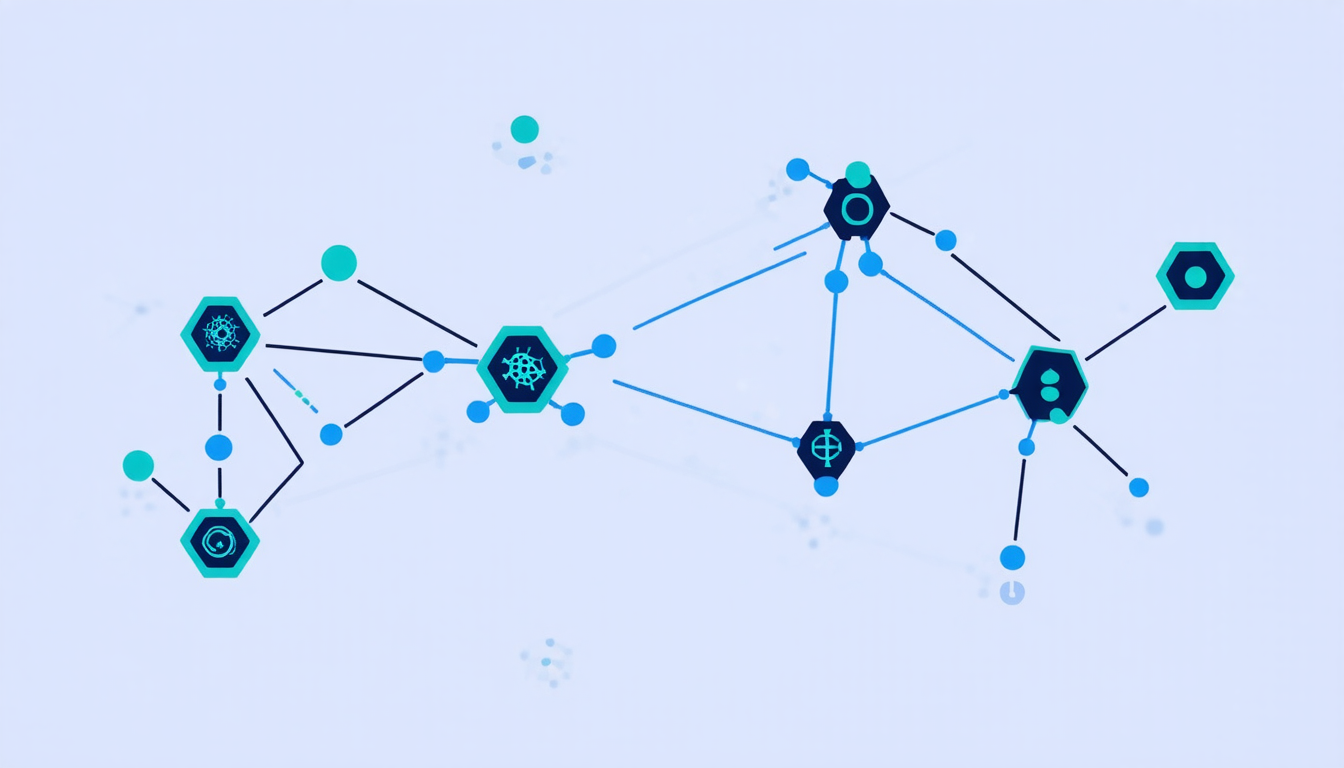
Researchers have long been fascinated by the properties of distance-regular graphs, which are mathematical structures that describe the relationships between nodes in a network. These graphs can be used to model everything from social networks to transportation systems, and understanding their properties is crucial for designing efficient and resilient systems.
Recently, a team of mathematicians made a significant breakthrough in this field by classifying all possible weakly distance-regular digraphs – a type of graph that’s particularly relevant to real-world applications. To put it simply, they’ve cracked the code on how these graphs are structured, which has major implications for fields like computer science, biology, and even sociology.
The key insight here is that weakly distance-regular digraphs can be thought of as a combination of two simpler types of graphs: undirected graphs and directed graphs. The former describe relationships between nodes where direction doesn’t matter (think friendships or business partnerships), while the latter capture directional connections (like email chains or supply lines).
By analyzing these combinations, the researchers were able to identify patterns and properties that hold true across different types of networks. For instance, they found that certain types of graphs are more resilient to damage than others, which could have important implications for designing robust systems.
One of the most intriguing aspects of this work is its potential applications in fields like biology. In biological systems, networks of molecules and cells interact with each other in complex ways, often giving rise to emergent properties that can’t be predicted from individual components alone. By understanding the properties of distance-regular graphs, scientists may be able to better model these interactions and gain insights into diseases and disorders.
The beauty of this work lies in its simplicity – despite the complexity of the mathematics involved, the underlying principles are surprisingly intuitive. And yet, the implications are far-reaching and could have significant impacts on a wide range of fields.
In essence, this research represents a major step forward in our understanding of complex networks, and it’s an exciting reminder that even in the most abstract realms of mathematics, there lies hidden beauty and potential for discovery.
Cite this article: “Unlocking the Secrets of Complex Networks”, The Science Archive, 2025.
Mathematics, Networks, Graph Theory, Distance-Regular Graphs, Digraphs, Computer Science, Biology, Sociology, Resilience, Complexity





