

Thursday 23 January 2025
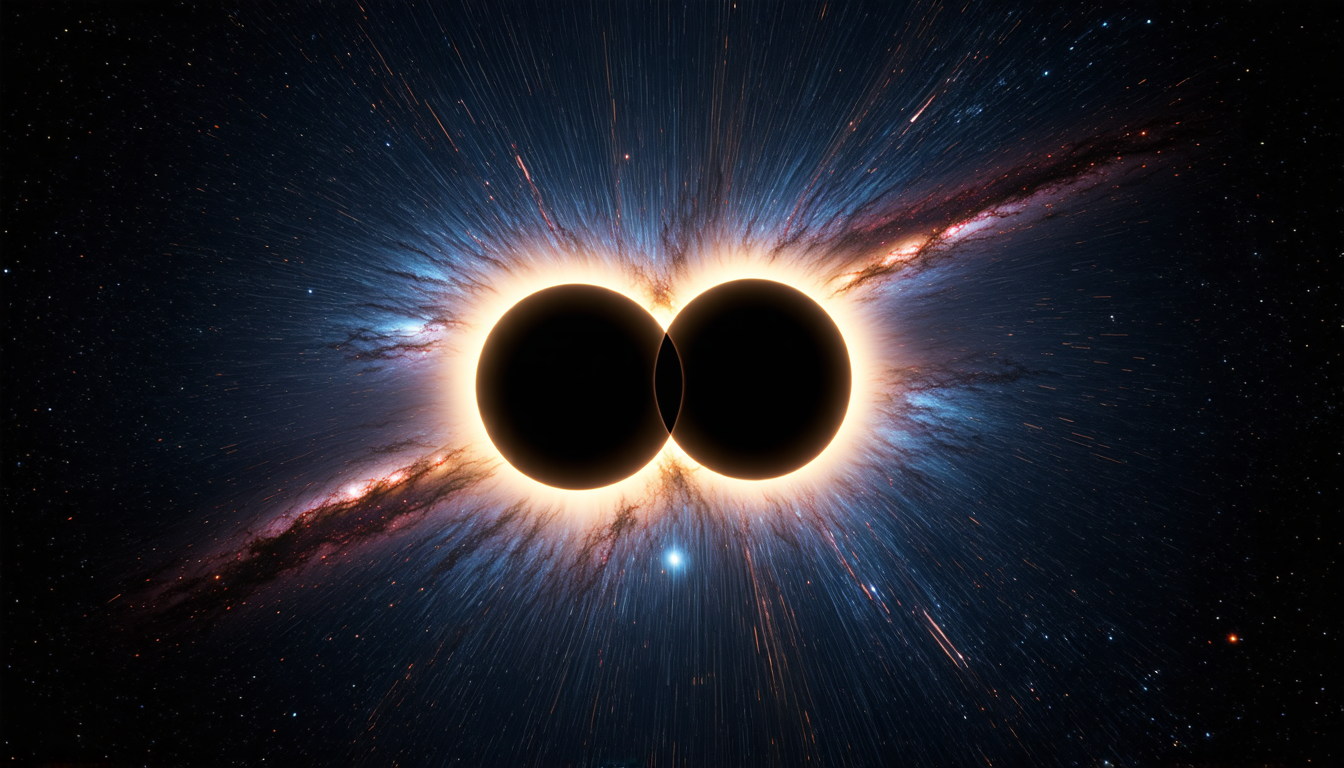
The study of black holes has long fascinated scientists and the public alike. These cosmic monsters are known for their intense gravitational pull, which warps space and time around them. But what happens when a black hole collides with another object in space? A recent study has shed new light on this phenomenon, providing insights into the behavior of these mysterious objects.
According to researchers, when a black hole collides with another object, such as a star or another black hole, it can create a spectacular display of gravitational waves. These ripples in space-time are produced by the acceleration of massive objects and have been detected by scientists using sensitive instruments.
The study, which analyzed data from several astronomical observations, revealed that black holes play a crucial role in shaping the universe. When two black holes collide, they merge into a single, more massive object, releasing an enormous amount of energy in the form of gravitational waves.
This merger can also produce a burst of radiation, including X-rays and gamma rays, which can be detected by telescopes on Earth. By studying these emissions, scientists can gain valuable insights into the properties of black holes and their role in the universe.
The study also found that black holes are not just destructive forces; they can also be powerful engines for creating new stars and planets. When a black hole collides with a star or another object, it can trigger the formation of new celestial bodies.
This research has significant implications for our understanding of the cosmos. It suggests that black holes may play a key role in shaping the structure and evolution of galaxies, including our own Milky Way.
The study’s findings are based on observations made by several space-based telescopes, including NASA’s Hubble Space Telescope and the European Space Agency’s XMM-Newton telescope. The data was analyzed using sophisticated computer simulations, which allowed scientists to model the behavior of black holes in different scenarios.
The results of this study provide a fascinating glimpse into the mysterious world of black holes. By studying these cosmic monsters, scientists can gain a deeper understanding of the universe and its many secrets.
Cite this article: “Unveiling the Secrets of Black Hole Collisions”, The Science Archive, 2025.
Black Holes, Gravitational Waves, Space-Time, Collision, Stars, Galaxies, Milky Way, Nasa, Hubble Space Telescope, Xmm-Newton Telescope





