
Thursday 23 January 2025
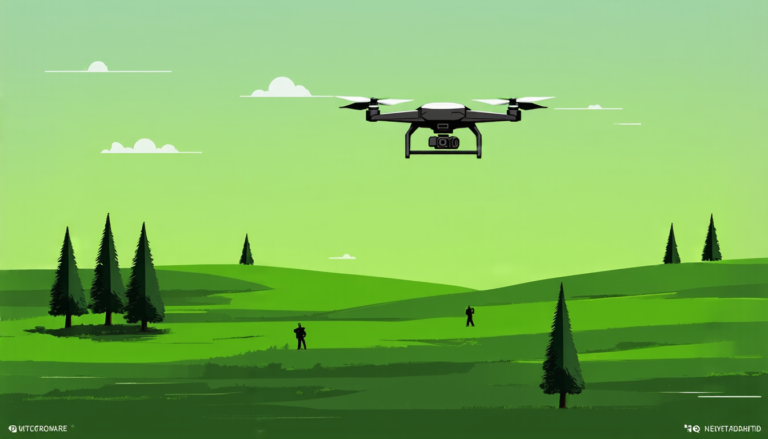
A team of researchers has made a significant breakthrough in the field of wireless communication systems, developing an innovative approach that enables drones to efficiently navigate and provide coverage in urban areas. The system, known as O-RAN (Open Radio Access Network), utilizes unmanned aerial vehicles (UAVs) equipped with radio units (O-RUs) to extend network coverage and adapt to changing user demands.
To achieve this feat, the team employed a dual-environment testing approach, combining simulated environments with real-world data from Wireless Insite, a cutting-edge ray-tracing tool. By using this hybrid approach, the researchers were able to validate their system’s performance in both synthetic and realistic urban scenarios.
The O-RAN system is designed to optimize UAV trajectories using Dueling Double Deep Q-Network (DDQN) with multi-step learning. This advanced reinforcement learning technique allows the drones to adapt to dynamic user demands and network conditions, ensuring efficient coverage and minimizing energy consumption.
In their experiments, the researchers found that the Transfer Learning (TL) approach significantly reduced training time and energy consumption. In the simulated environment, TL reduced energy consumption by 30.52% and 58.51% in two different scenarios. In real-world environments, TL achieved savings of 44.85% and 36.97%.
The O-RAN system’s ability to adapt to complex urban environments and varying user densities makes it an attractive solution for future wireless communication networks. The researchers plan to extend their work by exploring larger-scale environments with diverse user patterns.
In summary, the development of an O-RAN system that leverages UAVs as mobile radio units has significant implications for the field of wireless communication systems. By using advanced reinforcement learning techniques and transfer learning, the system can efficiently navigate complex urban environments, adapt to changing user demands, and minimize energy consumption.
Cite this article: “Efficient Urban Wireless Coverage with O-RAN System”, The Science Archive, 2025.
Wireless Communication Systems, O-Ran, Open Radio Access Network, Uavs, Radio Units, Reinforcement Learning, Transfer Learning, Dual-Environment Testing, Ray-Tracing Tool, Wireless Insite