

Tuesday 11 March 2025
A team of researchers has made significant strides in optimizing gas network operations, a crucial task for ensuring the efficient and reliable distribution of natural gas. By refining existing mathematical models and incorporating new techniques, they’ve managed to improve the accuracy and speed of these simulations.
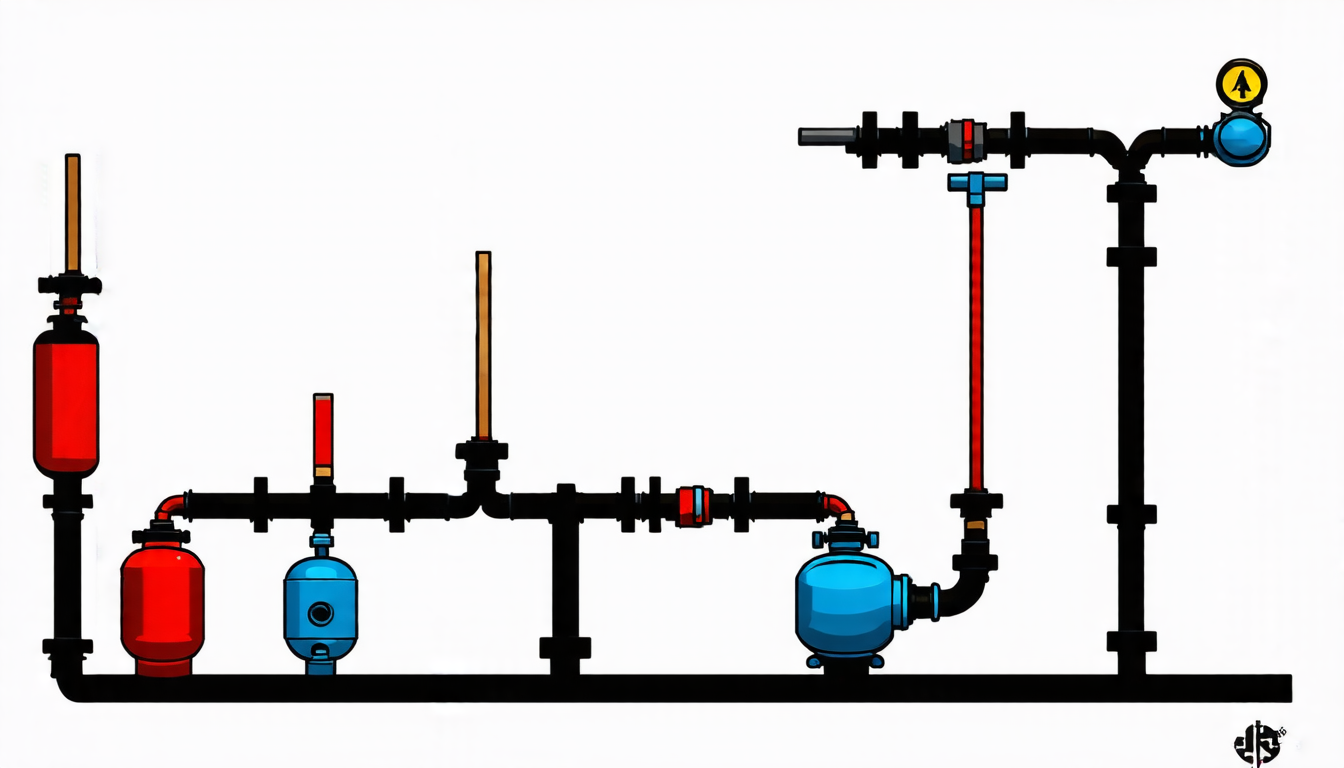
The current state of gas network optimization relies heavily on complex algorithms that must balance supply and demand while navigating a web of pipes, valves, and compressors. The process is notoriously tricky, as small changes in pressure or flow rate can have far-reaching consequences for the entire system. To make matters more challenging, the models used to simulate these networks are often oversimplified, leading to inaccurate predictions.
The researchers’ solution lies in developing a new class of cuts aimed at improving the performance of discrete mixed-integer nonlinear programs (MINLPs), a type of mathematical model commonly used for gas network optimization. These cuts are designed to exploit the bilinear structure inherent in the problem, allowing the solver to prune larger regions of the search space and reduce the number of iterations required to find an optimal solution.
The team also introduced two new pressure loss formulations that leveraged the directional flow variables required for the mixing formulations. These models were tuned to provide more accurate predictions of pressure losses in both turbulent and laminar flows, a crucial aspect of gas network operations.
In addition to these advances, the researchers conducted an extensive computational study using the global nonlinear optimization solver BARON. Their results demonstrate that the new MINLP model with cuts outperforms existing approaches in terms of reliability, accuracy, and solve times.
One of the key benefits of this research is its potential to improve the overall efficiency and reliability of gas network operations. By enabling faster and more accurate simulations, operators can better respond to changing demand patterns and unexpected disruptions, reducing the likelihood of supply shortages or infrastructure damage.
The study also highlights the importance of advanced mathematical modeling techniques in addressing complex real-world problems. As the world continues to rely on natural resources for energy, optimizing gas network operations will become increasingly critical. This research serves as a reminder that innovative solutions can often be found at the intersection of mathematics and engineering.
The authors’ work has significant implications for the development of more sophisticated gas network optimization models. By refining these models, researchers can improve the accuracy and speed of simulations, ultimately leading to more efficient and reliable energy distribution systems. As the global demand for energy continues to grow, this research provides a crucial step forward in ensuring that our infrastructure is equipped to meet those demands.
Cite this article: “Optimizing Gas Network Operations: A Breakthrough in Mathematical Modeling and Simulation”, The Science Archive, 2025.
Gas Network Optimization, Natural Gas Distribution, Mathematical Modeling, Minlp Models, Optimization Techniques, Discrete Mixed-Integer Nonlinear Programs, Pressure Loss Formulations, Computational Studies, Baron Solver, Energy Infrastructure.





