

Tuesday 11 March 2025
Scientists have made a significant breakthrough in understanding the behavior of supermassive black holes, which are found at the centers of many galaxies. These behemoths weigh millions or even billions of times more than our sun and are known for their incredible gravitational pull.
Researchers have long been fascinated by the way these massive objects interact with their surroundings. One area that has received a lot of attention is the way they affect the gas and dust around them, which can lead to the formation of stars and planets.
A new study published in The Astrophysical Journal has shed light on this process by simulating the behavior of supermassive black holes in different environments. The researchers used advanced computer models to create virtual galaxies and then simulated the growth of a supermassive black hole at their center.
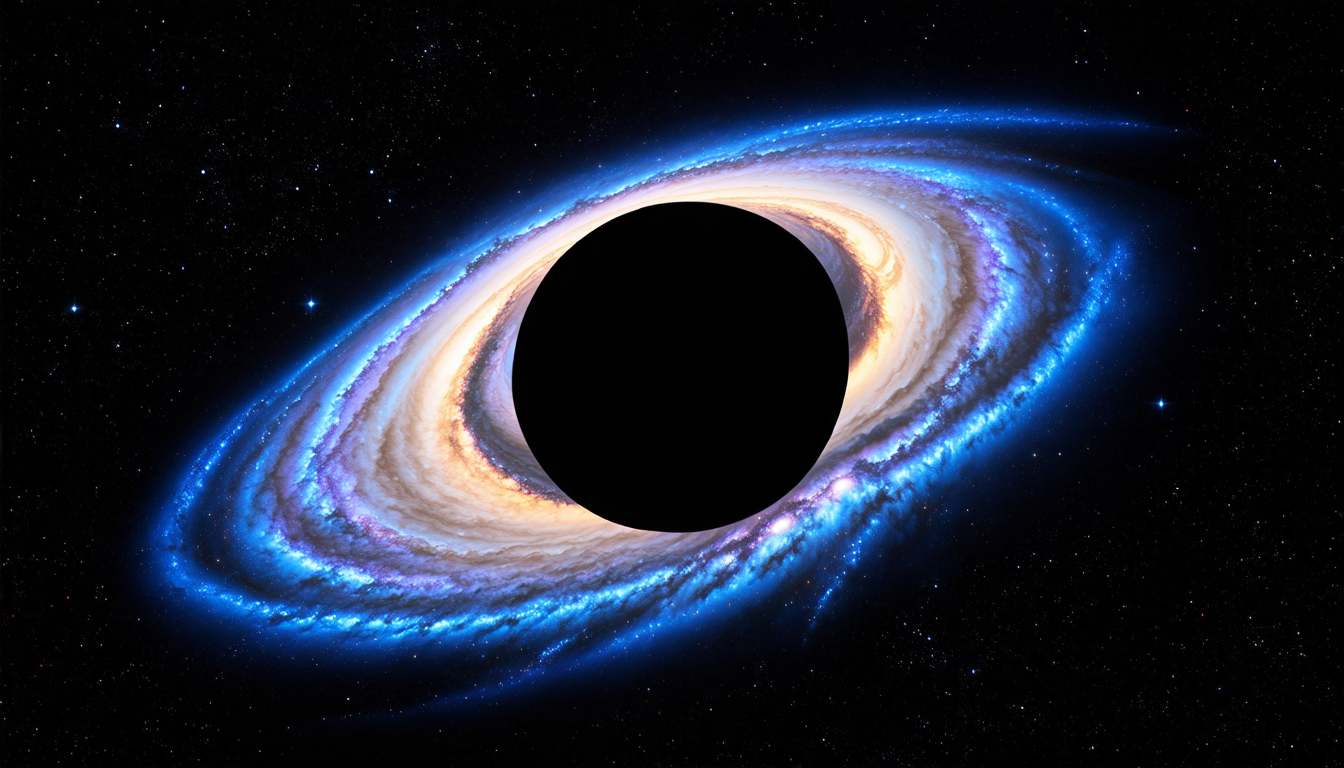
The simulations showed that the black hole’s gravitational pull causes gas and dust to fall towards it, forming a disk around its equator. This disk can heat up due to friction and eventually form stars and planets.
However, the researchers also found that the presence of other galaxies or large amounts of dark matter in the vicinity can disrupt this process. The simulations showed that the gravitational pull of these external objects can cause the gas and dust in the galaxy to be flung out into space, preventing the formation of new stars and planets.
The study’s findings have important implications for our understanding of galaxy evolution and the role supermassive black holes play in shaping their development. It also highlights the importance of considering the effects of external factors on the behavior of these massive objects.
In addition to providing insights into the workings of supermassive black holes, the research has also led to the development of new computer models that can be used to simulate the growth and evolution of galaxies. These models can be applied to a wide range of astrophysical phenomena, from the formation of stars and planets to the growth of supermassive black holes.
The study’s findings are likely to have far-reaching implications for our understanding of the universe and its many mysteries. By continuing to explore the behavior of supermassive black holes, scientists can gain a deeper understanding of the complex interactions that shape the cosmos.
Cite this article: “Unveiling the Secrets of Supermassive Black Holes”, The Science Archive, 2025.
Supermassive Black Holes, Galaxy Evolution, Gravitational Pull, Gas And Dust, Star Formation, Planet Formation, Dark Matter, Computer Simulations, Astrophysical Phenomena, Galaxy Development





