

Tuesday 11 March 2025
In a fascinating study, researchers have delved into the world of parking functions, a mathematical concept that may seem trivial at first glance but holds surprising secrets. By introducing randomness to this seemingly mundane topic, scientists have uncovered new patterns and behaviors that offer insights into complex systems.
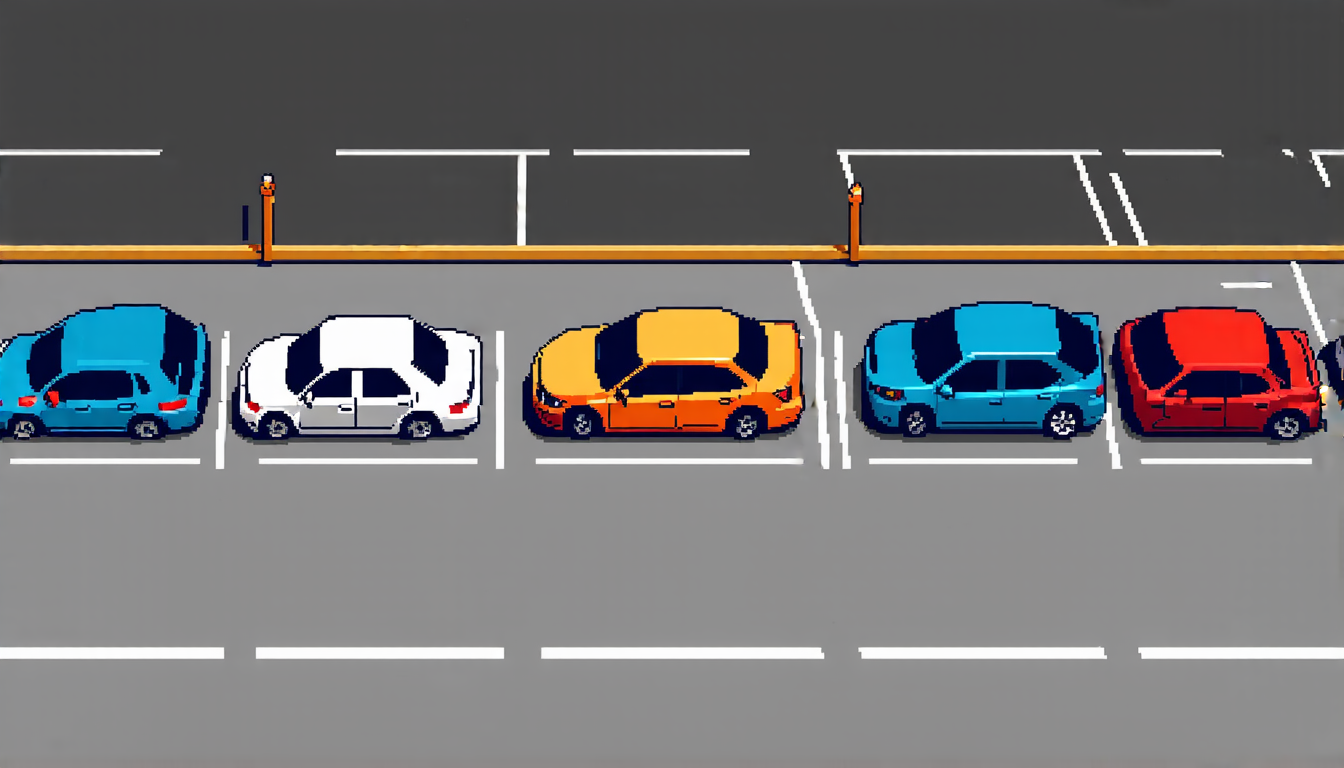
Parking functions are a type of combinatorial object that describes how cars park in a row. Each car has a preferred parking spot, and the goal is to assign each car its desired spot while taking into account the constraints of the parking lot. This problem may seem straightforward, but it’s surprisingly rich in mathematical structure. By studying these functions, researchers have discovered connections to other areas of mathematics, such as algebraic combinatorics and probability theory.
The new study takes this concept a step further by introducing randomness into the mix. Instead of assuming each car has a fixed preference for its parking spot, scientists allowed the preferences to vary randomly. This led to some astonishing discoveries. For instance, researchers found that the probability of all cars parking in their desired spots decreases rapidly as the number of cars increases.
But why is this important? The study’s findings have implications for our understanding of complex systems. Parking functions are a simple model for studying how particles interact with each other and their environment. By introducing randomness, scientists can gain insights into how these interactions affect the behavior of the system as a whole.
One surprising aspect of the study is its connection to the Kardar-Parisi-Zhang (KPZ) universality class, a concept that describes the behavior of particles in random environments. The KPZ class has been extensively studied in fields like physics and biology, but this new research shows that parking functions can also be used to model these systems.
The study’s authors used advanced mathematical techniques, including probability theory and statistical mechanics, to analyze the behavior of the parking functions. They found that the system exhibits a phase transition, where the probability of all cars parking in their desired spots changes abruptly as the number of cars increases.
This research has far-reaching implications for our understanding of complex systems. By studying simple models like parking functions, scientists can gain insights into how these systems behave and respond to random events. This knowledge can be applied to a wide range of fields, from traffic flow to social networks.
In this study, researchers have demonstrated the power of mathematical modeling in uncovering hidden patterns and behaviors in complex systems.
Cite this article: “Unlocking Secrets of Parking Functions: A Mathematical Odyssey”, The Science Archive, 2025.
Parking Functions, Combinatorial Objects, Randomness, Probability Theory, Algebraic Combinatorics, Complex Systems, Phase Transition, Kardar-Parisi-Zhang Universality Class, Statistical Mechanics, Mathematical Modeling





