

Tuesday 11 March 2025
A team of researchers has made a significant breakthrough in understanding the morphology evolution of organic solar cells. By developing a new phase-field model, they have been able to accurately simulate the behavior of these complex systems.
Organic solar cells are an exciting area of research, as they offer the potential for low-cost and flexible energy production. However, their efficiency is limited by the way in which the different components interact with each other. In particular, the morphology evolution of the active layer – where the light-absorbing material meets the electrically conductive electrodes – plays a crucial role.
The new phase-field model uses a combination of mathematical techniques and numerical simulations to describe the behavior of the active layer. By accounting for the interactions between different components, such as the polymer and non-fullerene acceptor molecules, the model is able to accurately predict the morphology evolution over time.
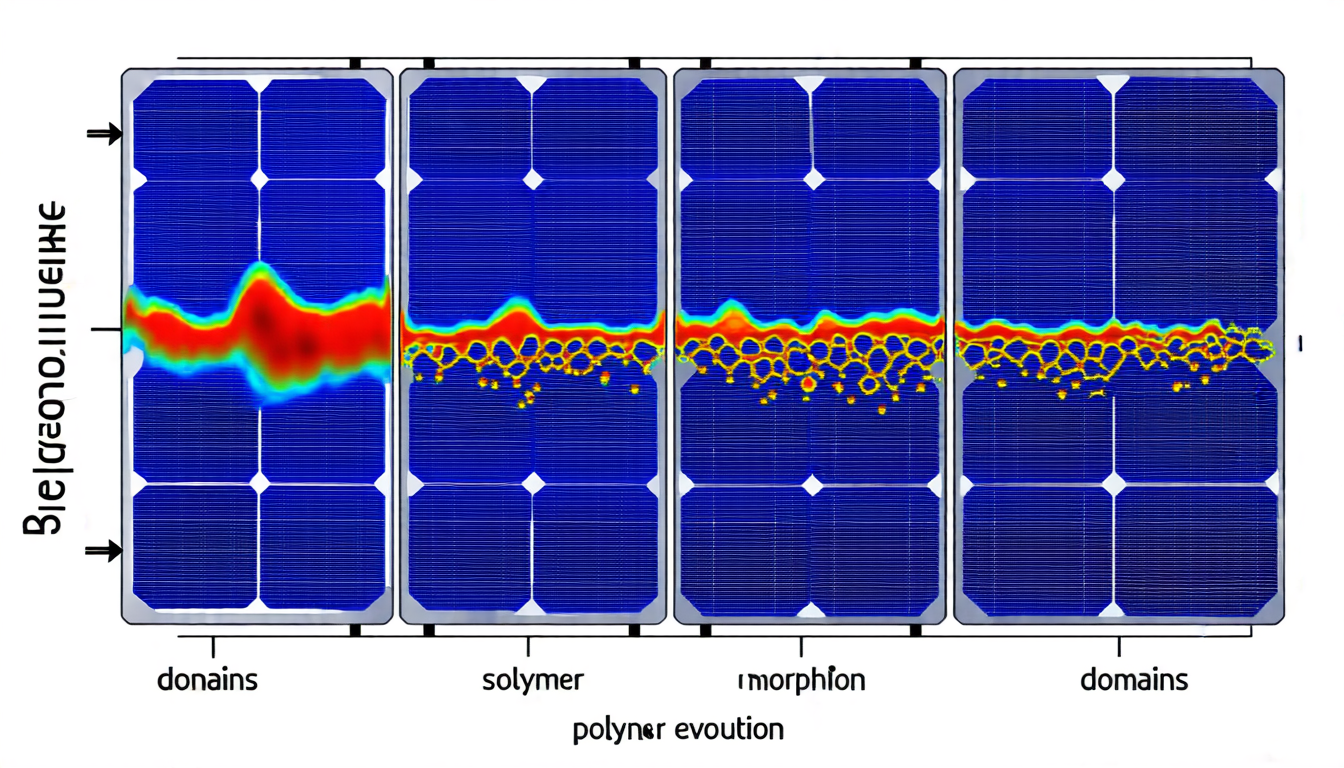
In the model, the active layer is treated as a mixture of two phases: the polymer and the solvent. The solvent evaporates over time, causing the polymer to concentrate and form domains. These domains are crucial for the efficient transport of charge carriers, but their size and shape can affect the overall performance of the solar cell.
The researchers used their model to simulate the morphology evolution of organic solar cells under different conditions. They found that the size and shape of the polymer domains were highly dependent on the solvent evaporation rate and the interaction between the polymer and non-fullerene acceptor molecules.
Their results suggest that by carefully controlling these interactions, it may be possible to optimize the morphology evolution of organic solar cells. This could lead to significant improvements in their efficiency and stability.
The new model has important implications for the development of organic solar cells. By providing a better understanding of the morphology evolution, researchers can design more efficient and effective devices. This could ultimately lead to the widespread adoption of organic solar cells as a sustainable source of renewable energy.
In addition to its applications in organic solar cells, the phase-field model may also have broader implications for materials science. It demonstrates the power of combining mathematical techniques with numerical simulations to understand complex systems.
Overall, the development of this new phase-field model is an important step forward in our understanding of organic solar cells and their potential as a sustainable source of renewable energy.
Cite this article: “Unlocking the Secrets of Organic Solar Cells: A Breakthrough in Morphology Evolution Modeling”, The Science Archive, 2025.
Organic Solar Cells, Phase-Field Model, Morphology Evolution, Polymer Domains, Solvent Evaporation, Non-Fullerene Acceptor Molecules, Charge Carrier Transport, Device Efficiency, Sustainability, Renewable Energy





