

Wednesday 12 March 2025
A team of scientists has been studying the globular cluster NGC 6397, a dense collection of stars located about 5,000 light-years away in the constellation Ophiuchus. By using advanced computer simulations and data from the European Space Agency’s Gaia spacecraft, they have gained new insights into the evolution of this ancient star cluster.
Globular clusters like NGC 6397 are thought to be some of the oldest objects in our galaxy, with ages estimated to be around 10 billion years old. They contain hundreds of thousands of stars, all moving together through space in a complex dance. The stars in these clusters are often older and more massive than those found in other parts of the galaxy, and they provide astronomers with a unique window into the early history of our universe.
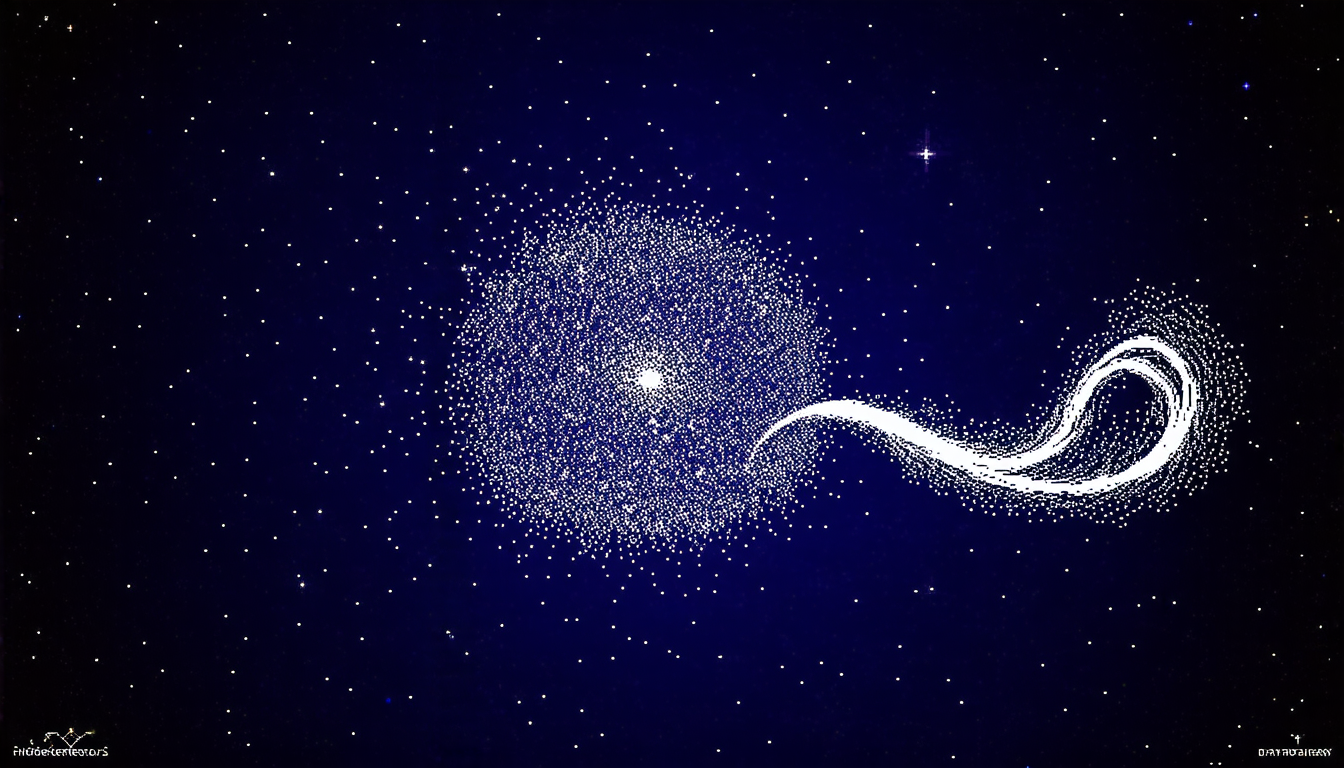
The new research focused on the tidal tails of NGC 6397, long streams of stars that have been stripped from the cluster by the gravitational forces of the Milky Way. These tails are thought to be rich in low-mass stars, which are difficult to detect individually but can provide valuable information about the evolution of the cluster.
Using computer simulations, the scientists were able to recreate the evolution of NGC 6397 over billions of years, including the formation of its tidal tails. They found that the cluster has undergone significant changes over time, with many stars being lost to the Milky Way and others forming new associations within the cluster.
The researchers also used data from Gaia to study the properties of the stars in NGC 6397, including their ages, masses, and chemical compositions. By combining this information with the results of their computer simulations, they were able to build a detailed picture of the cluster’s evolution.
One of the key findings was that the tidal tails of NGC 6397 are much more extensive than previously thought, stretching out for thousands of light-years into space. The scientists also found evidence of multiple waves of star formation within the cluster over its lifetime, which has helped to shape its current structure and composition.
The study provides new insights into the evolution of globular clusters like NGC 6397, and highlights the importance of tidal interactions with the Milky Way in shaping their properties. It also underscores the value of combining advanced computer simulations with data from space-based telescopes like Gaia to gain a deeper understanding of the universe.
Cite this article: “Unveiling the Evolutionary History of NGC 6397: A Study of a Ancient Star Cluster”, The Science Archive, 2025.
Globular Cluster, Ngc 6397, Stars, Simulations, Galaxy, Milky Way, Evolution, Tidal Tails, European Space Agency, Gaia Spacecraft





