

Wednesday 12 March 2025
A team of researchers has made significant strides in developing a novel approach to unlearning, a crucial technology for enhancing model robustness and data privacy in graph-based applications.
Unlearning is the process of removing knowledge from a machine learning model without retraining it from scratch. This is essential in scenarios where models need to forget sensitive information or adapt to changing data distributions. However, traditional unlearning methods often struggle with scalability issues, making them impractical for large-scale datasets.
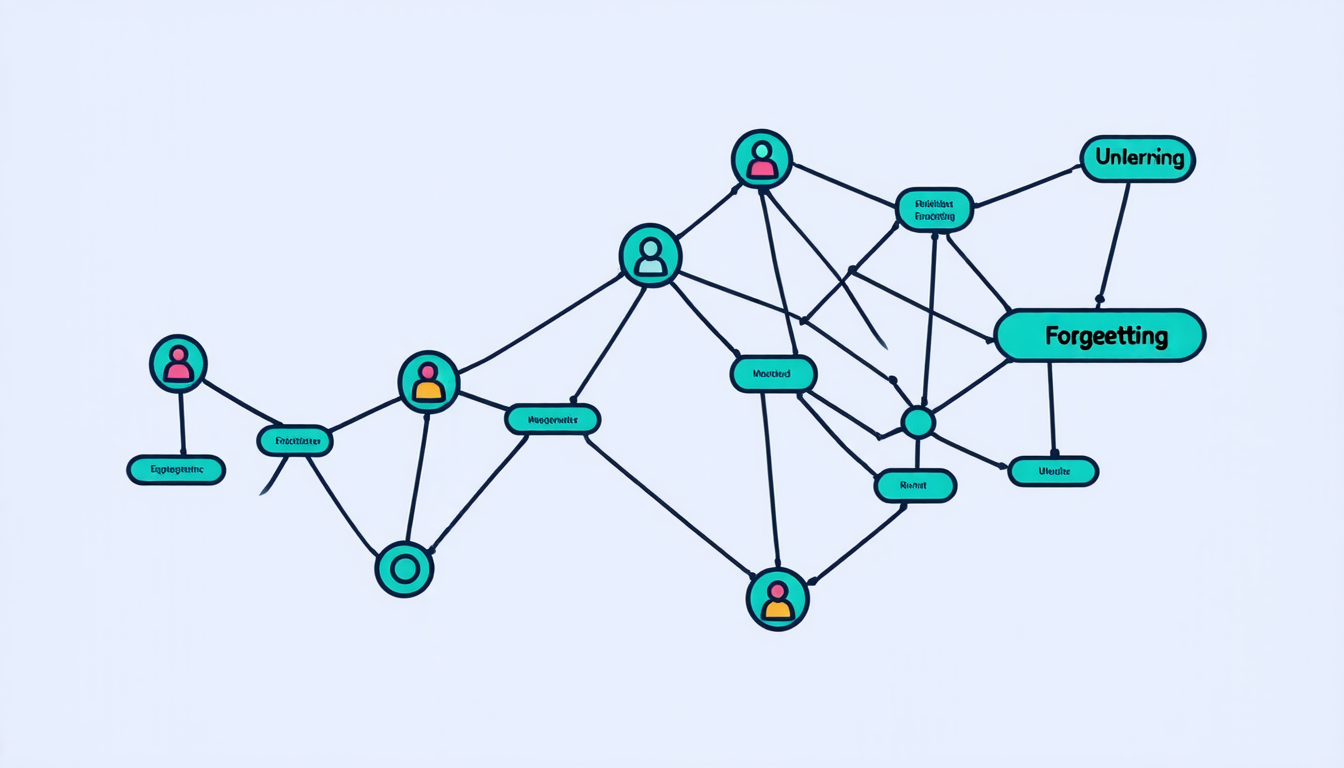
To address this challenge, researchers have proposed a new framework called Scalable Graph Unlearning (SGU). SGU leverages Node Influence Maximization (NIM) to identify the most critical nodes in a graph that need to be forgotten. This approach enables offline execution independent of unlearning entities, allowing it to be seamlessly integrated into various machine learning models.
The key innovation behind SGU lies in its ability to decouple influence propagation from entity-specific optimizations. By doing so, the framework can efficiently fine-tune model parameters while preserving the original graph structure. This not only enhances scalability but also improves predictive performance.
To evaluate the effectiveness of SGU, researchers conducted extensive experiments on 14 datasets, including large-scale ogbn- papers100M. The results show that SGU achieves comprehensive state-of-the-art performance and maintains scalability. In addition, it outperforms other unlearning methods in edge-level scenarios, where the removal of edges has a significant impact on predictive accuracy.
The researchers also explored the challenges associated with unlearning at different scales. They found that feature unlearning has a more pronounced effect on predictive performance compared to edge unlearning. This highlights the importance of considering the nuances of each unlearning scenario and tailoring the approach accordingly.
A critical component of SGU is the entity-specific optimization objective, which balances forgetting and reasoning capabilities. The researchers demonstrated that adjusting this hyperparameter can significantly impact both unlearning and predictive performance. By fine-tuning this parameter, users can customize the trade-off between knowledge removal and model accuracy to suit their specific needs.
The development of SGU has significant implications for various applications, including social network analysis, recommender systems, and traffic prediction. As data privacy concerns continue to escalate, the ability to efficiently unlearn sensitive information becomes increasingly important. With its scalable and adaptable nature, SGU is poised to play a crucial role in addressing these challenges.
The researchers’ findings have been published in a recent paper, providing a comprehensive framework for scalable graph unlearning.
Cite this article: “Scalable Graph Unlearning: A Novel Approach to Enhance Model Robustness and Data Privacy”, The Science Archive, 2025.
Machine Learning, Graph-Based Applications, Scalable Unlearning, Node Influence Maximization, Nim, Predictive Performance, Data Privacy, Social Network Analysis, Recommender Systems, Traffic Prediction





