

Wednesday 22 January 2025
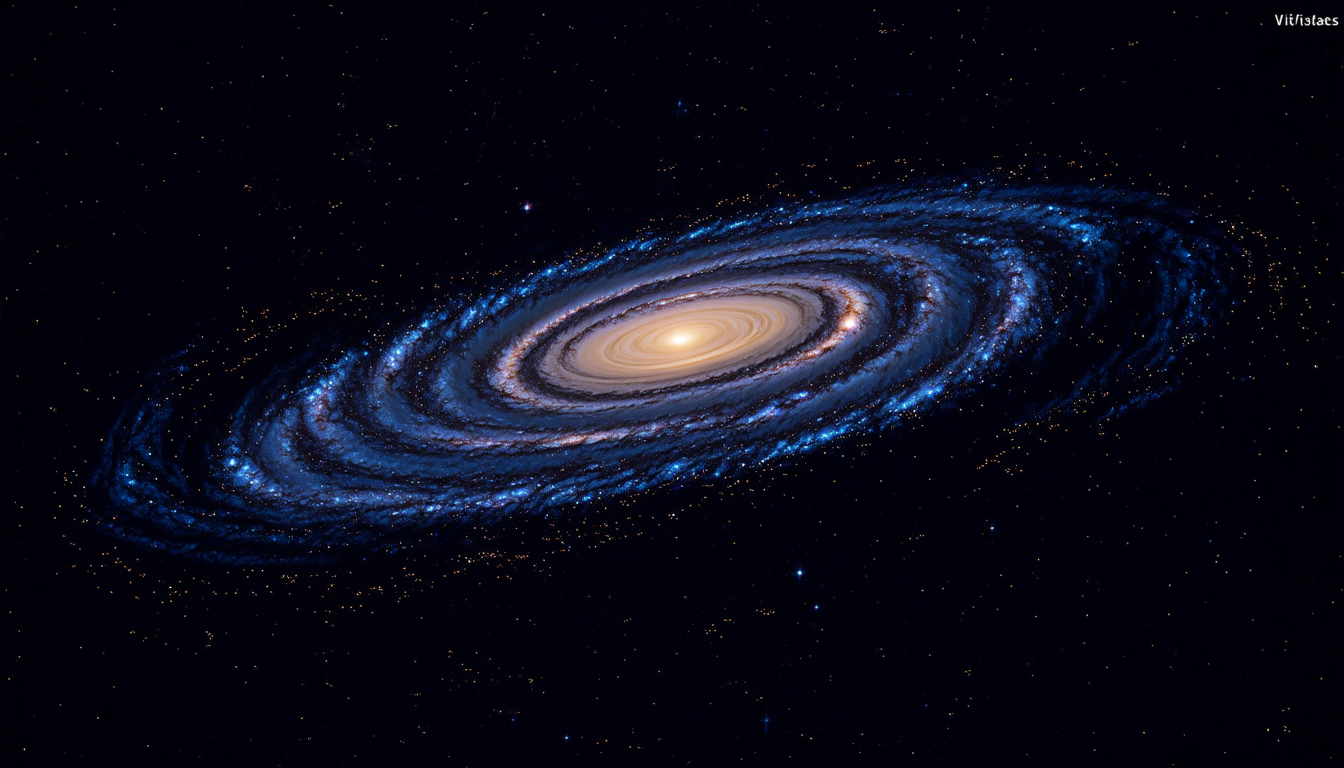
Galaxies are the building blocks of our universe, and understanding their behavior is crucial for grasping the fundamental laws that govern the cosmos. For decades, scientists have been studying the rotation curves of galaxies, which describe how fast stars and gas move around the center of a galaxy. These curves are like a cosmic fingerprint, revealing secrets about the distribution of mass within the galaxy.
Recently, researchers made a surprising discovery: many galaxies defy expectations by having flat or even declining rotation curves at large distances from their centers. This finding challenges our current understanding of how galaxies work and has significant implications for our understanding of dark matter, a mysterious substance that is thought to make up about 27% of the universe.
To investigate this phenomenon further, scientists turned to a new dataset of galaxy observations collected by the Sloan Digital Sky Survey IV (SDSS-IV) MaNGA project. This ambitious endeavor aimed to map the light emitted by stars within thousands of galaxies, providing a comprehensive picture of their internal dynamics.
Using advanced statistical techniques and machine learning algorithms, researchers analyzed the data to identify patterns in the rotation curves of galaxies. They found that many galaxies exhibit a peculiar behavior: their rotation curves flatten or decline at large distances from their centers, indicating that less mass is present than expected.
This unexpected finding has significant implications for our understanding of dark matter. If dark matter is responsible for the observed rotation curves, it would need to be significantly more diffuse and extended than previously thought. Alternatively, this behavior could be evidence of new physics beyond our current understanding of gravity and dark matter.
The SDSS-IV MaNGA project has opened a new window into the workings of galaxies, allowing scientists to probe deeper into their internal dynamics than ever before. As researchers continue to analyze the data, they may uncover even more surprising secrets about the nature of dark matter and the behavior of galaxies in our universe.
Cite this article: “Galaxies Hidden Secrets: A New Window into Dark Matters Mystery”, The Science Archive, 2025.
Galaxies, Rotation Curves, Mass Distribution, Dark Matter, Sdss-Iv Manga Project, Machine Learning Algorithms, Statistical Techniques, Galaxy Dynamics, Cosmic Fingerprint, Universe.





