

Wednesday 12 March 2025
A team of mathematicians has made a significant breakthrough in understanding the properties of curves on punctured disks, a fundamental concept in geometry and topology. The researchers have developed an algorithm that can detect whether a set of curves on a punctured disk gives a complete partition or not.
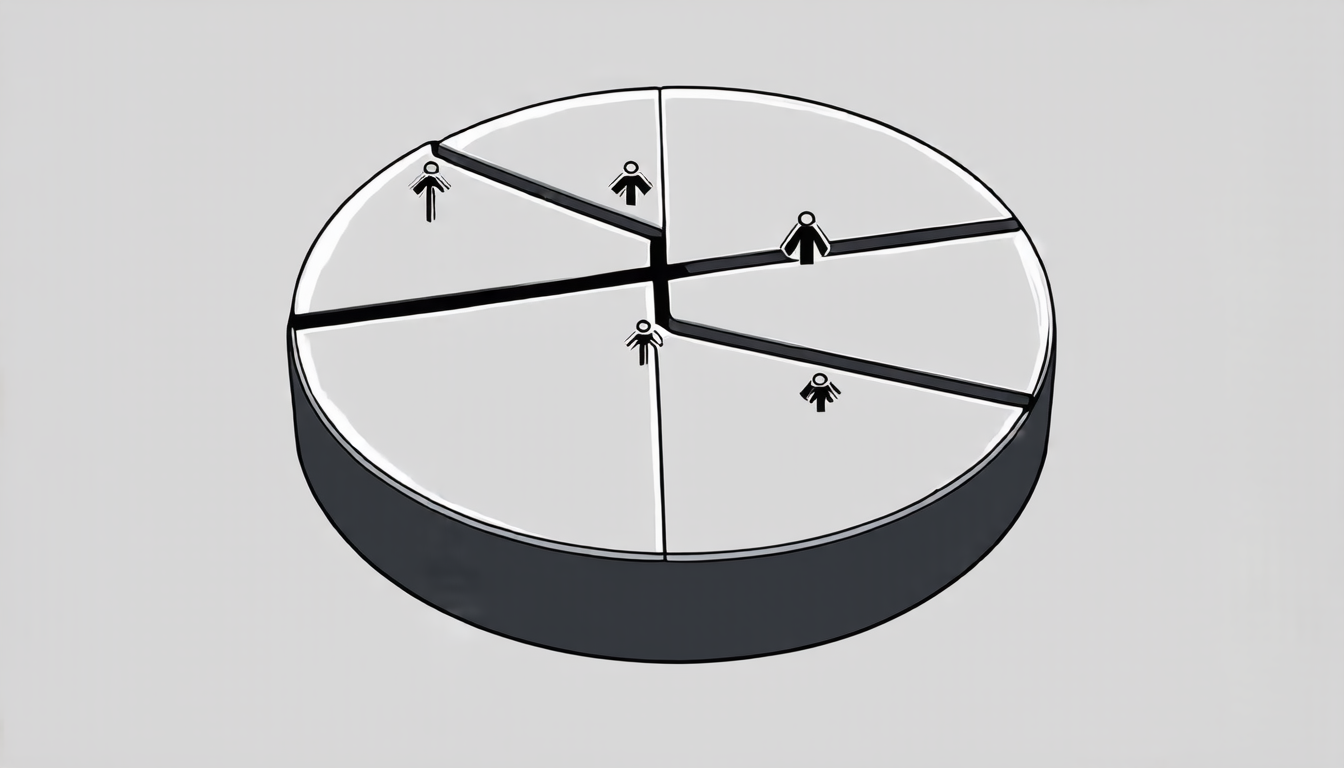
To understand what this means, let’s start with a simple example. A punctured disk is essentially a circle with some points removed. Now imagine drawing lines on the surface of the disk, connecting different points to create shapes. These lines are called curves. In geometry and topology, researchers are interested in understanding how these curves intersect and interact with each other.
A complete partition is when all the curves on a punctured disk can be grouped into separate sets such that no two curves from different sets intersect. Think of it like dividing the disk into non-overlapping regions, where each region is defined by its own unique set of curves. This concept has far-reaching implications in various fields, including computer science, physics, and engineering.
The new algorithm developed by the mathematicians allows them to determine whether a given set of curves on a punctured disk gives a complete partition or not. The method uses Dynnikov coordinates, a mathematical framework that describes the properties of curves on a punctured disk. By analyzing these coordinates, the researchers can identify when two curves are opposite, meaning they do not intersect.
The algorithm is based on a simple yet powerful idea. It first identifies the curves that lie entirely within a particular region of the disk, and then recursively applies the same process to each of these sub-regions until it reaches the smallest possible regions. This allows the researchers to build a hierarchical structure of curve sets, which can be used to determine whether the original set of curves gives a complete partition or not.
The significance of this breakthrough lies in its potential applications. For instance, computer scientists can use this algorithm to optimize algorithms for solving problems related to geometry and topology. Physicists may find it useful in understanding the behavior of complex systems, such as fluid dynamics or electrical circuits. Engineers can apply this concept to design more efficient systems, like traffic flow management or network optimization.
In addition, this research has shed new light on the properties of curves on punctured disks, a fundamental concept in geometry and topology. The algorithm provides a practical tool for researchers to explore the intricate relationships between curves and their intersections, which can lead to new insights and discoveries.
Cite this article: “Deciphering Curves on Punctured Disks: A Breakthrough in Geometry and Topology”, The Science Archive, 2025.
Geometry, Topology, Curves, Punctured Disks, Algorithm, Complete Partition, Dynnikov Coordinates, Computer Science, Physics, Engineering





