

Wednesday 12 March 2025
The quest for a solution to a stubborn problem in computer science has led researchers down a fascinating path, one that weaves together algebraic structures and combinatorial puzzles. For years, experts have struggled to determine the complexity of certain constraint satisfaction problems (CSPs), which involve assigning values to variables subject to specific constraints.
At the heart of this challenge lies the concept of promise CSPs, where some constraints are guaranteed to be satisfied before others are even considered. This twist adds a layer of complexity, making it difficult to devise efficient algorithms or prove lower bounds on their performance.
In recent years, researchers have made significant progress in understanding the properties of promise CSPs. They’ve discovered connections between these problems and other areas of mathematics, such as algebraic geometry and topology. By exploiting these relationships, they’ve been able to establish new hardness results for specific types of promise CSPs.
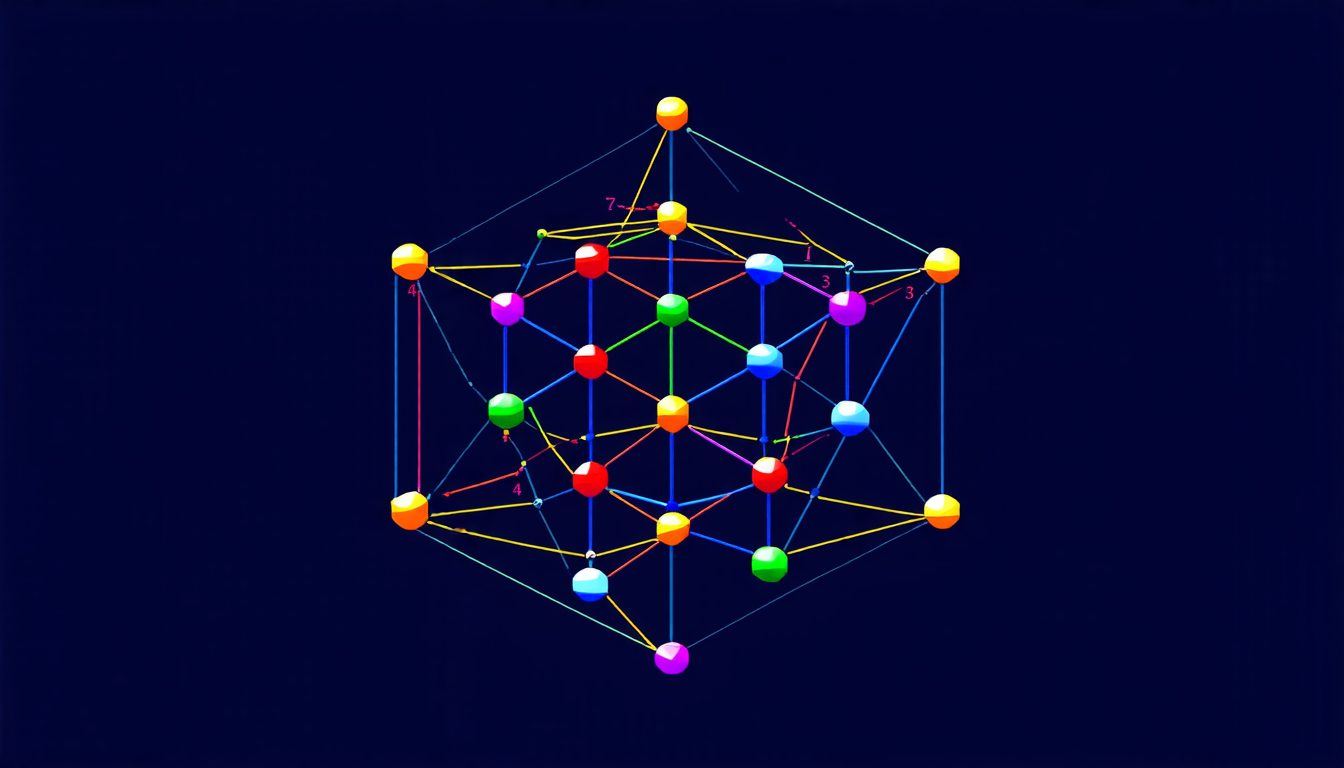
One notable example is the problem of coloring hypergraphs, which involves assigning colors to vertices in a way that satisfies certain constraints. In particular, researchers have focused on the case where the hypergraph is 3-colorable but requires more than three colors to color it properly. By showing that this problem is NP-hard for promise CSPs, they’ve provided evidence that certain algorithms may not be able to solve these problems efficiently.
This result has far-reaching implications for the study of computer science and mathematics. It suggests that some problems may be inherently difficult to solve, even with the aid of advanced algorithms and computational power. At the same time, it highlights the importance of understanding the underlying structures and properties of these problems in order to devise effective solutions.
The researchers’ approach combines elements of algebraic geometry and combinatorial optimization. They’ve developed new tools and techniques for analyzing the structure of promise CSPs, which have allowed them to establish a range of hardness results. These findings will likely inform the development of more efficient algorithms and provide insights into the nature of these complex problems.
As researchers continue to explore the properties of promise CSPs, they may uncover even deeper connections between different areas of mathematics. The potential for breakthroughs is vast, and the journey itself offers a fascinating glimpse into the intricate dance between algebra, geometry, and computer science.
Cite this article: “Unraveling the Complexity of Promise CSPs”, The Science Archive, 2025.
Constraint Satisfaction Problems, Promise Csps, Algebraic Geometry, Topology, Combinatorial Optimization, Np-Hardness, Hypergraphs, Coloring Problem, Computational Complexity, Computer Science.





