

Thursday 23 January 2025
A team of researchers has made a significant breakthrough in understanding the behavior of random walks on complex networks, specifically on trees. These networks are used to model various real-world systems, such as social networks, transportation networks, and even biological systems.
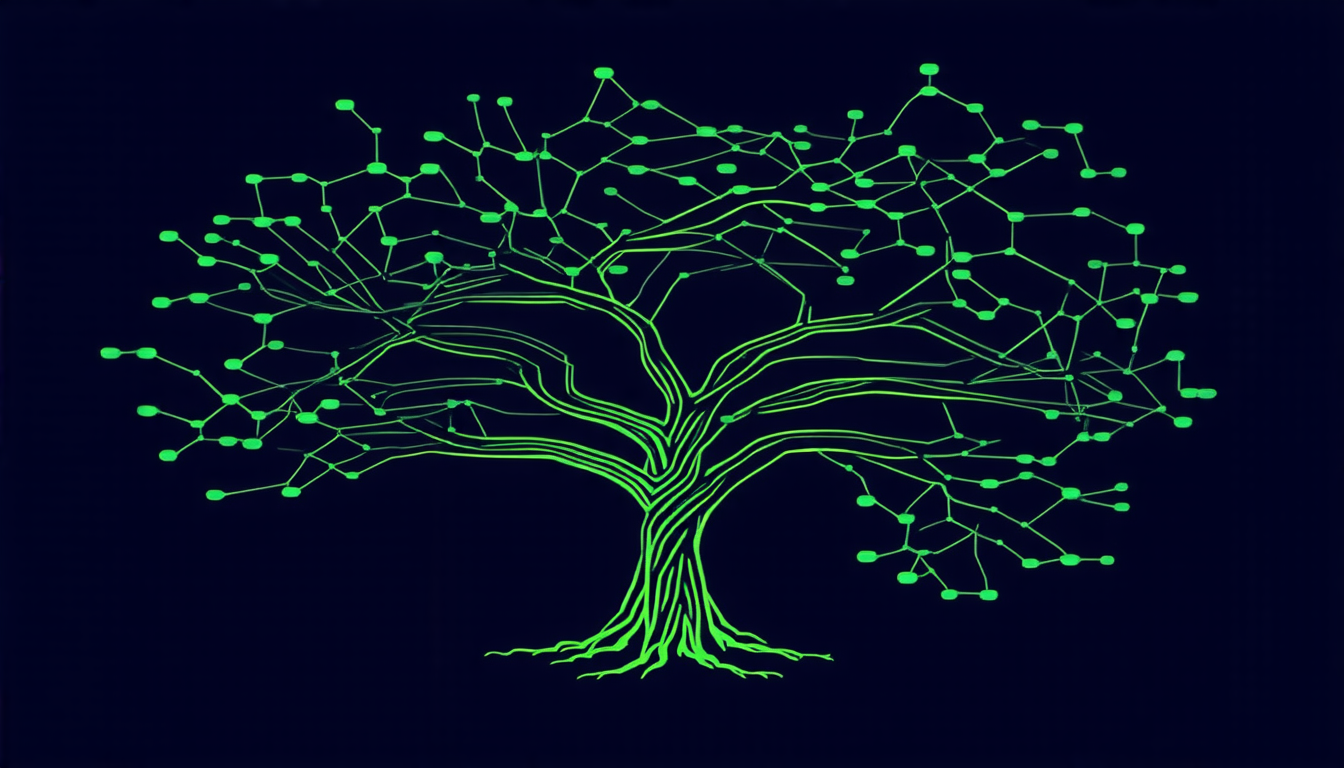
The study focused on a particular type of tree called the Galton-Watson tree, which is a branching process that grows randomly. The researchers were interested in understanding how a random walk, or a path taken by a particle moving randomly through the tree, behaves over time.
To tackle this problem, the team used a combination of mathematical techniques and computer simulations. They found that as the size of the tree increases, the random walk exhibits a scaling limit, meaning that its behavior becomes more predictable and follows certain patterns.
In particular, the researchers discovered that the random walk converges to a Brownian motion on the stable tree, which is a mathematical object that describes the behavior of particles in a fluid. This means that the random walk becomes increasingly smooth and continuous as it moves through the tree.
The findings have important implications for understanding complex networks and their behavior. For example, they could be used to model the spread of diseases through social networks or the flow of traffic on transportation networks.
The researchers also explored the connection between the random walk and percolation theory, which is a branch of mathematics that studies the properties of networks when some of its nodes are removed. They found that the scaling limit of the random walk is closely related to the critical behavior of percolation in the tree.
Overall, this study provides new insights into the behavior of random walks on complex networks and has important implications for understanding real-world systems. The findings could be used to develop more accurate models of network behavior and improve our understanding of how information spreads through social networks or traffic flows through transportation networks.
Cite this article: “Understanding Random Walks on Complex Networks: A Breakthrough in Modeling Real-World Systems”, The Science Archive, 2025.
Random Walks, Complex Networks, Galton-Watson Tree, Branching Process, Scaling Limit, Brownian Motion, Stable Tree, Percolation Theory, Network Behavior, Mathematical Modeling.





