

Wednesday 12 March 2025
For decades, scientists have been working on developing new methods for simulating complex phenomena in physics and engineering. One of these methods is called tensor networks (TNs), which has recently gained popularity due to its potential to solve complex problems more efficiently.
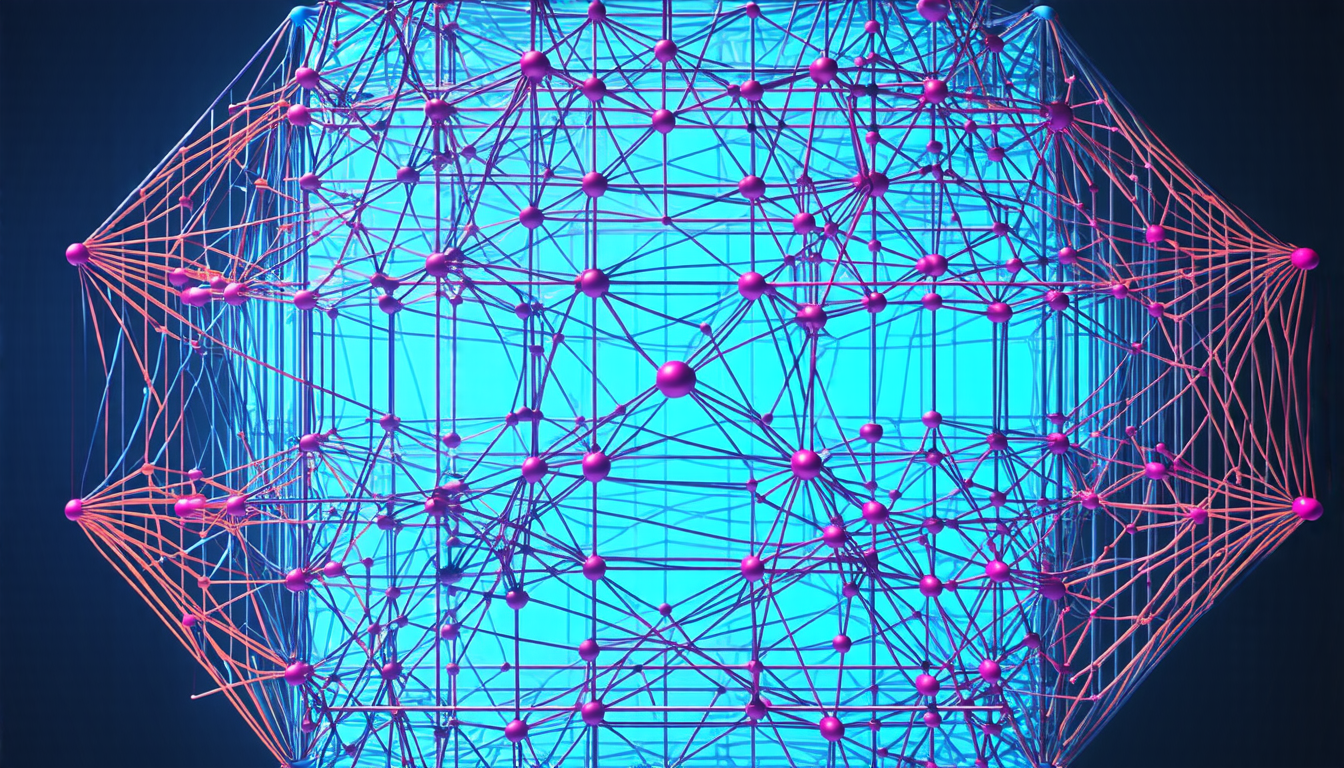
TNs are a type of mathematical framework that allows researchers to represent high-dimensional data using a network of interconnected tensors. These tensors can be thought of as multi-dimensional arrays that contain information about the relationships between different components of a system. By analyzing these networks, scientists can gain insights into complex phenomena such as phase transitions in materials and the behavior of particles at the quantum level.
One of the key advantages of TNs is their ability to compress large amounts of data into smaller, more manageable forms. This is achieved by identifying patterns and correlations within the data, which allows researchers to represent complex systems using a much smaller number of tensors than would be required by traditional methods.
Recently, a team of scientists has been working on applying TNs to the field of solid mechanics, where they have developed a new method for simulating material deformations. This method uses TNs to compress the stiffness matrix, which is a critical component of the finite element method (FEM), a widely used technique in engineering and physics.
The FEM is a numerical method that breaks down complex systems into smaller, more manageable pieces called elements. Each element is then analyzed separately using the laws of physics, and the results are combined to obtain a solution for the entire system. However, as the complexity of the system increases, the number of elements required also increases, which can lead to significant computational costs.
By applying TNs to the FEM, researchers have been able to reduce the computational cost of simulating material deformations by several orders of magnitude. This is achieved by compressing the stiffness matrix, which is a large and complex array that contains information about the relationships between different components of the system.
The team’s method uses a combination of techniques to achieve this compression, including tensor train decomposition and alternating minimal energy methods. These techniques allow researchers to identify patterns and correlations within the data, which can then be used to represent complex systems using a much smaller number of tensors than would be required by traditional methods.
The results of the study are promising, with simulations showing that the new method is able to accurately predict material deformations at a fraction of the computational cost of traditional FEM methods.
Cite this article: “Tensor Networks Revolutionize Solid Mechanics Simulations”, The Science Archive, 2025.
Tensor Networks, Solid Mechanics, Finite Element Method, Material Deformations, Stiffness Matrix, Computational Cost, Tensor Train Decomposition, Alternating Minimal Energy Methods, Complex Phenomena, High-Dimensional Data.





