

Thursday 23 January 2025
Thermodynamics, the study of heat and energy transfer, has long been a cornerstone of physics and engineering. However, traditional thermodynamic principles were developed under the assumption that systems are in equilibrium, meaning they have reached a state of balance where no further changes occur. But what about systems that are far from equilibrium? These systems, which include many biological and chemical processes, don’t follow traditional thermodynamic rules.
Researchers have long sought to develop a framework for understanding these non-equilibrium systems. Now, a team of scientists has proposed a new approach that combines the principles of information theory and statistical mechanics to describe the behavior of these complex systems.
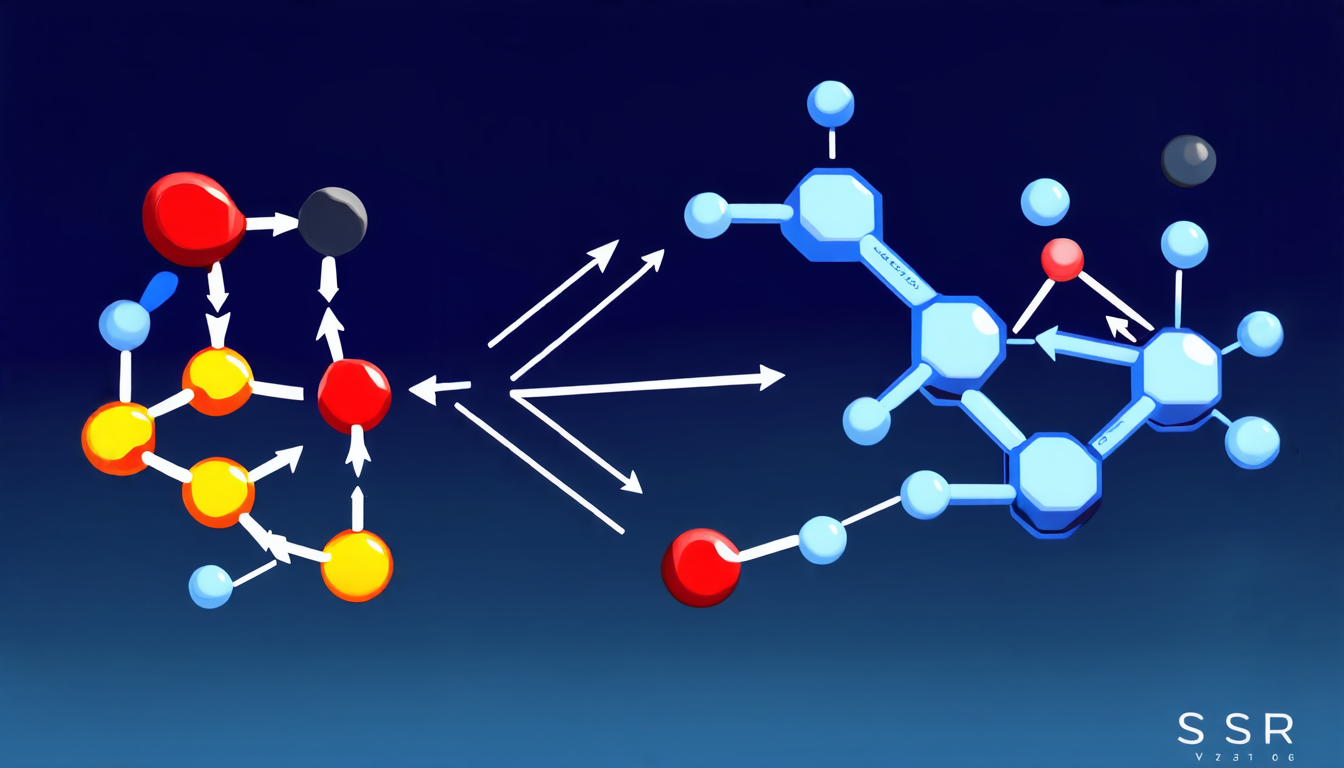
The key insight is that many non-equilibrium systems can be viewed as driven sample-space reducing processes (SSR). In an SSR process, energy or particles are transferred between different states, driving the system away from equilibrium. The team has shown that by using a framework based on multiplicity, they can derive thermodynamic equations for these systems that extend traditional equilibrium thermodynamics.
The new approach is built around Boltzmann’s principle, which relates entropy to the logarithm of the number of possible microstates in a system. However, in non-equilibrium systems, this relationship breaks down because the probability of different microstates changes over time. The team has developed a new formula that takes into account these changing probabilities and allows them to calculate entropy and other thermodynamic quantities.
One of the key benefits of this approach is that it provides a way to understand how energy and entropy are related in non-equilibrium systems. In traditional thermodynamics, entropy is typically viewed as a measure of disorder or randomness in a system. However, in non-equilibrium systems, entropy can also be seen as a measure of the complexity or richness of the system’s behavior.
The team has applied their approach to a range of examples, including biological processes such as language and chemical reactions. They have shown that their framework can accurately predict the behavior of these complex systems and provide insights into how they function.
Overall, this new approach represents an important step forward in our understanding of non-equilibrium thermodynamics. By combining information theory and statistical mechanics, researchers can now better understand the behavior of complex systems and develop new technologies that exploit their unique properties.
Cite this article: “New Framework for Understanding Non-Equilibrium Thermodynamics”, The Science Archive, 2025.
Thermodynamics, Non-Equilibrium Systems, Information Theory, Statistical Mechanics, Sample-Space Reducing Processes, Entropy, Boltzmann’S Principle, Microstates, Complexity, Disorder





