

Wednesday 12 March 2025
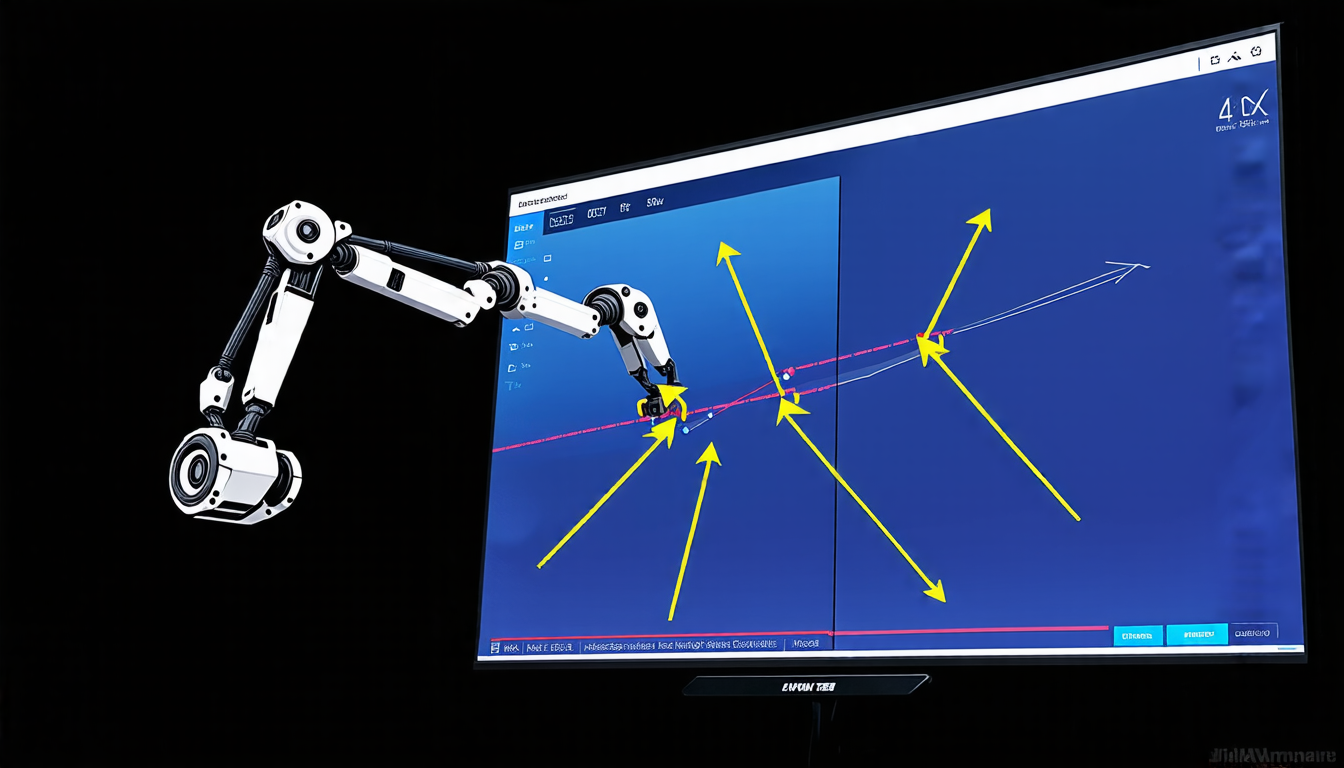
The quest for more efficient and accurate point tracking in videos has led researchers to develop innovative solutions, but a new approach takes it to the next level by injecting temporal awareness directly into feature backbones. This technique, dubbed Chrono, offers significant improvements over existing methods without relying on costly iterative refinement.
Point tracking is a fundamental task in computer vision, with applications ranging from robotics and video editing to medical imaging and surveillance. However, accurately identifying and following specific points across frames can be challenging due to complex motions, occlusions, and deformations. Traditional methods often employ simpler feature backbones trained from scratch on synthetic data, which may limit their robustness in real-world scenarios.
Chrono, developed by a team of researchers, tackles this issue by integrating temporal adapters into pre-trained DINOv2 representations. This approach enables the feature backbone to capture long-term contextual information, allowing it to better understand the relationships between points across frames. By doing so, Chrono achieves state-of-the-art performance in point tracking without relying on extensive iterative refinement or test-time optimization.
One of the key benefits of Chrono is its ability to reduce inference time while maintaining accuracy. This is achieved by injecting temporal information directly into the feature backbone, eliminating the need for costly post-processing steps. In experiments, Chrono demonstrated a significant boost in performance compared to vanilla DINOv2, making it a more efficient and effective solution for point tracking.
Another notable aspect of Chrono is its ability to produce temporally smooth representations over time. This is evident in visualizations of the feature output, which show consistent and fine-grained detail within semantic objects. This level of granularity is crucial for accurate point tracking, as it allows the model to better distinguish between similar points and maintain a robust understanding of their relationships.
Chrono’s architecture consists of several key components. The pre-trained DINOv2 backbone serves as the foundation, providing a rich representation of visual features. The temporal adapter injects long-term contextual information into this representation, enabling the feature backbone to capture complex spatiotemporal relationships. This fusion of spatial and temporal information allows Chrono to accurately track points across frames.
The researchers evaluated Chrono on several benchmark datasets, including TAP-VID-DAVIS and TAP-VID-Kinetics. Their results showed that Chrono outperformed existing state-of-the-art methods in terms of accuracy and efficiency, demonstrating its potential for real-world applications.
Cite this article: “Chrono: A Temporally Aware Point Tracking Method”, The Science Archive, 2025.
Point Tracking, Computer Vision, Video Analysis, Temporal Awareness, Feature Backbone, Dinov2, Chrono, Robotics, Medical Imaging, Surveillance





