

Thursday 23 January 2025
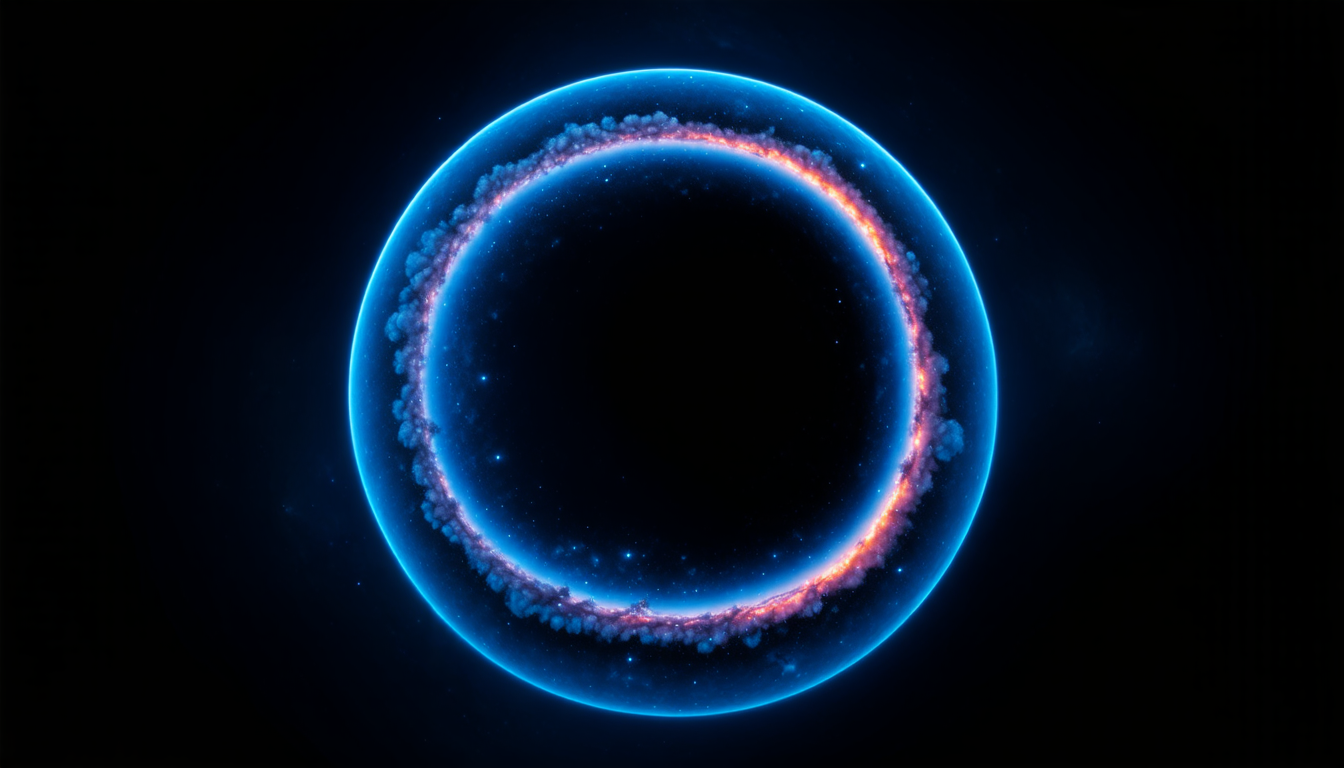
A team of astronomers has shed new light on the mysterious Ring Nebula, a stunning celestial wonder that has fascinated scientists for centuries. Using the Submillimeter Array (SMA), researchers have created the most detailed map yet of the nebula’s molecular envelope, revealing a complex and dynamic structure that challenges our understanding of how these objects form.
The Ring Nebula, also known as NGC 6720, is a planetary nebula – the glowing remains of a star that has exhausted its fuel and shed its outer layers. Located about 782 light-years from Earth, it’s one of the most studied objects in the night sky. But despite extensive research, much remains unknown about this enigmatic nebula.
The SMA observations have revealed a triaxial ellipsoid shape for the molecular envelope, with an elongated axis that points towards the central star. The data also show that the gas is not evenly distributed, but instead forms a series of clumps and knots that are moving at different velocities.
This complex structure suggests that the Ring Nebula may have formed through a two-stage process, involving the ejection of material by the star before its final explosion. The observed velocity patterns could be indicative of fast-moving gas streaming out from the star’s polar regions, shaping the nebula into its distinctive ring-like shape.
The findings also support the idea that planetary nebulas are not just static objects, but rather dynamic systems that continue to evolve over time. This challenges our traditional view of these objects as simple remnants of stellar evolution, and instead suggests a more complex and interactive process involving the star, its companion stars, and the surrounding environment.
The study’s authors note that their results have significant implications for our understanding of planetary nebulas and their role in shaping the universe. By studying these objects in greater detail, scientists can gain insights into the final stages of stellar evolution, as well as the complex interactions between stars and their surroundings.
In the coming years, researchers will continue to probe the mysteries of the Ring Nebula using a range of astronomical tools. With each new discovery, our understanding of this enigmatic object grows, revealing a more nuanced and dynamic picture of the cosmos.
Cite this article: “Unraveling the Mysteries of the Ring Nebula”, The Science Archive, 2025.
Ring Nebula, Planetary Nebula, Submillimeter Array, Sma, Molecular Envelope, Triaxial Ellipsoid, Star Formation, Stellar Evolution, Dynamic Systems, Astronomical Research





