

Wednesday 12 March 2025
Puzzle games have long been a staple of human entertainment, from ancient Egyptian board games to modern mobile apps. But beneath their engaging surfaces, these puzzles often hide complex mathematical problems waiting to be solved. Two recent studies have delved into the intricacies of such puzzles, shedding light on the intricate dance between gravity and computational complexity.
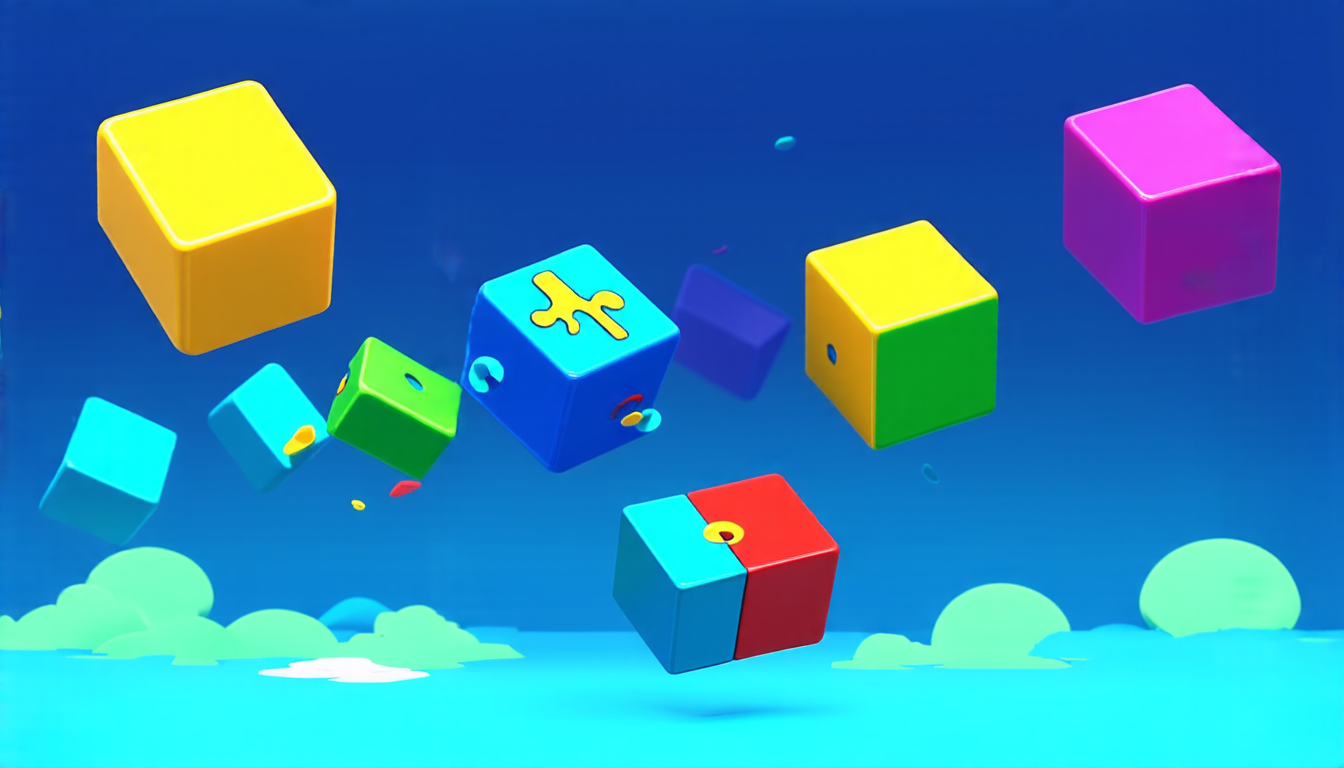
Jelly-No and Hanano are two popular puzzle games that challenge players to navigate colourful blocks across a dynamic board. Sounds simple enough, but beneath their deceptively straightforward gameplay lies a web of mathematical complexity. Researchers have long sought to understand the underlying maths behind these puzzles, and recent breakthroughs have shed new light on their inner workings.
One of the key findings is that Jelly-No, with its seemingly endless variety of block colours, is actually PSPACE-complete – a fancy way of saying it’s extremely difficult to solve using traditional computer algorithms. This has significant implications for our understanding of computational complexity, as it highlights the intricate interplay between gravity and problem-solving.
Hanano, on the other hand, is NP-hard even with just one colour – a remarkable feat considering its relative simplicity compared to Jelly-No. This discovery raises questions about the relationship between puzzle complexity and game design. Are some puzzles inherently more difficult than others due to their underlying math, or can clever game design be used to mask these complexities?
The studies’ findings have far-reaching implications for our understanding of computation and problem-solving. By examining the maths behind these popular puzzle games, researchers hope to develop new algorithms capable of tackling previously intractable problems. In turn, this could lead to breakthroughs in fields such as artificial intelligence, cryptography, and even biology.
But what does this mean for the average player? Simply put, it means that the next time you pick up Jelly-No or Hanano, you’re not just solving a simple puzzle – you’re engaging with a complex web of mathematical concepts that have far-reaching implications. And who knows? You might just stumble upon a hidden solution that could change the face of computer science.
The beauty of these puzzles lies in their ability to bridge the gap between art and science, entertainment and mathematics. By exploring the intricacies of Jelly-No and Hanano, researchers are not only advancing our understanding of computation – they’re also creating new, innovative puzzle games that challenge and delight players around the world.
Cite this article: “The Math Behind the Blocks: Uncovering the Secrets of Puzzle Games”, The Science Archive, 2025.
Puzzle Games, Mathematics, Computational Complexity, Gravity, Jelly-No, Hanano, Algorithms, Artificial Intelligence, Cryptography, Biology, Problem-Solving, Computer Science.





