

Thursday 23 January 2025
A team of researchers has made a significant breakthrough in the field of microgrid operation control, introducing a new method for modeling dynamic power limits for energy storage units. Microgrids are small-scale power systems that can operate independently of the main grid, providing resilience and flexibility to critical infrastructure.
Traditionally, microgrid optimization schemes assume fixed power limits for energy storage units, such as batteries. However, this simplification does not accurately reflect the real-world behavior of lithium-ion batteries, which exhibit increasingly restrictive power limits as they approach their state-of-charge (SoC) boundaries. The new method uses convex polytopes to approximate these dynamic constraints, allowing for more accurate and efficient operation control.
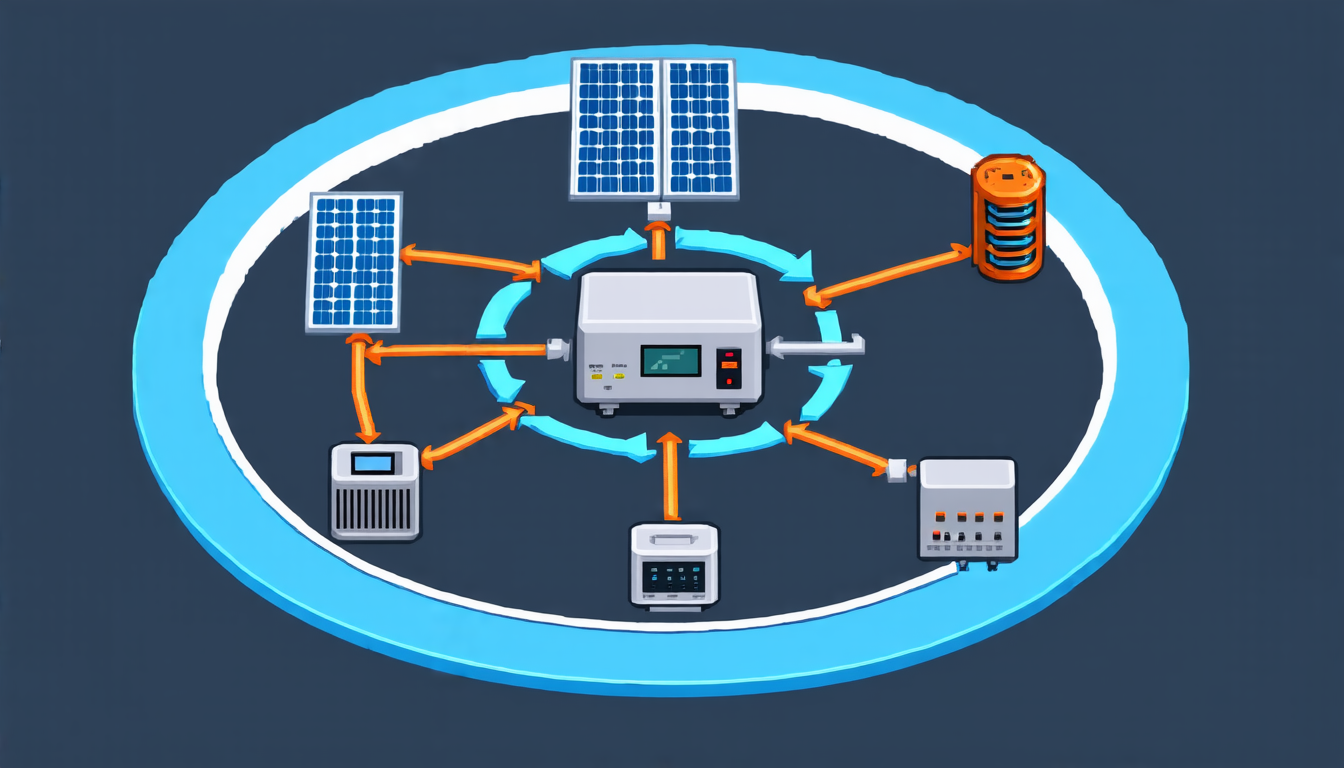
The researchers developed a prescient model predictive control (MPC) scheme that integrates the polytopic constraints into the optimization process. They tested this scheme in simulations of a stand-alone microgrid consisting of a fuel cell, photovoltaic generator, battery storage system, and load. The results showed that neglecting the dynamic power limits led to repeated constraint violations, potentially compromising the stability and reliability of the microgrid.
In contrast, the MPC scheme with polytopic constraints ensured safe and reliable operation, with no constraint violations observed during the simulation period. This achievement highlights the importance of considering dynamic power limits in microgrid optimization schemes, particularly when dealing with lithium-ion batteries.
The researchers’ work has significant implications for the development of future energy systems. As the world transitions to a more decentralized and renewable-based energy landscape, microgrids will play an increasingly important role in providing reliable and resilient power supply. The ability to accurately model and control dynamic power limits will be crucial for ensuring the safe and efficient operation of these systems.
The study’s findings also underscore the importance of considering the interplay between different components within a microgrid. By integrating the polytopic constraints into the MPC scheme, the researchers demonstrated that it is possible to develop more sophisticated and effective control strategies that take into account the complex interactions between various system elements.
As the energy sector continues to evolve, this research will likely have far-reaching consequences for the development of next-generation energy systems.
Cite this article: “Advanced Modeling of Dynamic Power Limits in Microgrid Operation Control”, The Science Archive, 2025.
Microgrid, Energy Storage, Power Limits, Lithium-Ion Batteries, State-Of-Charge, Model Predictive Control, Polytopes, Optimization Schemes, Renewable Energy, Decentralized Systems





