

Thursday 23 January 2025
The art of robot formation control has long been a fascinating topic in the world of robotics and artificial intelligence. Recently, researchers have made significant strides in developing novel methods for directing groups of robots to form precise configurations while relying solely on bearing measurements between agents.
One of the most significant challenges in robot formation control is ensuring that the robots converge to the desired configuration despite uncertainties and potential disturbances in their environment. Traditional approaches often rely on complex algorithms and precise distance measurements, which can be difficult to implement in real-world scenarios.
To address this issue, researchers have turned to directed graphs, a mathematical framework used to model relationships between agents. By carefully designing these graph structures, scientists have been able to develop more efficient and robust control strategies that rely solely on bearing measurements.
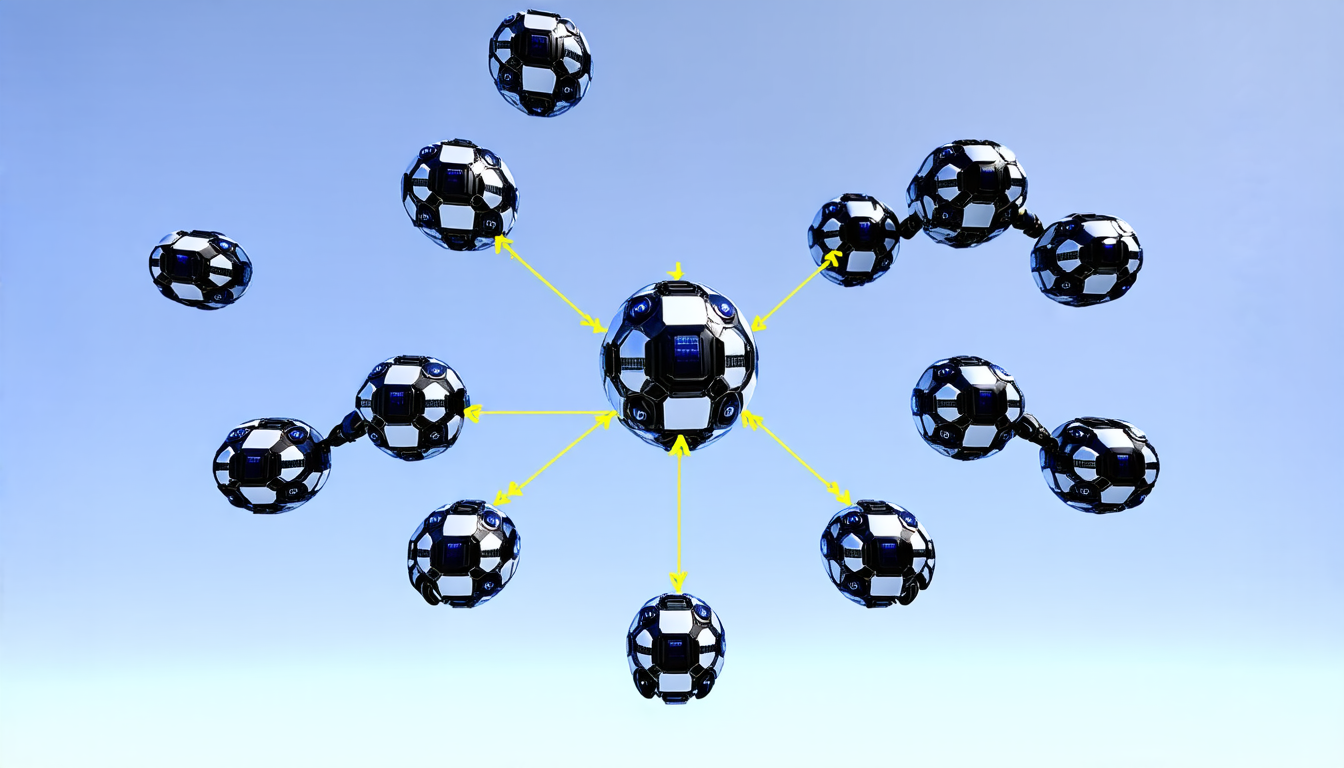
In recent years, the concept of leader-first follower (LFF) structures has emerged as a particularly promising approach for robot formation control. In this setup, one agent acts as the leader, while others follow its movements in a hierarchical manner. By carefully designing the LFF structure, researchers have been able to demonstrate remarkable stability and precision in robot formation control.
The latest breakthrough in this field involves extending the traditional LFF framework to include ordered leader-first follower (OLFF) graphs. In these structures, additional forward edges are added between agents, allowing for more complex formations and improved robustness.
Researchers have demonstrated that OLFF graphs can lead to faster convergence rates and improved stability in robot formation control. This is particularly significant when dealing with large groups of robots or those operating in dynamic environments.
One of the most impressive aspects of this research is its potential applications. Imagine a swarm of drones working together to monitor environmental pollution, or a team of autonomous vehicles coordinating their movements for efficient delivery routes. The possibilities are endless, and the ability to control these formations with precision and reliability could revolutionize various industries.
In addition to its practical implications, this research also highlights the fascinating mathematical concepts underlying robot formation control. By exploring the properties of directed graphs and bearing rigidity theory, scientists can develop more sophisticated algorithms for controlling complex systems.
As researchers continue to push the boundaries of robot formation control, it will be exciting to see how these novel approaches are applied in real-world scenarios. With the potential to transform industries such as transportation, agriculture, and environmental monitoring, this technology has far-reaching implications that could change the face of robotics forever.
Cite this article: “New Frontiers in Robot Formation Control”, The Science Archive, 2025.
Robot Formation Control, Directed Graphs, Leader-First Follower, Ordered Leader-First Follower, Bearing Measurements, Robot Swarm, Autonomous Vehicles, Environmental Monitoring, Transportation, Agriculture





