

Wednesday 12 March 2025
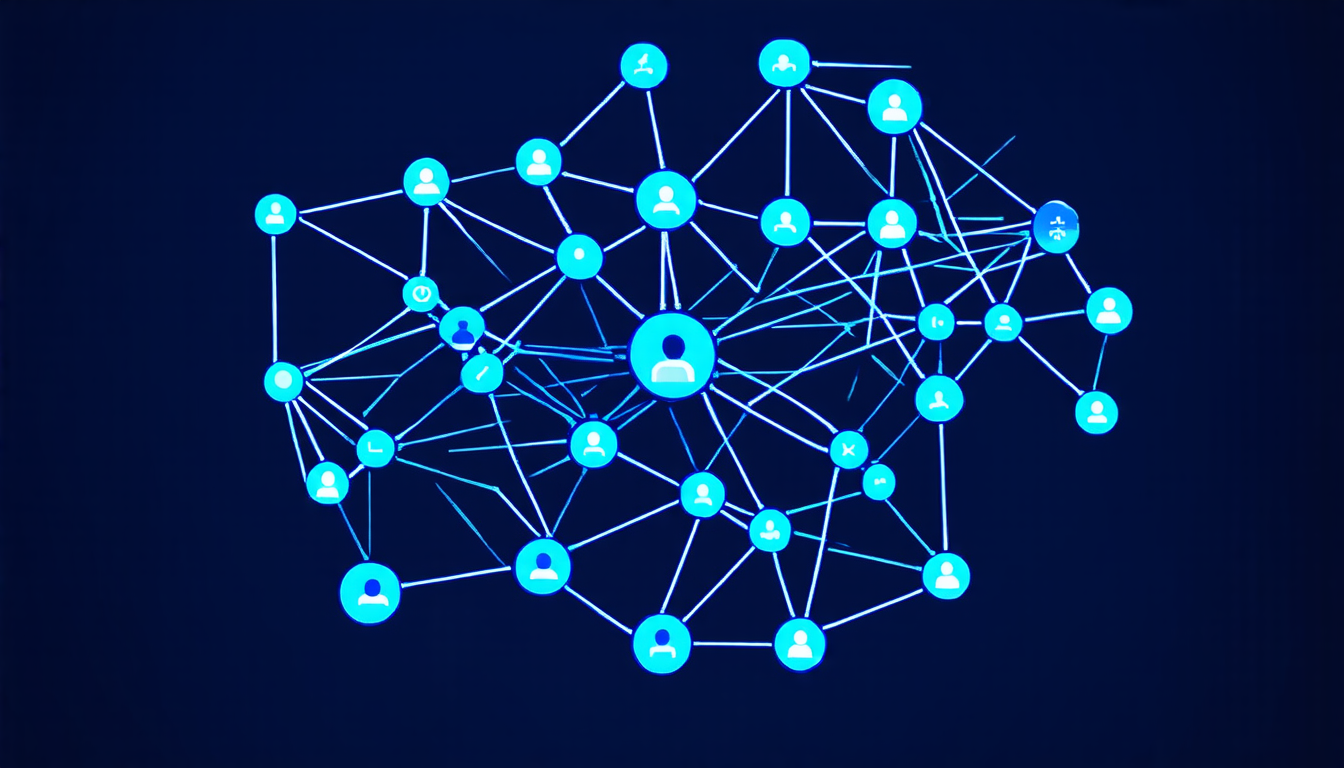
A new approach to community detection in complex networks has been proposed, offering a simpler and more effective way to identify groups of nodes that are closely connected within a network.
Complex networks, such as social media platforms or biological systems, are made up of countless connections between individual entities. Identifying communities within these networks is crucial for understanding how they function and making predictions about their behavior. However, traditional methods for community detection can be time-consuming and prone to errors.
The new approach uses a combination of graph convolutional networks (GCNs) and modularity maximization to identify communities in complex networks. GCNs are a type of deep learning algorithm that can learn node representations from structural information in the network. Modularity maximization is an optimization technique that aims to maximize the number of edges within communities while minimizing the number of edges between them.
In traditional community detection methods, modularity maximization is often used as a post-processing step after identifying candidate communities using other algorithms. However, this approach can be slow and computationally expensive. The new method integrates GCNs and modularity maximization into a single framework, allowing for faster and more accurate community detection.
The authors of the study tested their approach on several benchmark datasets and compared it to existing methods. They found that their approach outperformed traditional methods in terms of speed and accuracy, and was able to identify communities with high precision and recall.
One of the key advantages of the new method is its ability to handle large-scale networks with ease. Traditional methods can become computationally expensive when dealing with very large networks, but the integrated GCN-modularity maximization framework is designed to scale efficiently.
The study has implications for a wide range of fields, from social network analysis and epidemiology to biology and computer science. By providing a faster and more accurate way to identify communities in complex networks, researchers can gain deeper insights into how these systems function and make better predictions about their behavior.
In addition to its practical applications, the new method also sheds light on the fundamental properties of community detection in complex networks. The authors show that the integrated GCN-modularity maximization framework is able to capture subtle patterns and structures in the network that are not visible to traditional methods.
Overall, the study offers a significant advancement in community detection for complex networks, with potential applications across a wide range of fields. By providing a faster and more accurate way to identify communities, researchers can gain new insights into how these systems function and make better predictions about their behavior.
Cite this article: “Community Detection in Complex Networks: A Faster and More Accurate Approach”, The Science Archive, 2025.
Community Detection, Complex Networks, Graph Convolutional Networks, Modularity Maximization, Deep Learning, Social Network Analysis, Epidemiology, Biology, Computer Science, Machine Learning.





