

Wednesday 12 March 2025
Scientists have made a significant breakthrough in developing a new technology that could help us detect high-energy neutrinos, elusive particles that can travel long distances through space and water. These particles are of great interest to scientists because they can provide valuable insights into some of the most fundamental questions about the universe.
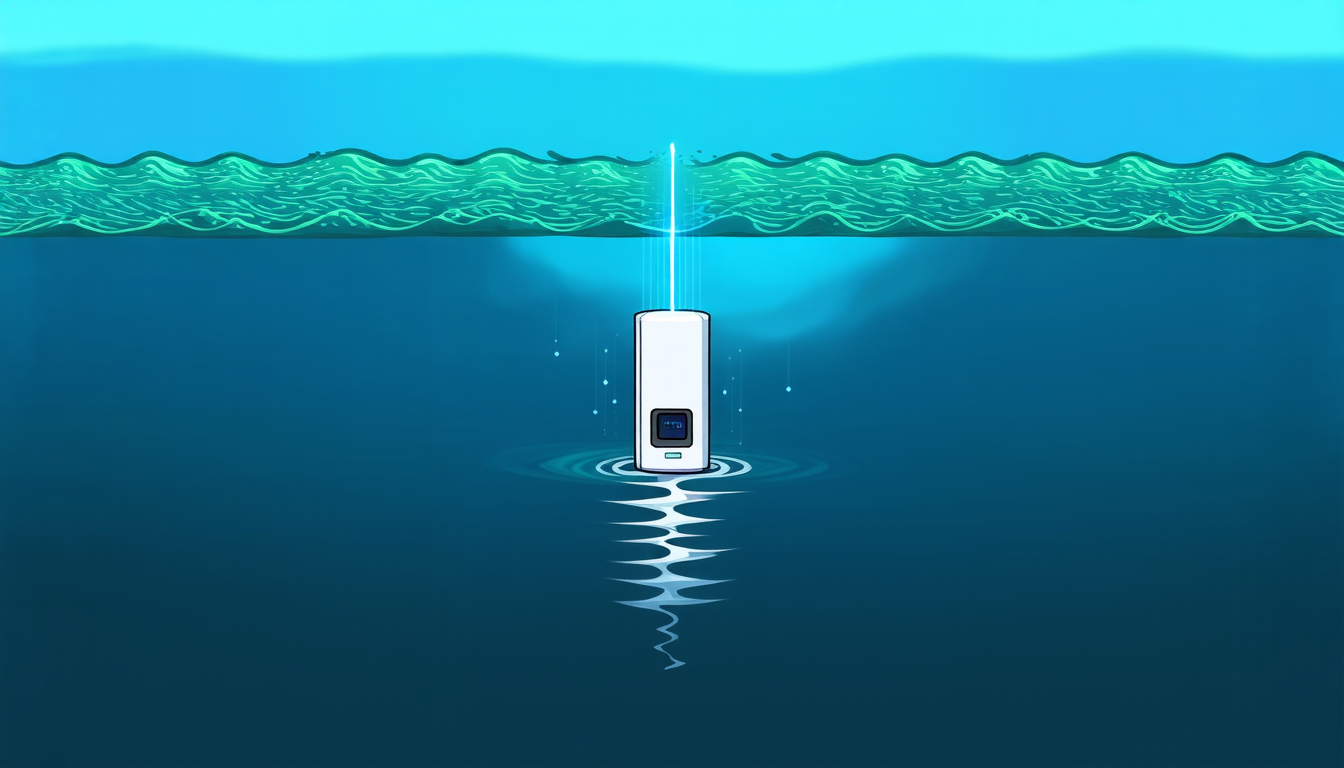
To detect these neutrinos, researchers have created a device called a fiber laser hydrophone, which is essentially a highly sensitive microphone that uses light instead of sound waves to detect changes in pressure caused by neutrino interactions. The device consists of a thin membrane attached to an optical fiber, which detects the tiny vibrations caused by neutrino collisions.
The team tested their device in a controlled environment and found that it was able to detect these subtle vibrations with remarkable accuracy. They were even able to measure the frequency and amplitude of the signals, which is crucial for understanding the properties of neutrinos.
One of the key challenges in developing this technology was ensuring that the device could withstand the extreme pressure conditions found deep in the ocean. To address this issue, researchers implemented a static pressure compensation mechanism, which allows the device to maintain its sensitivity even at depths of over 1 kilometer.
The team also tested the device’s performance in anechoic basin, a specialized tank designed to mimic the acoustic properties of the ocean. They found that the device was able to detect signals with remarkable accuracy, even in the presence of ambient noise.
The implications of this technology are significant. By detecting high-energy neutrinos, scientists could gain valuable insights into some of the most fundamental questions about the universe, such as the origins of matter and energy. Moreover, this technology has the potential to revolutionize our understanding of particle physics and potentially lead to new discoveries in fields like astrophysics and cosmology.
The next step is to deploy this technology in a large-scale neutrino telescope, which would allow scientists to detect neutrinos from distant sources such as supernovae or gamma-ray bursts. This could provide a new window into the universe, allowing us to study phenomena that are currently beyond our reach.
Overall, this breakthrough has the potential to open up new avenues for scientific discovery and could have significant implications for our understanding of the universe.
Cite this article: “Detecting High-Energy Neutrinos with Revolutionary Fiber Laser Hydrophone Technology”, The Science Archive, 2025.
Neutrinos, Detection, Fiber Laser Hydrophone, High-Energy Particles, Particle Physics, Astrophysics, Cosmology, Ocean, Pressure Compensation, Neutrino Telescope





