

Thursday 13 March 2025
A new approach has been developed for studying the dynamics of dwarf galaxies, which are small, irregularly shaped galaxies that orbit larger ones like our own Milky Way. These galaxies are of great interest to astronomers because they can provide insights into the formation and evolution of the universe.
Traditionally, researchers have relied on observing the motion of stars within these galaxies to understand their internal structure and dynamics. However, this method is limited by the fact that it only provides a snapshot of the galaxy’s current state, rather than its past or future behavior.
The new approach, described in a recent study, uses computer simulations to model the evolution of dwarf galaxies over time. This allows researchers to study not just the current motion of stars within the galaxy, but also how they moved in the past and will move in the future.
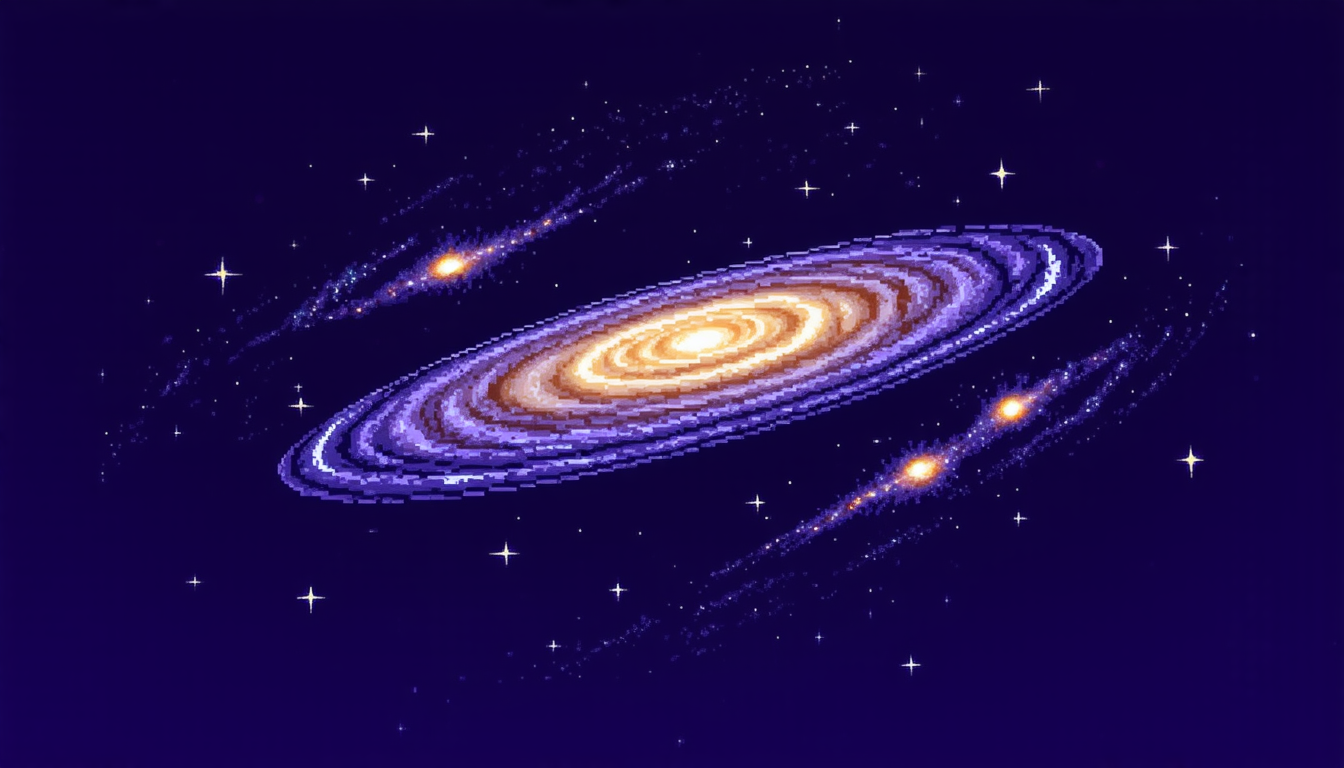
One of the key challenges facing astronomers is understanding how these small galaxies are affected by their larger neighbors. For example, as a dwarf galaxy orbits its parent galaxy, it may experience tidal forces that distort its shape or even cause it to tear apart.
The new simulations take into account these external influences, allowing researchers to study the long-term evolution of dwarf galaxies in unprecedented detail. This can provide valuable insights into how they form and evolve over time, as well as how they interact with their surroundings.
One of the key findings of the study is that even small galaxies like NGC205, which orbits our own Milky Way, can exhibit complex dynamics. For example, the galaxy’s motion may be influenced by its orbit around the larger parent galaxy, rather than just its internal structure.
The simulations also suggest that the shape and size of dwarf galaxies can change significantly over time due to external influences. For example, a galaxy that is currently spherical in shape may become more elongated as it orbits its parent galaxy.
The new approach has many potential applications beyond the study of dwarf galaxies. It could be used to model the evolution of larger galaxies like our own Milky Way, or even entire galaxy clusters.
Overall, the development of this new approach represents an important step forward in our understanding of the dynamics and evolution of small galaxies. By providing a more detailed and nuanced picture of their behavior over time, it has the potential to revolutionize our understanding of these fascinating objects.
Cite this article: “Unveiling the Dynamics of Dwarf Galaxies”, The Science Archive, 2025.
Galaxies, Dynamics, Simulations, Dwarf Galaxies, Computer Models, Galaxy Evolution, Tidal Forces, Star Motion, Orbital Behavior, Astronomy





