

Thursday 13 March 2025
A team of researchers has made a significant breakthrough in the field of mathematics education, developing a new method for constructing balanced task sets that assess students’ ability to compute derivatives. The approach, which leverages graph theory and combinatorial design principles, offers a more efficient and effective way to evaluate student understanding of complex mathematical concepts.
The traditional method of teaching calculus involves assigning tasks that focus on specific skills, such as computing derivatives or integrals. However, this approach can be limiting, as it doesn’t provide a comprehensive view of students’ abilities. A balanced task set, on the other hand, would combine different skills and problem types to give teachers a more complete picture of student proficiency.
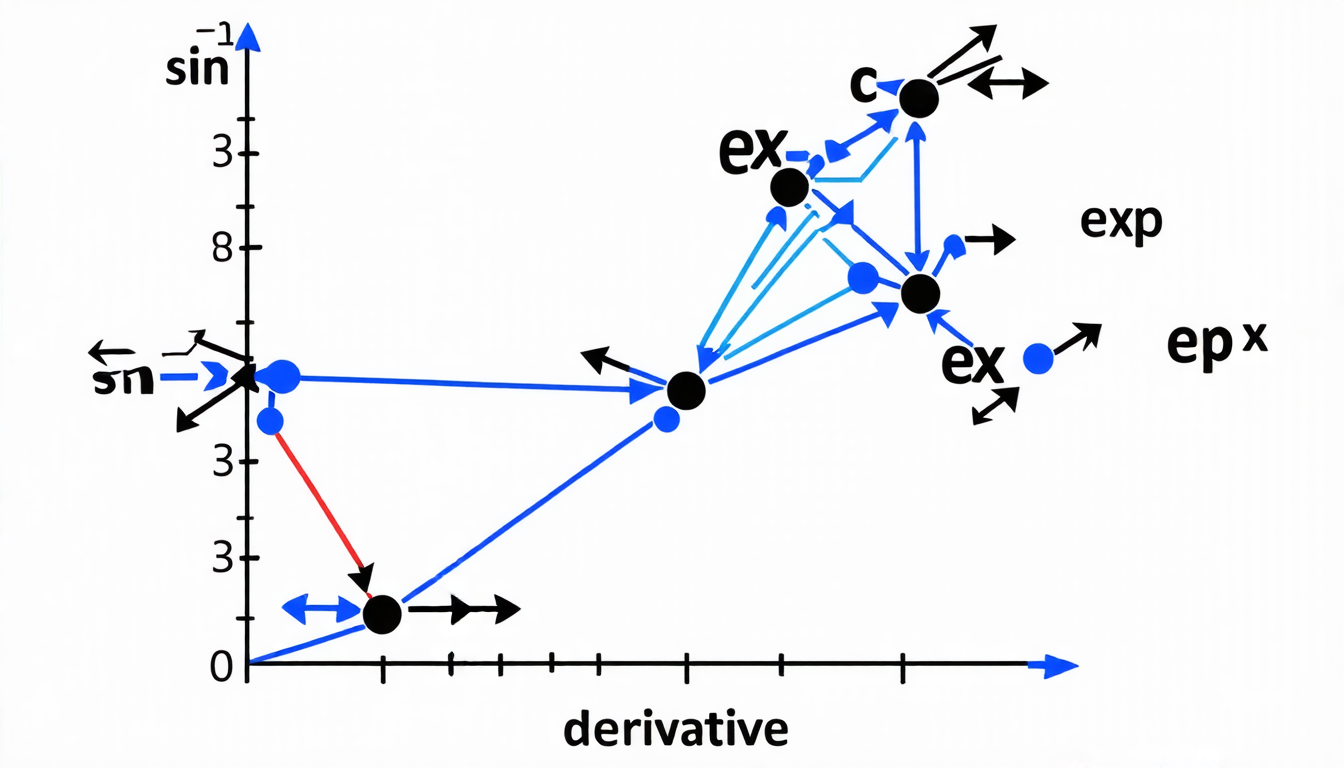
The researchers developed a novel method for constructing these balanced task sets by decomposing the complete directed graph into non-Hamiltonian paths. This decomposition process allows them to create task sets that are not only balanced but also varied and challenging. The resulting task sets can be used to assess students’ ability to compute derivatives of different functions, including trigonometric, exponential, and logarithmic functions.
One of the key advantages of this approach is its scalability. As the number of tasks increases, the researchers’ method allows them to efficiently generate balanced task sets that are tailored to specific student populations. This makes it an attractive solution for large-scale educational programs or online learning platforms.
The authors also demonstrated the effectiveness of their approach by generating a range of task sets with varying levels of difficulty. These task sets were then used to assess students’ ability to compute derivatives, and the results showed that the balanced task sets provided a more accurate measure of student proficiency than traditional methods.
This breakthrough has significant implications for mathematics education, as it offers a new way to evaluate student understanding and identify areas where additional support is needed. By providing teachers with a more comprehensive view of students’ abilities, this approach can help improve learning outcomes and better prepare students for advanced mathematical studies.
The researchers’ method also highlights the potential benefits of interdisciplinary collaboration between mathematicians and educators. By combining insights from graph theory and combinatorial design with knowledge of mathematics education, they were able to develop a novel solution that addresses a longstanding challenge in calculus instruction.
As educators continue to seek innovative ways to improve student learning outcomes, this breakthrough offers a promising new approach for assessing student proficiency in calculus. By leveraging the power of graph theory and combinatorial design principles, researchers can create more effective and efficient methods for evaluating student understanding and identifying areas where additional support is needed.
Cite this article: “Balanced Task Sets for Calculus Education: A Graph Theory Approach”, The Science Archive, 2025.
Mathematics Education, Calculus, Graph Theory, Combinatorial Design, Task Sets, Derivatives, Student Assessment, Learning Outcomes, Educational Programs, Online Learning Platforms.
Reference: Haile Gilroy, “On the Existence of Balanced Chain Rule Task Sets” (2025).





