

Thursday 13 March 2025
Scientists have made a fascinating discovery in the field of superconductivity, uncovering an unexpected phase transition in a type of material known as a kagome metal. The findings, published in a recent study, reveal that these metals can exhibit unusual behavior when subjected to strong magnetic fields.
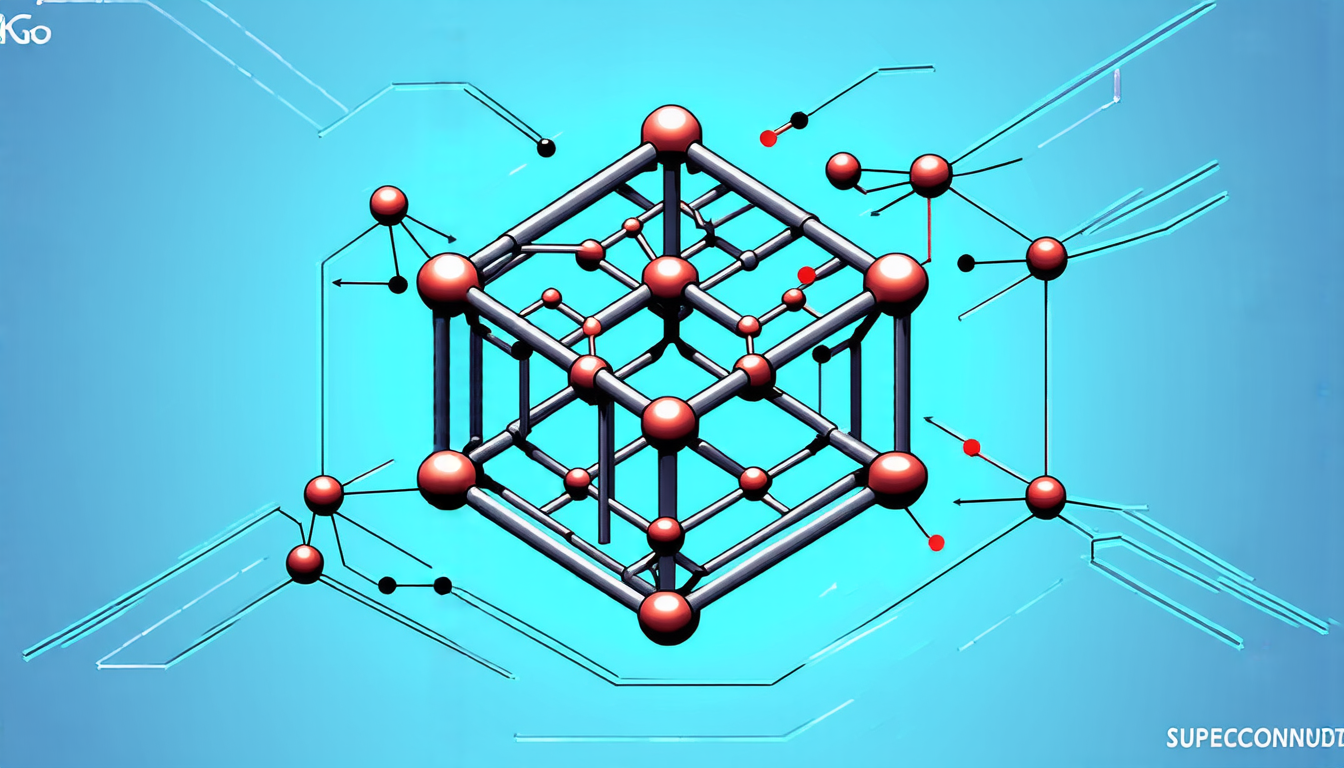
The research focuses on a specific compound called KV3Sb5, which is made up of potassium, vanadium, and antimony atoms arranged in a unique lattice structure known as the kagome pattern. This arrangement creates a fascinating interplay between the material’s electronic properties and its crystal structure.
When cooled to extremely low temperatures, KV3Sb5 exhibits superconductivity, meaning it can conduct electricity with zero resistance. However, under strong magnetic fields, the material undergoes a surprising phase transition, where its electrical resistance increases dramatically. This is unusual because most materials would typically exhibit reduced resistance in response to an applied magnetic field.
The researchers used advanced techniques, including transport measurements and angle-resolved photoemission spectroscopy (ARPES), to study KV3Sb5 under different conditions. They found that the material’s electronic structure changes significantly during the phase transition, with the emergence of new electron and hole pockets.
These pockets are regions within the material’s energy landscape where electrons or holes can move freely. In KV3Sb5, the researchers discovered that the electron pockets are primarily composed of Sb pz orbitals, while the hole pockets arise from reconstructed portions of the vanadium kagome saddle points near the M-point.
The discovery has significant implications for our understanding of superconductivity and the behavior of materials under extreme conditions. The findings suggest that strong magnetic fields can induce novel electronic phases in certain materials, which could lead to new applications and technologies.
Moreover, the study highlights the importance of considering the interplay between a material’s electronic properties and its crystal structure. This interplay can give rise to unexpected phenomena, such as the phase transition observed in KV3Sb5.
The research team plans to continue exploring the properties of kagome metals under different conditions, aiming to uncover further secrets about their behavior and potential applications. As scientists delve deeper into the mysteries of these materials, they may uncover new avenues for advancing our understanding of superconductivity and developing innovative technologies.
Cite this article: “Unveiling Novel Electronic Phases in Kagome Metals Under Strong Magnetic Fields”, The Science Archive, 2025.
Superconductivity, Kagome Metal, Phase Transition, Magnetic Field, Electronic Structure, Arpes, Transport Measurements, Superconducting Materials, Quantum Phenomena, Materials Science





