

Thursday 13 March 2025
Scientists have made a significant breakthrough in developing a new method for simulating sound waves in complex environments, such as cities and buildings. This achievement has the potential to revolutionize our understanding of how sound propagates and interacts with its surroundings.
The researchers used a technique called Gaussian Beam Tracing (GBT) to model sound waves in three-dimensional spaces. GBT is an innovative approach that combines the power of computer simulations with the precision of mathematical calculations to accurately predict how sound behaves in different scenarios.
In traditional methods, simulating sound waves can be computationally intensive and time-consuming. However, the new approach utilizes graphics processing units (GPUs) to accelerate the calculation process, making it much faster and more efficient.
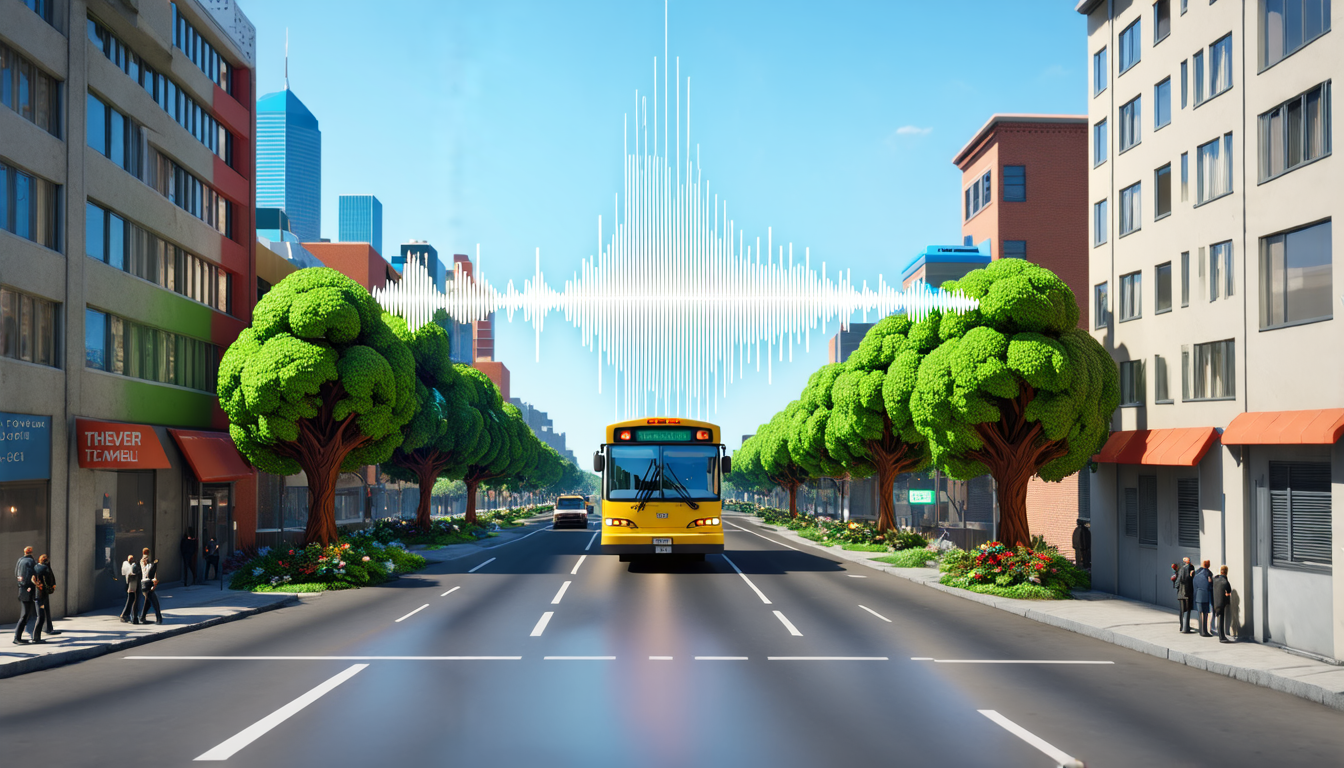
The team tested their method by simulating sound propagation in various environments, including city streets, buildings, and open spaces. They found that the GBT algorithm was able to accurately predict how sound waves scatter and reflect off different surfaces, creating a realistic representation of the acoustic environment.
One of the key advantages of this new method is its ability to handle large-scale simulations quickly and efficiently. This makes it an ideal tool for architects, urban planners, and environmental scientists who need to assess the impact of noise pollution on communities.
For example, the GBT algorithm can be used to design quieter buildings and cities by identifying areas where sound waves are more likely to scatter and reflect off surfaces. This information can then be used to optimize building designs and urban planning strategies to reduce noise levels and improve air quality.
The researchers also tested their method using real-world data from environmental monitoring stations, which showed a high degree of accuracy in predicting sound wave propagation. This suggests that the GBT algorithm could be used to monitor and mitigate the effects of noise pollution in real-time.
Overall, this breakthrough has significant implications for our understanding of how sound interacts with its environment and has the potential to revolutionize the field of acoustics. The ability to simulate complex acoustic environments quickly and accurately will have far-reaching benefits for a wide range of industries and applications.
Cite this article: “Accurate Sound Wave Simulation Breakthrough”, The Science Archive, 2025.
Sound Waves, Complex Environments, Gaussian Beam Tracing, Computer Simulations, Mathematical Calculations, Graphics Processing Units, Noise Pollution, Urban Planning, Acoustic Environment, Environmental Monitoring.





