

Thursday 13 March 2025
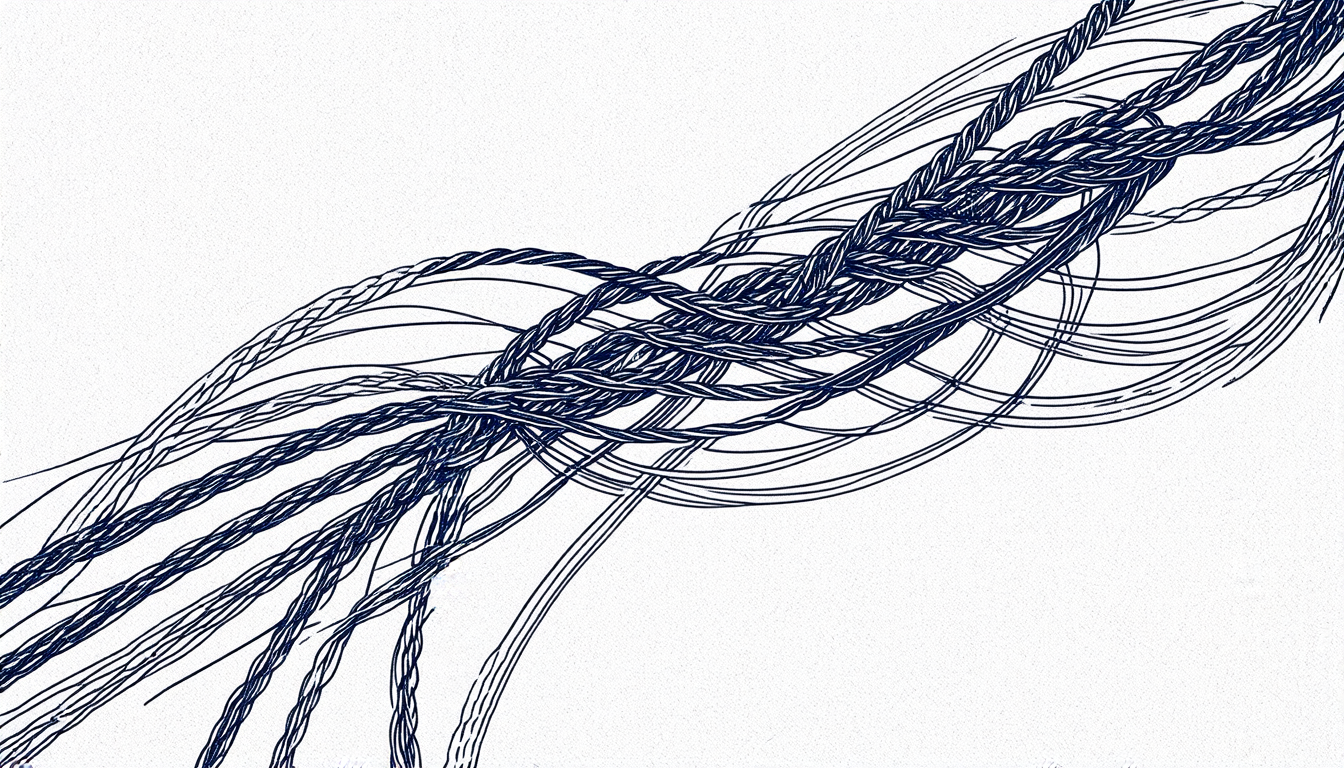
The study of braids has been a staple in mathematics for centuries, with mathematicians and physicists alike fascinated by the intricate patterns that can be created using strands of string or other flexible materials. Recently, researchers have made significant strides in understanding the properties of braids and their extensions to more complex structures.
One such extension is the singular braid monoid, which is a mathematical object that generalizes the concept of a braid group to include additional operations. This new structure has far-reaching implications for our understanding of knot theory and its applications in physics and engineering.
In recent years, researchers have made significant progress in classifying local representations of braids and their extensions to singular braid monoids. Local representations are a way of describing the properties of a mathematical object by analyzing how it behaves under different transformations. In the case of braids, this means studying how the strands of string move relative to each other.
The latest breakthrough in this field comes from researchers who have classified all non-trivial homogeneous 3-local representations of braids and their extensions to singular braid monoids for certain values of n. This is a significant achievement because it provides a deeper understanding of the properties of these mathematical objects and opens up new avenues for research.
One of the key findings is that there are eight distinct ways in which a braid can be represented as a local representation, each with its own unique set of properties. These representations can then be extended to singular braid monoids, allowing researchers to study more complex structures.
The implications of this work are far-reaching and could have significant impacts on our understanding of knot theory and its applications in physics and engineering. For example, the study of braids has long been used to model complex systems such as DNA molecules and protein structures. By extending these models to singular braid monoids, researchers may be able to gain new insights into the behavior of these systems.
Furthermore, the classification of local representations of braids and their extensions to singular braid monoids could also have implications for our understanding of quantum gravity. The study of quantum gravity is an active area of research that seeks to reconcile two major theories in physics: general relativity and quantum mechanics. By better understanding the properties of braids and their extensions, researchers may be able to gain new insights into the nature of space and time.
Overall, this latest breakthrough in the field of braid theory has significant implications for our understanding of mathematics and its applications in physics and engineering.
Cite this article: “Unlocking the Secrets of Braids: A Breakthrough in Mathematics and Physics”, The Science Archive, 2025.
Braids, Knot Theory, Singular Braid Monoids, Local Representations, Classification, Mathematics, Physics, Engineering, Quantum Gravity, Algebraic Geometry.





