

Thursday 13 March 2025
Scientists have long been fascinated by the behavior of granular materials, such as sand and soil, when subjected to temperature fluctuations. These materials can exhibit complex and counterintuitive properties, making them a challenge to study and understand.
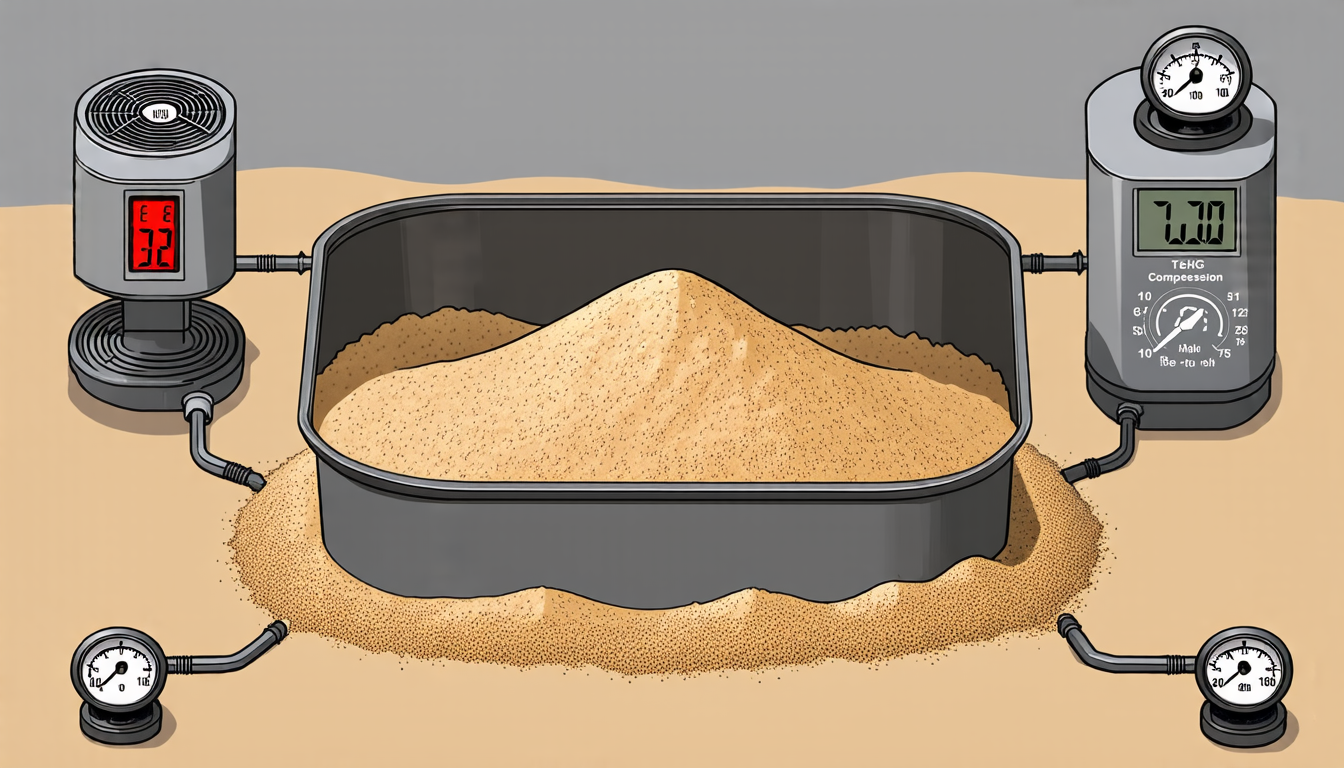
Researchers have recently made significant progress in understanding the compaction dynamics of granular materials under thermal cycling. In this process, the material is repeatedly heated and cooled, causing it to compress and expand in a predictable pattern. This behavior has been observed in various types of granular materials, from monodisperse glass beads to polydisperse sand.
One key finding is that the compaction dynamics of granular materials can be described using three different fitting models. These models are commonly used to analyze relaxation dynamics in disordered systems, such as glasses and polymers. The first model is the Kohlrausch-Williams-Watts (KWW) function, which describes the slow relaxation process as a system transitions from out-of-equilibrium toward equilibrium.
The second model is the double-exponential (D-exp) fitting, which suggests that the system’s relaxation behavior is governed by two independent processes occurring at different timescales. The third model is the logarithmic (log) fitting, which decays significantly more gradually than exponential models, particularly as the system is very close to its steady state.
These models were used to analyze the compaction dynamics of granular materials under thermal cycling, with surprising results. The researchers found that the compaction process exhibits characteristics similar to those observed in aging dynamics within glassy systems. In other words, the material’s relaxation behavior can be described using the same mathematical frameworks as those used to study glasses and polymers.
This discovery has significant implications for our understanding of granular materials and their behavior under thermal cycling. It suggests that these materials may exhibit universal properties that are not unique to any particular type of granular material or experimental setup. This finding could lead to new insights into the fundamental mechanisms underlying compaction dynamics, potentially allowing researchers to develop more accurate predictive models.
The study also highlights the importance of considering the container’s thermal expansion in experiments involving granular materials under thermal cycling. The researchers found that the differential thermal expansion between the container and the grains is the primary mechanism driving compaction, rather than internal grain deformation alone.
These findings have significant implications for a range of fields, from soil mechanics to engineering applications.
Cite this article: “Thermal Cycling Reveals Universal Properties in Granular Materials”, The Science Archive, 2025.
Granular Materials, Thermal Cycling, Compaction Dynamics, Kohlrausch-Williams-Watts Function, Double-Exponential Fitting, Logarithmic Fitting, Aging Dynamics, Glassy Systems, Universal Properties, Soil Mechanics





