

Thursday 13 March 2025
Scientists have made a major breakthrough in the field of quantum dots, tiny particles that have the potential to revolutionize technology. By patterning the surface of these particles, researchers have been able to create ordered arrays of quantum dots that can be used for a variety of applications.
Traditionally, quantum dots are grown on flat surfaces using a process called molecular beam epitaxy. However, this method has its limitations, as it’s difficult to control the size and shape of the dots. By patterning the surface with nanoscale holes, researchers have been able to create a template for the growth of the quantum dots.
The team used a technique called laser interference lithography to create the patterns on the surface. This method involves using a laser to create an interference pattern on the surface, which is then transferred onto the material. By adjusting the wavelength and intensity of the laser, researchers were able to control the size and shape of the holes.
Once the patterns were created, the team used a combination of ozone oxidation and chemical etching to transfer the patterns onto the surface of the quantum dots. This process allowed them to create arrays of quantum dots with precise control over their size and shape.
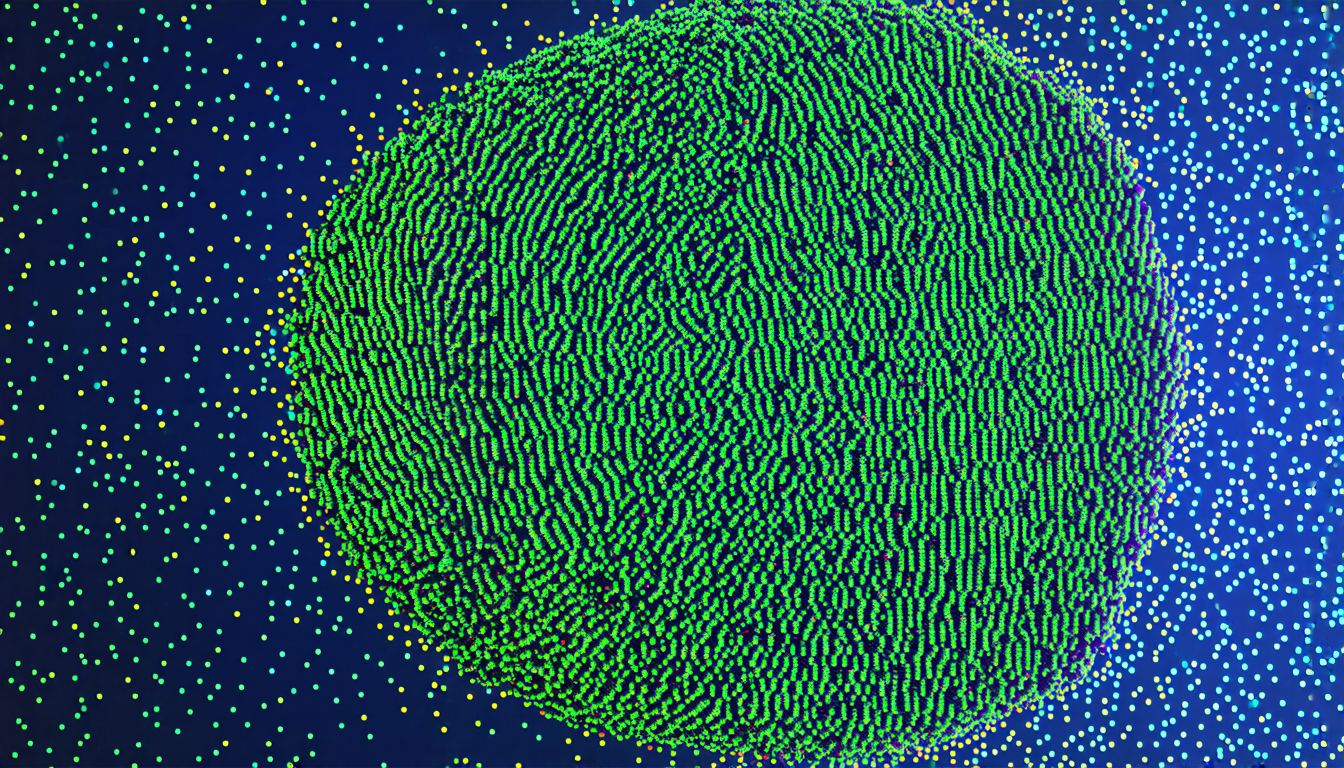
The results are impressive, with the team able to create arrays of quantum dots that are highly ordered and uniform. The dots themselves are also extremely small, measuring just a few nanometers in diameter.
This breakthrough has significant implications for the development of new technologies. Quantum dots have been shown to be incredibly versatile, and can be used for a wide range of applications, from solar cells to medical imaging devices.
One potential application is in the field of quantum computing. By creating arrays of highly ordered quantum dots, researchers may be able to create more efficient and reliable quantum computers.
Another area where this technology could have an impact is in the development of new types of solar cells. Quantum dots can be used to absorb light and convert it into electrical energy, making them a promising material for use in solar panels.
The team’s work also has implications for the field of medicine. Quantum dots can be used as contrast agents for medical imaging devices, allowing doctors to see inside the body with greater precision.
While this technology is still in its early stages, it has the potential to revolutionize a wide range of fields. The ability to create highly ordered arrays of quantum dots could lead to breakthroughs in everything from computing and energy to medicine and beyond.
The researchers are now working to refine their technique and explore new applications for this technology.
Cite this article: “Patterning Quantum Dots for Revolutionary Technologies”, The Science Archive, 2025.
Quantum Dots, Patterning, Surface Engineering, Nanotechnology, Laser Interference Lithography, Ozone Oxidation, Chemical Etching, Quantum Computing, Solar Cells, Medical Imaging.





