

Thursday 13 March 2025
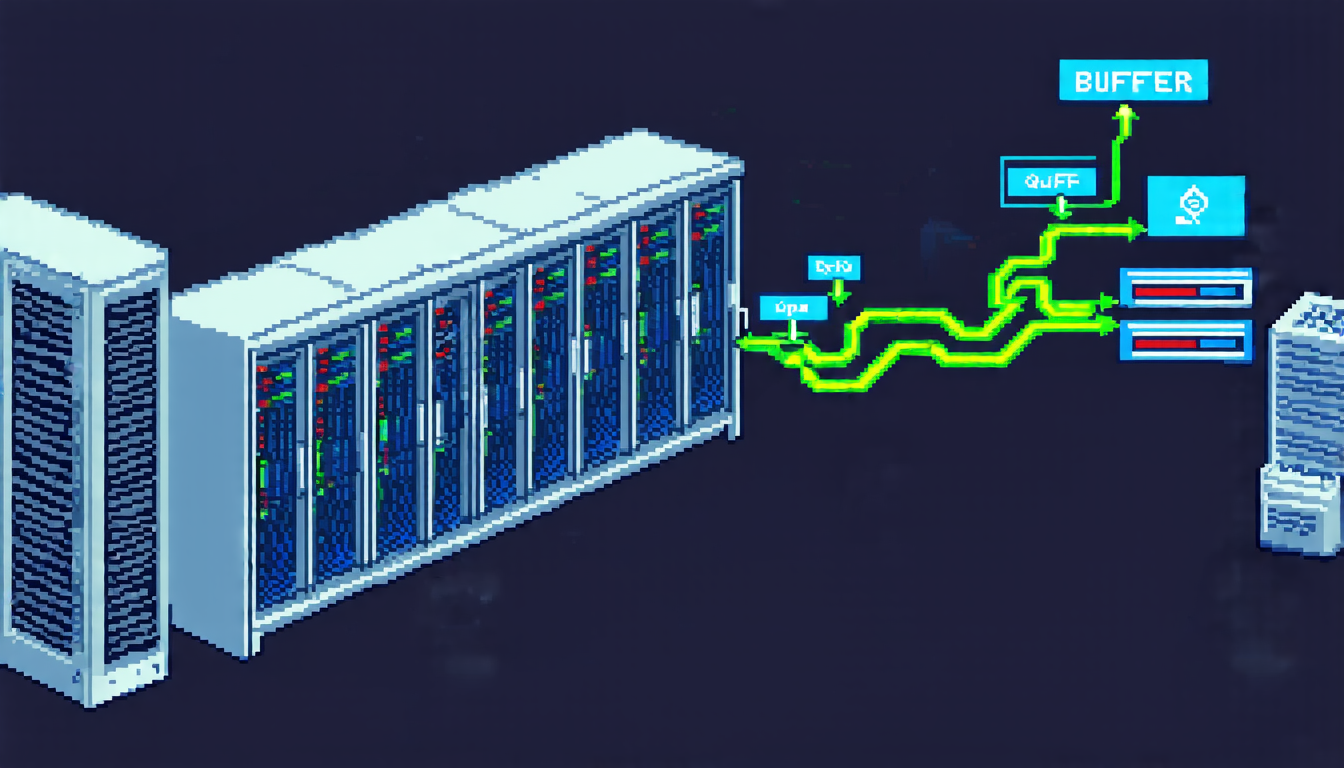
As our reliance on data centers grows, so too does the challenge of managing the massive amounts of traffic that flow through them. The latest innovation in this field is a new approach to buffer management, designed to help data centers absorb and process the intense bursts of traffic that are becoming increasingly common.
Buffer management refers to the way in which data centers allocate memory space to handle incoming traffic. In traditional systems, buffers are typically managed using a fixed threshold, where packets are either dropped or stored based on whether they exceed this threshold. However, as data centers continue to scale and traffic demands increase, this approach is no longer sufficient.
The new approach, developed by researchers at X University, takes a more dynamic approach to buffer management. Instead of relying on a fixed threshold, the system uses a preemptive mechanism that actively reallocates memory space in real-time to meet changing traffic demands. This allows data centers to absorb and process even the most intense bursts of traffic with greater efficiency.
The key innovation behind this approach is the use of redundant memory bandwidth. By harnessing this extra capacity, the system can quickly expel packets from over-allocated queues, making room for new arrivals and preventing congestion. This proactive approach helps to reduce packet loss and latency, ensuring that data centers can operate at maximum efficiency even under intense traffic loads.
The researchers behind this innovation have been working on developing more efficient buffer management strategies for several years. Their previous work focused on optimizing buffer allocation using machine learning algorithms, but these approaches were limited by their reliance on historical traffic patterns.
In contrast, the new preemptive mechanism is designed to adapt to real-time traffic conditions, making it better suited to modern data center environments where traffic demands are highly unpredictable. The system has been tested in a range of scenarios, from simple packet transmission to complex network simulations, and has shown significant improvements in terms of buffer utilization, packet loss rates, and overall network performance.
The implications of this innovation extend beyond the data center itself, as it has the potential to improve the reliability and efficiency of online services that rely on these networks. With the increasing demand for cloud computing, streaming services, and social media, the need for efficient and scalable buffer management strategies has never been greater.
As the data center landscape continues to evolve, it will be interesting to see how this innovation is adopted and built upon by other researchers and industry leaders.
Cite this article: “Dynamic Buffer Management: A Game-Changer for Data Centers”, The Science Archive, 2025.
Data Centers, Buffer Management, Traffic Demands, Memory Space, Preemptive Mechanism, Redundant Memory Bandwidth, Packet Loss, Latency, Machine Learning Algorithms, Network Performance.





