

Thursday 13 March 2025
Coherence is a fundamental property of light, describing how its various components are correlated with each other. In the context of optics, coherence is crucial for understanding the behavior of light in complex systems, such as optical fibers or imaging devices. A recent paper has shed new light on the role of coherence in shaping the properties of light beams.
The researchers focused on a specific type of light beam known as Schell-model sources, which are characterized by their Gaussian intensity profiles and general degree of coherence. These sources are widely used in applications such as optical communication systems or biomedical imaging. The team set out to investigate how the longitudinal coherence properties of these sources affect the behavior of light beams.
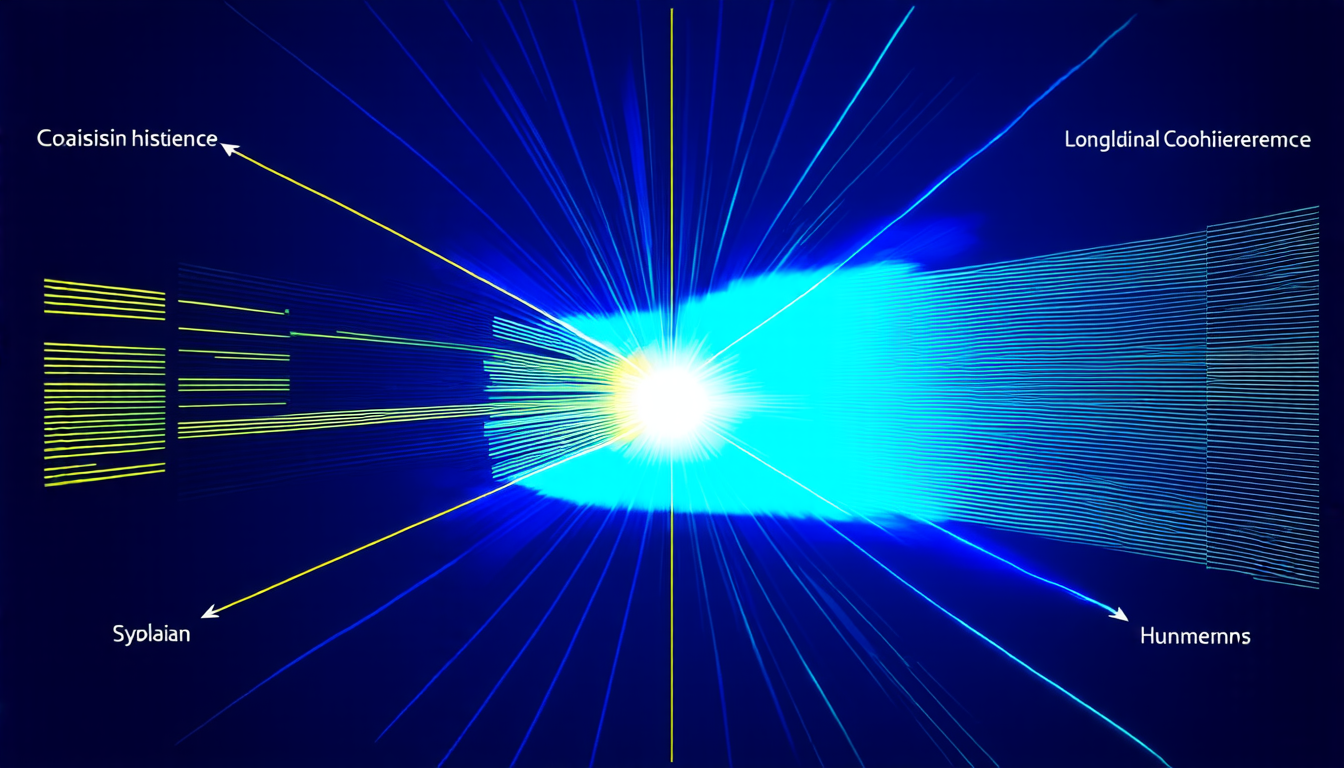
The researchers found that the longitudinal coherence length, a measure of how well-correlated light is over time, plays a crucial role in determining the intensity distribution along the axis of the beam. This property can be manipulated by adjusting the degree of coherence and the intensity profile of the source. The team demonstrated that increasing the degree of coherence leads to a more uniform intensity distribution, while decreasing it results in a more irregular pattern.
The study also explored the relationship between longitudinal coherence and the spatial coherence properties of light. Spatial coherence refers to how well-correlated light is across different points in space. The researchers found that the longitudinal coherence length affects the spatial coherence properties, with longer coherence lengths resulting in stronger correlations across space.
These findings have significant implications for various applications where light beams are used to image or manipulate objects. For instance, in optical imaging systems, the longitudinal coherence properties can be adjusted to enhance image resolution or reduce noise. In biomedical imaging techniques such as optical coherence tomography (OCT), the degree of coherence can be optimized to improve the accuracy of tissue characterization.
The study also has potential applications in fields like quantum optics and optical communication systems. By controlling the longitudinal coherence properties, researchers can manipulate the behavior of light beams in complex systems, enabling new possibilities for information transmission or manipulation.
Overall, this research provides a deeper understanding of the intricate relationships between coherence properties and the behavior of light beams. The findings have far-reaching implications for various fields where light is used to image, manipulate, or transmit information.
Cite this article: “Coherence Properties of Light Beams: New Insights and Applications”, The Science Archive, 2025.
Optics, Coherence, Light Beams, Schell-Model Sources, Longitudinal Coherence, Intensity Distribution, Spatial Coherence, Biomedical Imaging, Optical Communication Systems, Quantum Optics





