

Thursday 13 March 2025
A team of astronomers has been exploring a fascinating group of stars, known as hot subdwarfs, which are incredibly dense and have unusual properties. These stars are so dense that they would be crushed by their own gravity if they were only slightly larger.
The researchers used data from the Southern African Large Telescope (SALT) and the Transiting Exoplanet Survey Satellite (TESS) to study these hot subdwarfs. They focused on a particular type of hot subdwarf, known as hydrogen-deficient stars, which are characterized by having very little or no hydrogen in their atmospheres.
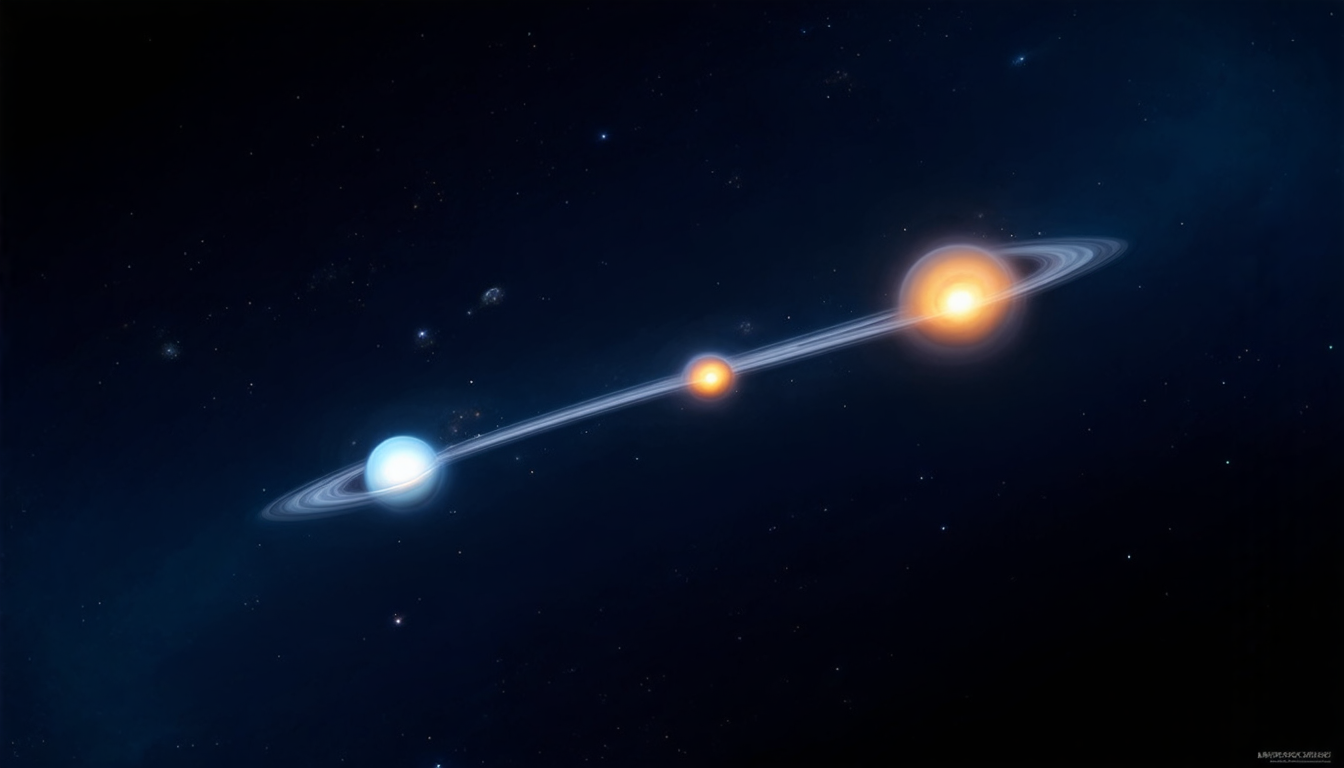
The team’s analysis revealed that about 3.5% of the hot subdwarfs they studied were part of close binary systems, where two stars orbit each other extremely closely. This is a significant finding, as it suggests that these dense stars may have formed through interactions with their companion stars.
One of the most interesting discoveries was the detection of periodic light curve variations in six of the hydrogen-deficient hot subdwarfs. These variations are thought to be caused by the stars’ companions, which can distort the shape of the star and cause it to pulsate.
The researchers also found that some of these stars have unusual properties, such as extremely high temperatures or strong magnetic fields. These properties could be related to their formation processes or the presence of a companion star.
The study provides new insights into the lives of hot subdwarfs and how they form and evolve. It highlights the importance of studying these stars in close binary systems, which can reveal clues about their origins and behaviors.
The findings also have implications for our understanding of the universe as a whole. Hot subdwarfs are thought to be remnants of ancient stars that have shed most of their material over billions of years. By studying these stars, scientists can gain insights into the early history of the universe and how it evolved over time.
Overall, this research is an important step forward in our understanding of hot subdwarfs and the complex processes that shape the universe. The study’s findings will likely continue to inspire further research and exploration of these fascinating stars.
Cite this article: “Unlocking the Secrets of Hot Subdwarfs: New Insights into Ancient Star Formation and Evolution”, The Science Archive, 2025.
Stars, Hot Subdwarfs, Binary Systems, Hydrogen-Deficient, Telescopes, Salt, Tess, Astronomy, Universe, Evolution





