

Thursday 13 March 2025
A team of researchers has made a significant breakthrough in understanding how electromagnetic waves behave in eccentric waveguides, which are crucial components in various technologies such as high-frequency optical circuits and electromagnetic sensors.
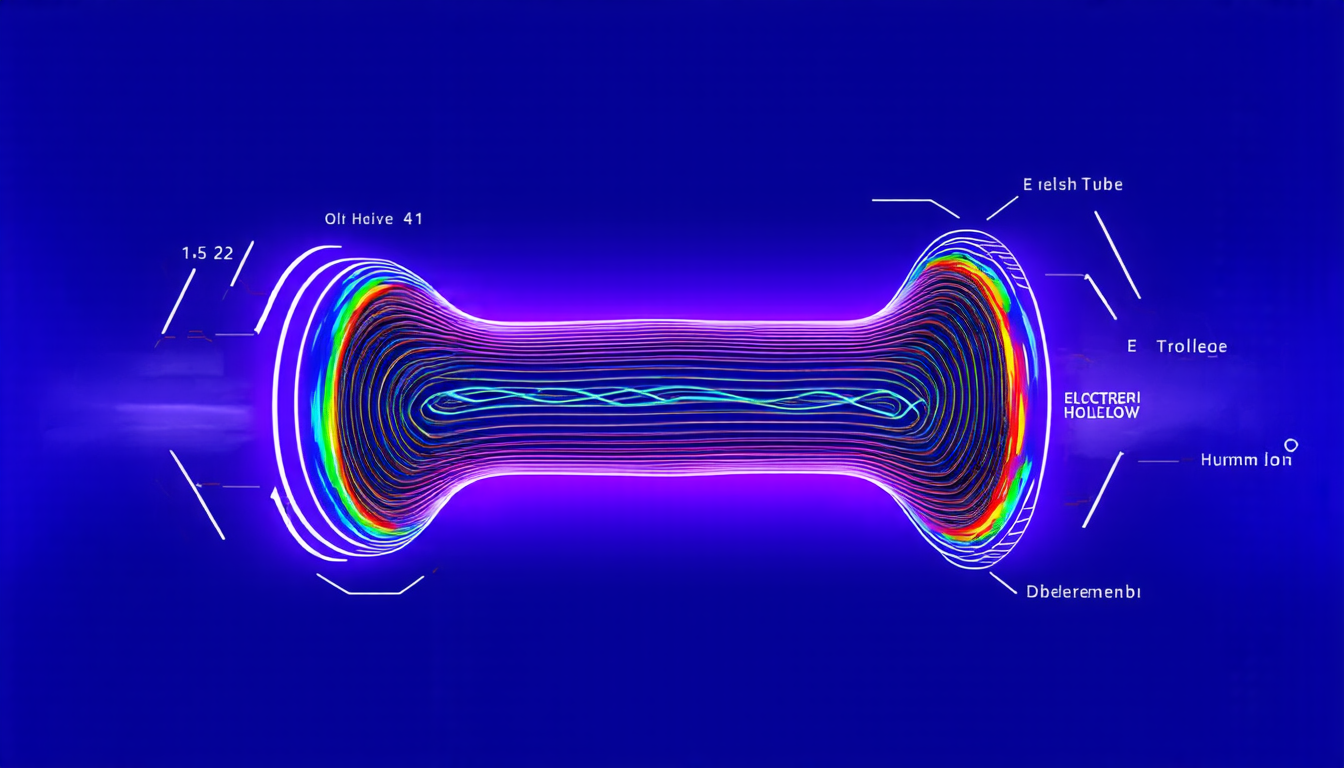
Eccentric waveguides are essentially hollow tubes that can transmit electromagnetic waves, but they are not perfectly circular. This irregular shape causes the waves to interact with the tube’s walls in complex ways, making it challenging to predict how they will propagate.
To tackle this problem, scientists have been using various methods, including perturbation-based techniques and conformal transformation optics. However, these approaches have limitations, such as only being applicable for small eccentricities or requiring complex mathematical calculations.
The new research presents a novel finite difference method that can accurately model electromagnetic waves in eccentric waveguides with arbitrary shapes and sizes. This approach is particularly useful for analyzing waveguides filled with lossy anisotropic media, which are common in many practical applications.
One of the key advantages of this method is its ability to decouple transverse magnetic (TM) and transverse electric (TE) modes, allowing researchers to focus on specific waves without having to consider the entire electromagnetic spectrum. This can significantly simplify the analysis process and reduce computational costs.
The study also demonstrates the flexibility of the finite difference method by applying it to a range of scenarios, including waveguides with different eccentricities, shapes, and material properties. The results show excellent agreement with other numerical methods and experimental data, providing confidence in the accuracy of the approach.
The implications of this research are far-reaching, as it can be used to design and optimize various electromagnetic devices and systems. For instance, high-frequency optical circuits could be improved by optimizing the shape and size of their waveguides to reduce signal loss and distortion.
Electromagnetic sensors, which are commonly used in geophysical exploration and medical imaging, could also benefit from this research. By accurately modeling the behavior of electromagnetic waves in eccentric waveguides, scientists can develop more sensitive and reliable sensors that can detect subtle changes in their environment.
Overall, this study represents an important step forward in understanding the complex interactions between electromagnetic waves and eccentric waveguides. The novel finite difference method offers a powerful tool for researchers and engineers to analyze and design a wide range of electromagnetic systems, with potential applications in various fields.
Cite this article: “Unlocking the Secrets of Electromagnetic Waves in Eccentric Waveguides”, The Science Archive, 2025.
Electromagnetic Waves, Waveguides, Finite Difference Method, Eccentric Waveguides, High-Frequency Optical Circuits, Electromagnetic Sensors, Conformal Transformation Optics, Perturbation-Based Techniques, Lossy Anisotropic Media, Transverse Magnetic Modes, Trans





